
The next day, Heward was one of a dozen men standing in the company’s main office, asking to be sent home so they could join the service.
“I came home, took a few days to be with my wife and folks, then went down to the Navy recruiting station in Portland.”
The recruiter discovered that Heward had a permanent deferment from military service because of his construction work at military bases. This did not sit well with Heward.
“I want you to take me off of this permanent deferment or I’m going to Canada and join the Canadian navy,” he said.
A few days later a letter arrived saying he was cleared for duty.
“The next morning I was back in the recruiter’s office.”
After basic training, Heward and a buddy of his, Harold Norman from Oakland, Maine, were left hanging around with nothing to do. They were told it would be two or three months before there would be enough sailors trained to form a new battalion.
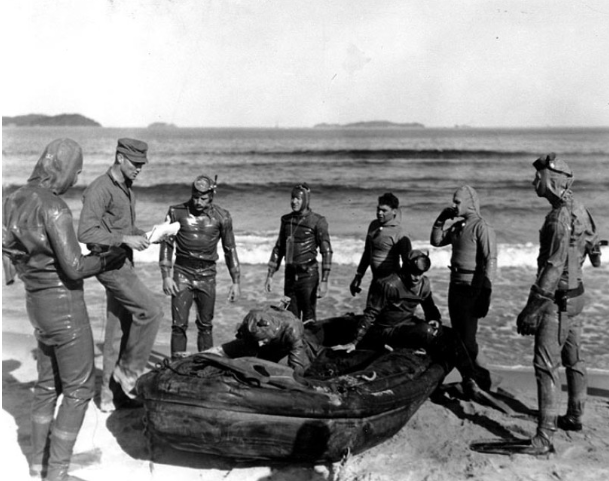
UDTs in Wonsan 1950
“There was a sign on the side of a building that said ‘Volunteer for Hazardous Duty’. We went over and talked to them. I said, ‘If we signed up for duty with you people, how long before we’d be the hell out of here?'”
“The man said, ‘This afternoon or tomorrow morning.’ I said, ‘Where do I sign?’ Harold and I both signed.”
They were sent to Norfolk, Virginia, joining about 200 others who had signed up.
“We had a meeting and they began to explain the types of duties we’d be doing. Very dangerous, very hazardous duties. But work that had to be done.
“One day this young officer who was leading our group said, ‘Has anybody here ever had anything to do with explosives?’
“I’m looking around and I didn’t see anybody [responding], so I faintly put my hand up.”
Back in his CCC days, Heward had been on a dynamite crew, blasting ledges and stumps and trees to make emergency roads for fire trails.
“The officer asked me a lot of questions about my experience. He said to me, ‘You know more about it than I do.’ So they shipped Harold and I right out into another group to start more training.
“We got put into a Naval Combat Demolition Unit. There was Amphibious Scouts and Rangers and there was our group.”
Later in the war, Amphibious Scouts and Rangers and Naval Combat Demolition Units would be combined.
Heward served in the Pacific.
“We met a lot of resistance [from the enemy] because we weren’t that experienced in what we were supposed to be doing. But we tackled it as best we could. We lost a lot of men, but we kept at it.
“When we had too many casualties, they’d send us back to Hawaii and they’d rebuild the group, doing a little more training, blow a little dust off, then send us out again.
“It was really funny. During the war, anytime there was anything involving a heavy lot of explosives, they used to say, ‘Get Hewie. Get Hewie.’ That’s me.
“I didn’t really know anything more than anybody else, but they remembered the day early on how I was the one with dynamite experience. So they associated me with explosives.”
On one occasion, some marines radioed for assistance, and Heward was told to take three men and go see what they needed…
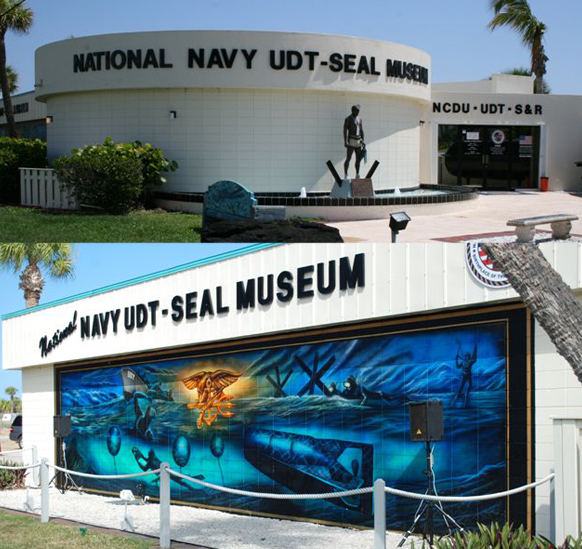
Also check out the UDT-SEAL Museum here.







COMMENTS