

The fighters both roll towards each other, set lift vectors on each other and prepare for the canopy-to-canopy pass. The gray shape inside the diamond blooms instantly, as if it exploded. Not into parts and pieces, but instead into a live airplane, with color, markings, insignia, a clearly visible canopy, and missiles, all easily seen in the split second heartbeat of this pass—then it’s gone.
“ID HOSTILE GRIPEN!” he shouts on the radio. He adjusts his lift vector to the adversary’s plane of motion, and pulls back on the stick. Here come the Gs.
“Fight’s On!”
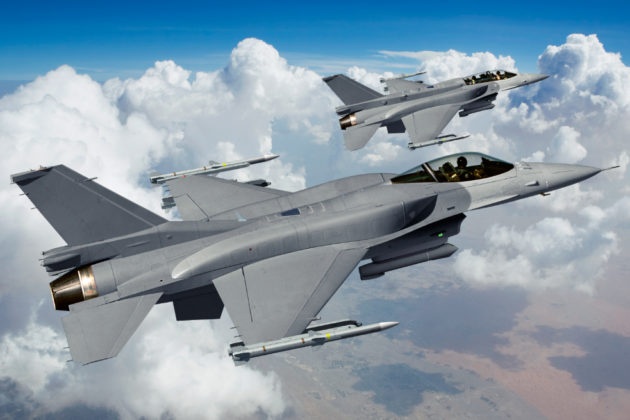
The F-16V versus the J-39E. Both are considered “top of the line” fourth generation fighter aircraft. Both have exceptional radars, cueing systems, engines, and technology. Who would win this fictional dogfight between the new mighty Viper “V” and the superb J-39E Gripen? Let’s dig a little deeper.
First the similarities. And I’m not going to split hairs here. I could care less if one aircraft carries a few more bullets, or can go 200 nm farther, or 5,000 feet higher.
I care about the stuff that the fighter pilot cares about…the “meat” of the aircraft, and what it can really do, on a real day with real weapons and fuel on board. Not some artificial test results published on the internet under certain and exact circumstances.
How do the systems and capabilities of the machine help the pilot?
Both fighters can do Mach 2, fly about 50,000 feet MSL (Mean Sea Level), and both are fantastic multi-role, single-seat fighters. Each has long range and heat-seeking missiles, as well as an array of dumb and smart bombs, and air-to-surface missiles at their disposal. Both have fly-by-wire controls and can in-flight refuel. They each have an AESA (Active Electronically Scanned Array) radar, and fuel loads are similar.
Both have solid HUDs and HMCS (Helmet Mounted Cueing Systems) and can carry external targeting and laser pods. Both also can haul Link-16 datalink, ROVER (for secure video communication with ground parties), and satellite communication capabilities, and both are also touted as being able to super cruise, with limited air-to-air weapons on board. Impressive no doubt.
Now the differences.
The F-16V
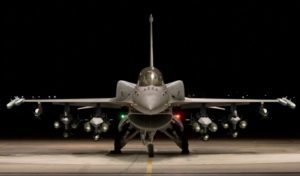
The F-16V is the same ole F-16 your pappy flew, but with a few more modern enhancements that makes this Viper much more deadly. While the “V” retains all the incredible capabilities of the normal F-16, this new variant carries some new goodies that the J-39E doesn’t have.
The V model gets some new displays in the cockpit. There is limited data and photos of these new displays, however it is supposed to have a color MFD (Multi-Function Display) in the center position, in addition to other new advanced displays on the sides. Gucci!
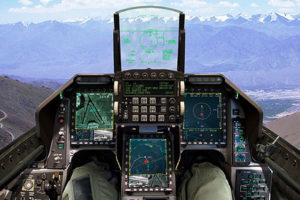
It is surmised that this new cockpit display also contains some amount of sensor fusion. A cockpit that is said to be “sensor fused” allows for multiple incoming data pathways to present themselves on one display. In a sense, overlaying all the battlefield knowledge onto one presentation.
This aids the pilot’s workload and SA and eliminates the need for him or her to use a lot of “brain bytes” to interpret and react to the situation around him as he gets data from different systems on board the jet. It’s like flipping burgers on five grills at the same time, versus having one grill with everything on it.
The last two key distinctions for the new Viper are a little less “meat and potatoes” however, they are extremely important. The F-16V has actually flown, and is being tested right now. This is paramount, and also means that the concept and design has been funded and should be entering low rate production. The F-16V could be on the battlefield soon.
Secondly, the F-16V is building upon an already existing and proven combat design. Sure, the J-39 is an already existing design too, but further investigation reveals that the E model will have a whole new powerplant, avionics, fuel tanks and capacities, and cockpit.
It’s the shell of a J-39, but it’s entirely new. It’s about as similar to the old J-39 as a modern laptop is to a toaster. The new E model will require multiple test programs and flight hours to see IOC, so it’s an entirely different animal. Additionally, the baseline J-39 has seen limited actual combat operations, while F-16s fly thousands of combat hours a month over various global hotspots.
While less tangible, these key differences give the F-16V a huge edge in the global combat arena.
The J-39E
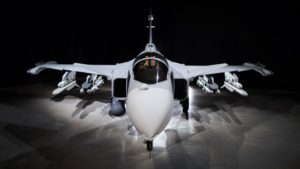
The J-39E is a fairy tale unicorn…but a bad ass fairy tale unicorn at that! It has a reported cockpit suite that embraces sensor fusion, the future of cockpit displays. It has a lower RCS (Radar Cross Section) than a traditional Gripen, and supposedly it will also have an IRSTS (Infra Red Search and Track) system that can detect and track targets passively, using their heat signature alone. Some capability against certain low RCS stealthy targets are being touted with the IRSTS, but that capability is yet to be tested and documented on the new Gripen.
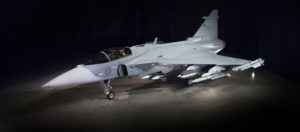
The J-39 also has a smaller engine than the F-16V, but this canard-carrying bird is also lighter. The Viper’s GE powerplant produces almost 30,000 pounds of thrust for the Viper’s max takeoff weight of 48,000 pounds. Compare that to the new engine (same as the F/A-18) on the J-39E with it’s 22,000 pounds of thrust for the much lighter 31,000 pound max takeoff weight Gripen.
That’s a 0.625 ratio for the F-16 and a 0.70 ratio for the Gripen E if you’re bad at the math. At max weight, the J-39E has a better thrust-to-weight ratio, and a fuel burn rate at combat power settings will be slightly lower than the F-16 as well.
Lastly, some sources say that the J-39, with its large forward canards can sustain flight at much higher AoA (Angle of Attack) than the F-16. Over 50 degrees AoA, as compared to the 35 degree limits of the F-16.
Both fighters are limited by fly-by-wire flight control logic and “HAL” as we call it, but the canards and thrust-to-weight ratio of the J-39E should give it a slight advantage in the slow-speed “phone booth” regime.
But recall that the E model Gripen is still in development. That’s a big “what if” for Saab and any country looking to purchase a few new E models. Brazil ordered some J-39Es back in October of 2014, but as of August 2016, none have been delivered. Saab is still in “development.”
Only time will tell whether or not this bad ass unicorn will pass all the tests and enter full rate production.
The Verdict
The F-16V is the clear winner here, because it exists and flies today. It is the most combat proven design in the history of fourth generation multi-role fighter airpower, and it is actual flying and being tested now. I vote for IT as the obvious winner of the F-16V versus J-39E mock-fight.
However, (as a former F-16 operator, this part pains me to say) that if the J-39E becomes a reality, and all the discussed items become real too, IT will be the clear winner. The lower RCS design, the IRSTS, and the higher thrust-to-weight ratio give the J-39E the edge for the top spot on the fourth generation multi-role fighter podium. It will be one highly capable and extremely difficult unicorn to defeat by any capable adversary!
This article was originally published on Fighter Sweep and written by Nate Jaros.
Nate “Buster” Jaros is a retired USAF F-16 fighter pilot, current Lockheed Martin test pilot, LO SME, aviation enthusiast, and author. He has written a book for General Aviation pilots called Engine Out Survival Tactics: Fighter Pilot Tactics for General Aviation Engine Loss Emergencies. You can find it at most major retailers or at http://engineout.weebly.com
Featured Image: F-16V – The Most Technologically Advanced 4th Generation Fighter in the World (courtesy Lockheed Martin)








COMMENTS