Aviation

Super-Secret Warriors: The Guns of 1st Capabilities Integration Group and Aviation Technology Office

The 1st CIG’s greatest expertise lies in precisely locating American hostages held by foreign terrorist groups and pinpointing high-value terrorist leaders, a capability they demonstrated when helping track down Iraqi dictator Saddam Hussein in December 2003, al-Qa’ida leader Osama bin Laden in Pakistan in May 2011, and ISIS terrorist leader Abu Bakr al-Baghdadi in Syria in October 2019.

“We sleep soundly in our beds, because rough men stand ready in the night to visit violence on those who would harm us.” — Prime Minister Winston Churchill, 1942. (Also attributed to George Orwell.)

Advertisement

“Talk about close target recce…That’s pretty frickin’ ballsy…Two people with a lockpick kit and a camera. If they would have been caught, they were done.”  — Delta Force operator (on 1st CIG breaking into an al-Qa’ida safehouse.)

The U.S. Army’s ultra-secret, ultra-elite, 1st Capabilities Integration Group (Airborne), or 1st CIG, was officially created in 1981 as the Intelligence Support Activity (ISA), a Top-Secret, special operations unit that provides direct, actionable, intelligence analysis, pathfinding, and operational support to the nation’s top counterterrorist (CT) units, as a result of CIA intelligence failures in the past.

But the 1st CIG is also tasked with direct action and hostage rescue, when required. Michael Smith’s superb, ground-breaking, 2007 book, “Killer Elite,” vividly describes the 1st CIG (still commonly known as ISA) in great detail, as does British author Samuel Longstreth’s more recent, October 20, 2022, article, “ISA: Soldier Spies of the Intelligence Support Activity.”

Advertisement

Directly supporting Delta Force and SEAL Team Six, the 1st CIG is also known as “the Activity,” or Task Force Orange, headquartered at Fort Belvoir, Virginia, but with secret detachments in Alexandria, Virginia, Bethesda, Maryland, Rome, New York, and four other U.S. cities, plus three more locations around the globe, according to author Marc Armbinder of The Atlantic and National Journal.

They have been known by a wide variety of unit names, cover names, and program names, including the Field Operations Group (FOG, 1980), Intelligence Support Activity (ISA, 1981), Tactical Concept Activity (first official, cover name, 1981), Royal Cape (mid-1980s), Centra Spike (1989), Tactical Coordination Detachment (1989), Capacity Gear (1989), Torn Victor (1996), Quiet Enable, Opaque Leaf, Cemetery Wind, Gray Fox (2001-2002), Titrant Ranger (2002), Mission Support Activity (MSA, 2003), Tactical Support Team (TST, 2004), Intrepid Spear (2009), and Studies and Analysis Activity (SAA, 2010), but its various names have certainly changed since then, to include the 1st Capabilities Integration Group (Airborne), or 1st CIG.

Advertisement
CIG patches
1st CIG unit shoulder patch, beret flash, and challenge coin. Photo credits: eBay, and fity.club.

The unit is primarily staffed by approximately 300 highly-capable, self-reliant, former Delta Force operators and veteran, Special Forces soldiers, all qualified paratroopers, skilled in foreign languages (often multilingual), with a selection course reportedly tougher than Delta’s. Although technically an Army organization, 1st CIG also recruits from other services and even has some female case officers, specializing in human intelligence (HUMINT) and signals intelligence (SIGINT) collection.

1st CIG SIGINT
1st CIG SIGINT-collection vehicle in Afghanistan. Photo credit: Uriah Popp.

Stavros Atlamazoglou wrote for The National Interest on November 14, 2024, “ISA: Inside the Army’s Most-Secretive Unit Ever…A combination of a special operations and an intelligence-gathering outfit, Intelligence Support Activity operates in the shadows…paving the way for other secretive, special mission units, such as the Army Delta Force and Navy’s SEAL Team Six. ISA is one of JSOC’s Tier 1 units…ISA operators primarily come from the Green Berets. Their training focuses on HUMINT and SIGINT collection, infiltration techniques, and other skills.”

Most members are fully-qualified operators (or “shooters”), usually with an extensive intelligence background and key linguistic skills in Arabic, Kurdish, Farsi, Russian, or other in-demand languages, but the unit has its own separate shooter detachment for dealing with CT situations. They are then specially trained in infiltration techniques, offensive and defensive driving skills, deep surveillance, intelligence tradecraft (trained by the CIA), disguises, state-of-the-art communications, survival skills, freefall parachuting, advanced weapons skills, and hand-to-hand combat.

Advertisement
ISI Operator Team
ISA operator team in desert uniforms, with MH-6MLittle Bird special operations transport helicopter. Photo credit: gendischarge.com/

According to journalist Samuel Longstreth, “These operatives can remotely turn on a (terrorist) cell phone that’s been turned off, which allows them to hear everything going on near it. Or, these operatives can clone a cell phone, allowing them to send and receive communications to and from the phone from remote locations.”

The 1st CIG’s greatest expertise is in precisely locating American hostages held by foreign terrorist groups and pinpointing and targeting high-value, terrorist leaders. They fought in Afghanistan alongside Delta and SEAL Team Six, helped locate and capture Iraqi dictator Saddam Hussein in December 2003 (Operation Red Dawn), were instrumental in tracking down and killing al-Qa’ida, terrorist leader Osama bin Laden in Pakistan in May 2011 (Operation Neptune Spear), and undoubtedly played a crucial role in hunting down ISIS terrorist leader Abu Bakr al-Baghdadi in Syria in October 2019 (Operation Kayla Mueller), who blew himself up with an explosive, suicide vest.

1st CIG operators utilize the same weapons-acquisition process, through the Army Contracting Command (ACC), as Delta Force, and very much the same type of MultiCam uniforms (or civilian clothes), HK416 carbines, Glock-19/26/30S pistols, and ammunition, so they are virtually indistinguishable from one another in the field.

CIG Operators
1st CIG operators at an unknown location. Photo credit: Uriah Popp.

1st CIG soldiers typically wear Crye Precision MultiCam field uniforms and related gear in the field, and uniform variations are authorized. In garrison, they may wear the maroon paratrooper’s beret, since the entire unit is airborne-qualified. The Gentex Ops-Core FAST MT Special Operations Forces ballistic helmet is worn on combat operations. Civilian clothing is also often worn on covert operations outside of current war zones.

Their footwear in the field includes Merrell Moab (photographed on Delta operators in April 2012, and on Air Force combat controllers in Afghanistan), Moab-2 (since 2017), or Moab-3 (since 2022) hiking boots (worn daily by this author for thousands of miles), or similar, lightweight, water-resistant boots from other manufacturers.

Since 2004, both Delta Force and the 1st CIG have been using the Heckler and Koch (German-made) HK416 carbine, with its gas-piston operating system, venting sooty gasses into the handguard area above the barrel, for much-cleaner and more-reliable operations. It is often used with an EOTech EXP S3 (or similar) holographic, red-dot, sighting system, a $700 addition, for rapid target acquisition.

Delta
Delta Force operator firing an HK416 carbine, April 2012. (Note the Merrell Moab hiking boots.) Photo credit: USASOC.

This top-quality weapon was offered in several different barrel lengths, but the most-popular variant is the short, assault carbine (#D10RS) with a 10.4-inch barrel, usually mounting a suppressor to minimize muzzle flash and blast. Since 2009, it has been produced as the newer, HK416A5 model, with an 11-inch barrel for greater muzzle velocity and slightly reduced flash. The Black Hills 77-grain OTM (Open-Tip Match) ammunition with Sierra MatchKing bullets seems to be the most-preferred load.

The principal sidearm, since about 2014, is the Glock-19 (military designation Mk. 27) in 9mm, often with an extended, threaded barrel and Glock-17 magazine. The subcompact Glock-26 (Mk. 26) in 9mm is used for concealment purposes, and the Glock-30S (introduced in 2013) is for those diehard operators who prefer the mighty .45 ACP, in a modern Glock design. But the 9mm pistol is simply easier for many people to operate, and holds more ammunition.

A federal contract solicitation (#W15QKN15R0196, totally unclassified, but exceptionally revealing) posted by the U.S. Army Contracting Command (ACC) on August 24, 2015, specifically stated that ACC, “has the need to procure a wide variety of Glock weapon systems…to support the United States Special Operations Command (USSOCOM)…and other Government Agency (presumably CIA) mission objectives. The weapon systems include Glock 17, 18 (selective-fire, machine pistol), 19…22, 26, and 30S.”

The well-known, compact Glock-19 is now the top choice of U.S. Army Special Forces, Delta Force, 1st CIG, Army Rangers, CIA/SOG paramilitary operatives, Air Force Special Operations Command, Marine Corps Special Operations Command, Navy SEALs, and the U.S. Secret Service.

The little-known Glock-30 (introduced in 1997), by comparison, is offered as an optional handgun by Delta Force, 1st CIG, the Israeli Mossad intelligence service, the CIA/SOG, and as the primary sidearm of the Kenyan Special Forces, who must defend themselves not only against renegade, al-Shabaab (“the Youth”) terrorists from neighboring Somalia, but from the ever-present threat of numerous wild animals, including lions, leopards, cheetahs, wild dogs, hyenas, jackals, warthogs, and crocodiles.

Glock 30s
Glock-30S pistol in .45 ACP. Photo credit: Gun Digest.

On March 30, 2019, Kyle Mizokami wrote for The National Interest: “Glock’s Insanely-Powerful, Pocket Cannon: Meet the Glock-30 .45 ACP. Glock’s most-powerful, and compact, handgun…has few equals…one of the smallest pistols chambered in .45 ACP round…Powerful, reliable, and concealable, the G30 might just be Glock’s ultimate, subcompact handgun.”

The Glock-30S (slimmer slide, since 2013) version, favored by Delta Force and 1st CIG, incorporates a slightly smaller frame, with a narrower slide (1.00 inch wide instead of 1.12 inches wide) from the Glock-36, single-stack model in .45 ACP. All Glock-30s normally hold 10 rounds in the magazine, but a flat-based, nine-round magazine is available for greater concealability. The 13-round factory magazine from the larger Glock-21 model also fits quite easily, for extra firepower.

In December 2017, the U.S. Special Operations Command (including Delta and 1st CIG) officially adopted the new Speer Gold Dot G2 (Speer LE 54226) 147-grain JHP round as the standard ammunition for their Glock-19 pistols, although the Army has recently fielded the brand-new, Winchester M1153 147-grain, 9mm Special Purpose JHP. Speer also manufactures a Gold Dot G2 230-grain +P round in .45 ACP, which is the likely choice for the 1st CIG’s optional Glock-30s.

1st CIG snipers have used a large variety of weapons over the decades, including scoped M14 rifles. More-modern, sniper rifles have included the M110 SASS in 7.62mm NATO, the M110A1 CSASS (HK417A2 Sniper), also in 7.62mm, M2010 ESR in .300 Winchester Magnum, Mk. 22 ASR (Barrett MRAD, $17k) in .338 Norma Magnum, and the Barrett M107A1 (M82A3) in .50-caliber, used primarily as an anti-matériel weapon for stopping hostile vehicles and aircraft.

Most recently, since 2018, the 1st CIG has adopted modest quantities of the new, suppressed, SIG MCX (Mission-Configurable Weapon System) Virtus (“Truth”) Low-Visibility Assault Weapon (LVAW), also affectionately known as the “Black Mamba,” with a 6.75-inch barrel in either 5.56mm or .300 BLK, and gas-piston operating system, the SIG MCX SBR (short-barrel rifle) with nine-inch barrel (in .300 BLK), and the ultra-compact, SIG MCX Rattler personal-defense weapon (PDW), in both 5.56mm and .300 BLK chamberings, with a 5.5-inch barrel and overall length of just 16 inches.

The Rattler “is the shortest rifle that’s on the market today…shorter than any M4 ever produced,” according to SIG officials. Any of these three weapons may utilize the quick-detachable, SIG SRD556 or shorter, “SRD556K” suppressors, and they have definitely been photographed in the hands of covert operators in Afghanistan and Syria. It replaces previous personal-defense weapons, such as the H&K MP5k submachine gun.

SIG MCX
SIG Sauer MCX Rattler in .300 BLK, suppressed. Photo credit: The Truth About Guns.

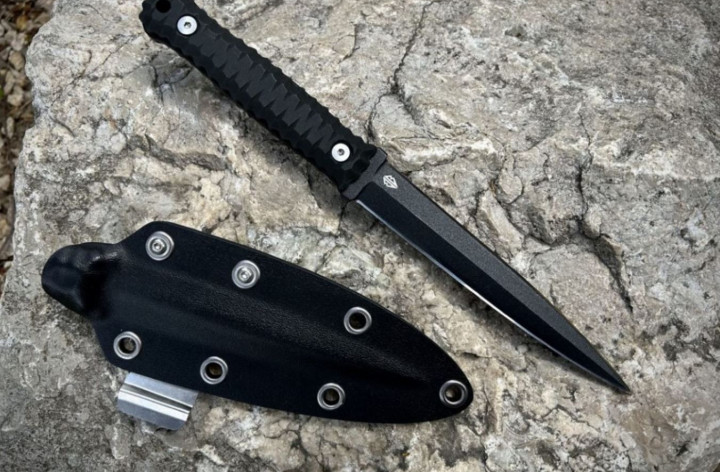
1st CIG members carry a wide variety of knives, usually privately purchased and owned, into action. The most-common are Leatherman multi-tools and Swiss Army Knives, used strictly as tools, and not for fighting. Some Special Forces veterans may carry the Chris Reeve Knives (of Boise, Idaho) Yarborough-SF (Special Forces) combat/survival knife, which is a special status symbol. Otherwise, Daniel Winkler knives, of Boone, North Carolina, are quite popular and expensive. These may include the WK (Winkler Knives) Operator, WK Utility Knife, WK Recon, or WK Tactical Dagger.

Next, complementing the ultra-secretive nature of 1st CIG, the U.S. Army has its own, very secret, special operations helicopter unit, the Aviation Technology Office (ATO) at Fort Eustis, Virginia. It was formerly known as the 1st Rotary Wing Test Activity, then as Aviation Technical Services (one of many cover names), later as the Flight Concepts Division (FCD), and then as ATO in 2017, a covert, special operations aviation asset supporting the nation’s very finest counterterrorist units. Its military code name was initially “Seaspray,” but this has changed every few years since then, to include names such as “Quasar Talent,” Echo Squadron (of Delta Force), and “Latent Arrow.”

ATO is manned primarily by former aircrew members from the elite 160th Special Operations Aviation Regiment (Airborne), and specializes in Top-Secret, plausibly-deniable missions, often deep behind enemy lines. It operates at least two dozen aircraft, including the CH/MH-47F/G Chinook, MH-60M Black Hawk, and Bell 407GX, all recently seen in satellite imagery of their base. Other aircraft in the past have included small numbers of MD-500Ds, MD-530Fs, MH-6J/M Little Bird transports, AH-6J/M Little Bird gunships, Russian-made Mi-171E Hip-H helicopters, and Beechcraft King Air 350s.

A wartime photo taken between 2010 and 2012 shows an unarmed, olive-drab, UH-60A Black Hawk in Afghanistan, bearing only the weathered, white tail number “337” (this would be #79-2337) and no other markings at all, with an armed, FCD pilot in MultiCam uniform in the foreground, and his face blacked-out to protect his identity.

FCD Pilot
FCD pilot at war, with a UH-60A Black Hawk helicopter. Photo credit: Reddit.com.

More recent acquisitions apparently include the C-27J Spartan fixed-wing transport and the S-92A Helibus helicopter, seen in dark-gray colors flying over northern Syria. ATO also apparently operated the famous prototype MH-60X “Stealth Hawk” helicopters used in the Osama bin Laden raid (Operation Neptune Spear) on May 2, 2011, in Abbottabad, Pakistan, and again subsequently on the unsuccessful Foley Hostage-Rescue Raid in Syria on July 3, 2014.

ATO personnel wear the standard Army Aircrew Combat Uniform in the Operational Combat Pattern (A2CU-OCP), similar to MultiCam, since 2015, with suede combat boots or jump boots in Coyote Brown. As paratroopers, they also wear the Army’s maroon, Airborne beret when in garrison. They’re usually armed with Colt M4A1 carbines (suppressed) and SIG M17/M18 or Glock-19 pistols, although it’s entirely possible that they may also use HK416 or SIG MCX Black Mamba or Rattler carbines, like the elite, Army Delta Force and Navy SEAL units that they support. The Aircrew Survival Egress Knife (ASEK) completes their pilot gear.

ATO operator
Alleged photo of FCD/ATO operator with suppressed, Colt M4A1 carbine. Photo credit: armyfighter.blogspot.com.

ATO currently operates five Bell 407GX helicopters originally intended for the Iraqi Army Aviation Command, but they were all retained in the United States for “trials and development work.” The actual, serial numbers are 12-01141, 12-01142, 12-01143, 12-01144, and 12-01145, all being 2012-model aircraft.

On January 13, 2021, three of these mysterious, unarmed, semi-gloss, dark-gray helicopters using the military callsign of “Mike-01” were photographed over downtown Los Angeles, California, bearing non-standard serial numbers, military-style antennas, and military wire-cutting devices, but no FLIR sensors.

Bell
Mysterious Bell 407GX #12-1141, assigned to ATO. Photo credit: Scott Lowe, January 13, 2021.

While observed as unarmed on this one occasion, it would be a simple matter to purchase and install conversion kits to transform these helicopters into aerial gunships, like the five brand-new IA-407GX attack aircraft of the Iraqi Army Aviation service, or the 29 NSA 407MRH helicopter gunships of the United Arab Emirates (UAE) Air Force, all combat-proven.

NSA Chopper
NSA 407MRH Lightning gunship. Photo credit: NorthStar Aviation (NSA)

The NSA 407MRH’s standard armament consists of two GAU-19/B .50-caliber Gatling guns, with 500 rounds of ammunition per gun, and two M260 seven-shot pods full of either 70mm Hydra-70 unguided rockets or AGR-20B APKWS-II laser-guided missiles.

DillonAero currently offers weapons-upgrade packages for the Bell 407, with up to six weapon stations instead of the standard four, adding two wingtip AGM-176B Griffin-B laser-guided missiles, 600-round ammunition magazines (instead of the standard, 500-rounders) for .50-caliber weapons, and the brand-new, 503D Gatling gun, designed to replace the .50-caliber, three-barrel, GAU-19/B weapon. The 503D is 21 percent lighter and 6.5 percent faster-firing than the already lightweight GAU-19/B, which has been in service since 2012.

In conclusion, combating global terrorism is a truly daunting task, because the terrorists always hold the advantage in knowing precisely when, where, and how they will strike, but dedicated, highly-professional, 1st CIG operators and ATO aircrews stand ready to respond to any incident worldwide within just a few hours. The 1st CIG and ATO are not only two of the world’s premier and most-secretive CT units, but they’re constantly testing and evaluating new weapons, tactics, and procedures as international terrorism continues to evolve in an uncertain world.

Author
Author at Fort Bragg, NC, 1987, in a special ops assignment. Photo credit: Melody Gray.


Advertisement

What readers are saying

Generating a quick summary of the conversation...

This summary is AI-generated. AI can make mistakes and this summary is not a replacement for reading the comments.