The A-1 Skyraider, from WWII relic to Vietnam hero, proved its worth with robust design and versatile combat roles.
Read the full article for more on:
Important insights and detailed analysis
Expert commentary on current events
Breaking developments and updates
Updating summary...
The A-1 Skyraider: The Propeller-Driven Warrior That Defied the Jet Age
SOFREP News Team
Speed
1x
Listen
COMMENTS
The A-1 Skyraider, from WWII relic to Vietnam hero, proved its worth with robust design and versatile combat roles.
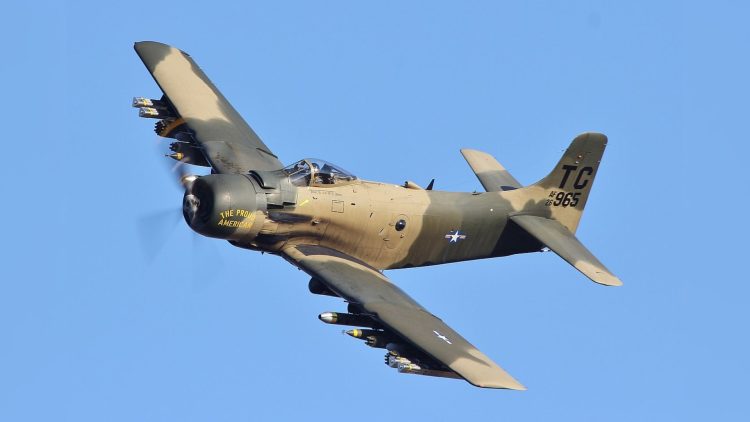
A Douglas A-1 Skyraider in flight. (Heritage Flight Museum/Wikimedia Commons)
The A-1 Skyraider, nicknamed “Spad” or “Able Dog,” looks out of place among the sleek jets of the 20th century. Yet this propeller-driven aircraft earned a reputation as one of the most versatile and durable warplanes in US military history. From Korea to Vietnam, it became the ultimate close-air-support platform, proving that raw power and adaptability could outmatch speed alone.
Advertisement
Born for a Role That Vanished
The Skyraider’s story began at the tail end of World War II. Designed by legendary Douglas Aircraft engineer Ed Heinemann, the XBT2D-1 prototype was conceived as a carrier-based dive bomber capable of torpedo strikes and precision bombing.
By the time the aircraft was ready for evaluation in 1945, Japan had surrendered, leaving the Navy without a need for the plane’s original mission. Test pilots, however, were stunned. Its robust Wright R-3350 engine, massive 14,491-pound payload, and rugged construction hinted at an entirely different future: the perfect platform for close-air-support.
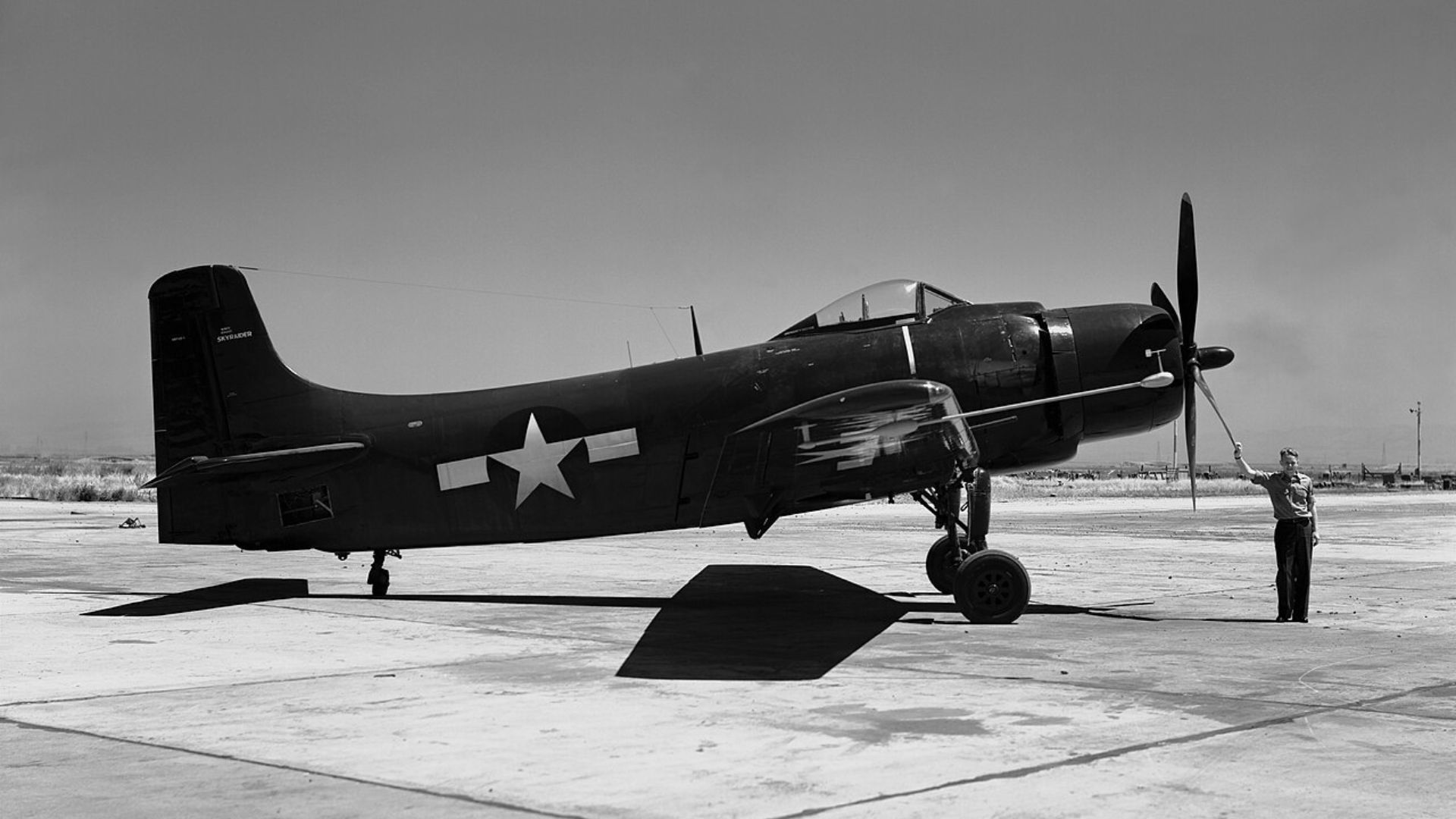
A Douglas XBT2D-1 Skyraider prototype, 1946. (Image Credit: Wikimedia Commons)
In December 1946, now christened the AD-1 Skyraider, it entered service with VA-19A. Sailors and aviators immediately recognized its hidden potential. “No aviator [who] flew one then would ever forget the experience,” the National Naval Aviation Museum notes.
Advertisement
Earning Respect in Combat
The Korean War was the Skyraider’s baptism by fire. Flying low and slow, it drew heavy ground fire but delivered precision strikes that earned the trust of troops on the ground. Its long loiter time allowed pilots to support infantry for extended operations—a capability jets could not match.
By 1957, over 3,180 Skyraiders had been produced across eight main models and 37 variants. Beyond the Navy, Marine Corps squadrons and later the US Air Force embraced the aircraft. The Marines, in particular, valued its ability to carry large ordnance loads from short runways, cementing the Skyraider as a backbone of close air support missions.
Advertisement
Even as jets like the A-4 Skyhawk replaced propeller planes in frontline Marine squadrons, the Navy and Air Force continued to rely on the Skyraider. In 1962, the Department of Defense standardized aircraft designations: the AD-5, AD-6, and AD-7 became the A-1E, A-1H, and A-1J.
The Workhorse of Vietnam
When jets dominated headlines, the A-1 quietly excelled in Vietnam. Its first Air Force deployment came in May 1964 with the 1st Air Commando Squadron at Bien Hoa Air Base. Call-sign “Hobo,” these aircraft excelled in counterinsurgency, close air support, and search-and-rescue operations.
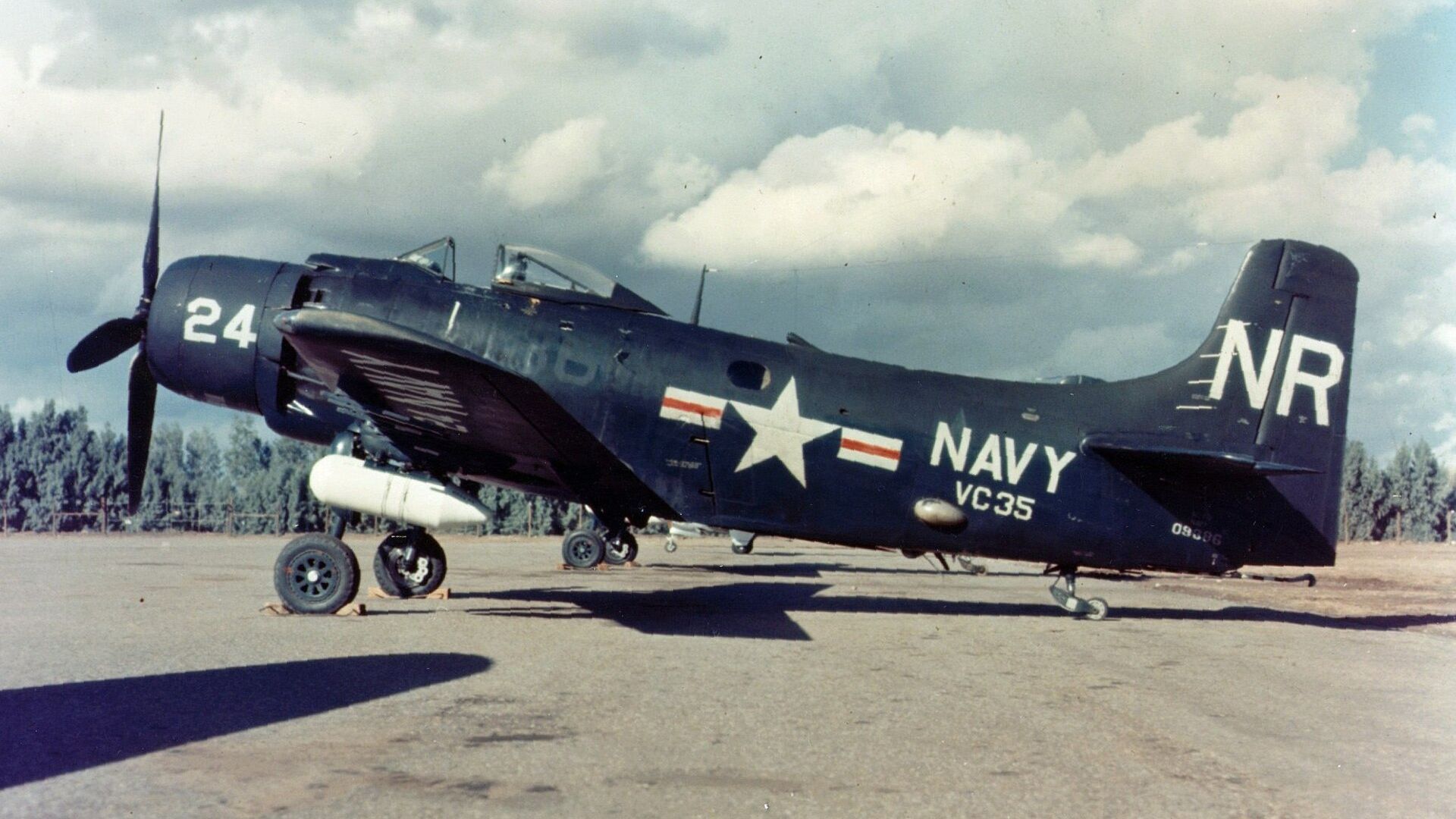
A US Navy Douglas AD-1Q Skyraider used for electronic countermeasures, circa 1950. (Image Credit: Wikimedia Commons)
The Skyraider’s endurance, low-speed maneuverability, and ruggedness made it ideal for spotting downed pilots and defending besieged outposts. Perhaps no mission better illustrates its heroism than Major Bernard F. Fisher’s 1966 rescue at A Shau Special Forces Camp. Risking his life under heavy fire, Fisher landed his Skyraider on a battered runway, rescued his wingman, and earned the Medal of Honor—a testament to both pilot skill and the aircraft’s reliability.
Advertisement
By 1973, all US Skyraiders were transferred to the South Vietnamese Air Force. Their combat career ended with the fall of Saigon in 1975, when most were destroyed.
Legacy of Strength and Adaptability
In a jet-dominated era, the Skyraider proved that durability, payload, and versatility could outweigh raw speed. It was more than an aircraft; it was a guardian for ground troops, a flying tank in the sky, and a symbol of the ingenuity and determination of American airpower.
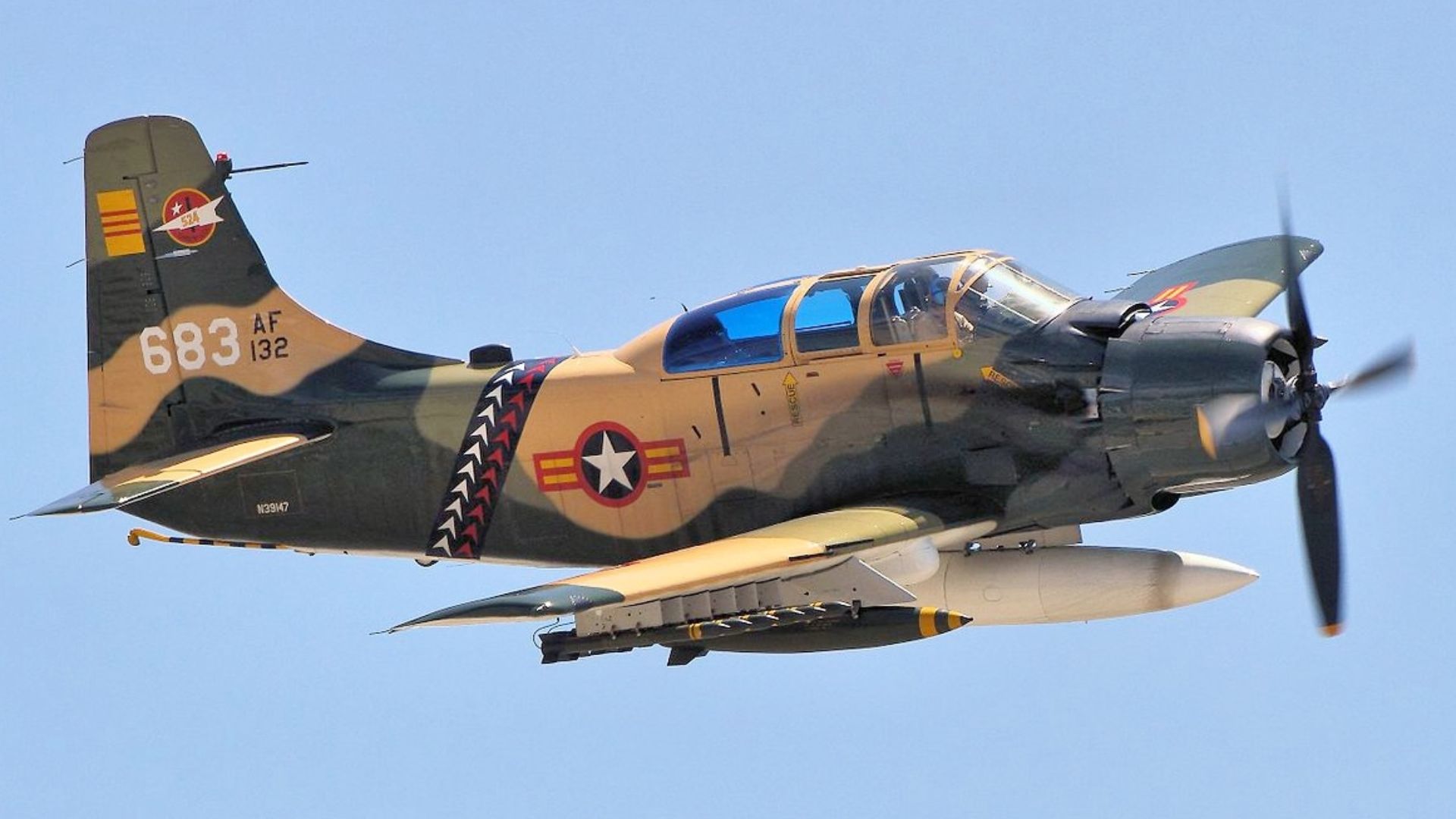
RVNAF A-1E Skyraider during an airshow. (Image Credit: Wikimedia Commons)
The A-1 Skyraider’s enduring legacy is a reminder that sometimes the most unassuming tools leave the deepest mark on history. Its propeller may have seemed outdated, but in the chaos of battle, it became indispensable. From Korea to Vietnam, the “Able Dog” earned its place as one of the most respected aircraft of the 20th century.
Advertisement
What readers are saying
Generating a quick summary of the conversation...
This summary is AI-generated. AI can make mistakes and this summary is not a replacement for reading the comments.










COMMENTS