The bomb didn’t just flatten a city—it ripped a hole in the world so deep that eight decades later, we’re still peering into the abyss and pretending it’s not staring back.
Read the full article for more on:
Important insights and detailed analysis
Expert commentary on current events
Breaking developments and updates
Updating summary...
It’s Been 80 Years to the Day Since We Dropped the First Atomic Bomb on Hiroshima
Guy D. McCardle
Speed
1x
Listen
COMMENTS
The bomb didn’t just flatten a city—it ripped a hole in the world so deep that eight decades later, we’re still peering into the abyss and pretending it’s not staring back.
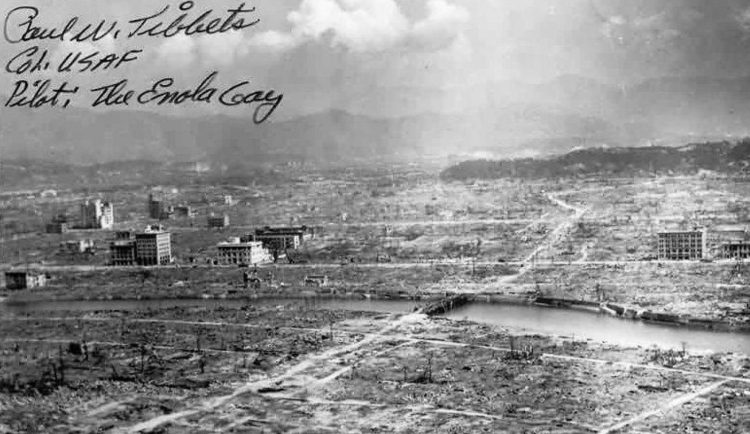
Col. Paul Tibbets, pilot of the Enola Gay, took this photo of the bomb damage. Image Credit: Columbia K=1 Project
August 6, 1945 — The Bomb Falls
At 8:15 a.m., a B‑29 named Enola Gay drifts over Hiroshima and releases Little Boy, a uranium-fueled bomb built by the Manhattan Project. Forty‑three seconds later, at about 580 m above ground, it detonates. Within that heartbeat, up to 78,000 people were killed instantly, and over 140,000 died by year‑end from burns, blast trauma, and radiation. Sixty-two thousand buildings are incinerated across five square miles. The firestorm consumed everything within 2 km, heat rays between 3,000–4,000 °C vaporized people instantly, their flesh turning to ash. The blast winds exceed 440 m/s near ground zero. Those on the fringes would fall ill from residual fallout or never recover from radioactive “black rain.”
Advertisement
It was a hell on Earth, never before the likes of which was seen by humankind.
Survivors recall skin hanging off bodies, bones visible through charred ribbons of flesh. Children were vaporized or their organs expelled. Hospitals collapsed under waves of the wounded, screaming—those few still animated try to shove intestines back into open bellies. Entire families vanished as if they never existed.
Advertisement
The Manhattan Project & The Road to the Bomb
Our story starts in 1938, when nuclear fission was discovered by Hahn, Meitner, and Strassmann in Germany. The U.S. would later launch the Manhattan Project with labs from Los Alamos to Oak Ridge. Billions were spent, and the collective intelligence of the most brilliant physicists of the day was poured into a single devastating goal. The first nuclear test, Trinity, was detonated in New Mexico on July 16, 1945. Only weeks later, leaders would decide a mere demonstration would not be enough to convince the enemy to surrender—they opted to destroy a city, thus hopefully forcing Japan to surrender.
Little Boy (a uranium gun‑type device) was deployed over Hiroshima; three days later, Fat Man (a plutonium device) obliterated Nagasaki. The death toll in that city grew to 60,000–80,000 victims by the end of 1945.
Advertisement
With both bombs dropped and the entry of the Soviet Union into the war in the Pacific, Emperor Hirohito announcedsurrender on August 15. Formal documents were signed on September 2, 1945, aboard the USS Missouri, ending WWII.
Post‑Blast Suffering & Hibakusha Lives
Blast Survivors, known as Hibakusha, were to endure lifelong illnesses: leukemias, cancers, chronic respiratory illnesses, and social ostracism. Japan recognizes about 650,000 Hibakusha, though fewer than 100,000 remained alive as of 2024, and their average age was 85. Of all the people exposed to the bomb’s effects, whether from blast, radiation, or fallout, only about 1% of these recognized survivors have been certified by the Japanese government as suffering from a bomb related illness.
Eventually, many citizens broke decades of silence to demand recognition, medical care, and a push for nuclear abolition. They bear witness still: with tales of death and destruction, and alligator-like scars, their collective experience burned into the soul of a generation.
Advertisement
On August 6, 2025, Hiroshima’s Peace Park is hosting a large international ceremony. It is to include 55,000 people across 120 nations, featuring dove releases and the Peace Bell tolling at 8:15 a.m. Mayor Kazumi Matsui urges global powers not to abandon nuclear deterrence. He warns that conflicts in Ukraine and the Middle East illustrate how the world is forgetting the lessons of Hiroshima.
Still, frustration hangs heavy: survivors and organizations like Nobel‑winning Nihon Hidankyo criticize Japan for remaining under the U.S. nuclear umbrella and refusing to sign the Treaty on the Prohibition of Nuclear Weapons.
The day Little Boy fell on Hiroshima was transformative—it was the moment war stepped into the nuclear age. In an instant, the rules changed. From then on, as other nations developed their own nuclear weapons, any major conflict carried the possibility of mutual assured destruction.
In the months that followed, the United States and the Soviet Union scrambled to outdo each other—building hydrogen bombs hundreds, even thousands, of times more destructive than the one that leveled Hiroshima. Fast forward to today: roughly 12,000 nuclear weapons sit in the arsenals of nine nations, with modern thermonuclear warheads packing many times the punch of that first bomb.
We’ve had treaties, disarmament talks, and public pressure campaigns—the NPT, arms control regimes, civil society protests—but the doctrine of deterrence still keeps the specter of atomic annihilation very much alive. Hiroshima itself is now part memorial, part warning: the skeletal Genbaku Dome locked in time, museums holding victims’ stopped watches, scorched clothing, strands of hair, and letters that still cry out for peace.
The World Today — Shadowed by Nuclear Threat
What followed was a new kind of world order—one defined by Cold War standoffs, proxy wars, nuclear brinksmanship, and an arms race kept in check only by fragile treaties. From the rubble of Hiroshima came a future where the same scientific brilliance that split the atom was harnessed to build weapons capable of ending civilization. The moral fight hasn’t stopped. Some argue a demonstration blast could have ended the war without killing tens of thousands. Others insist Japan would have surrendered after Hiroshima alone. Historians keep debating, but no amount of argument changes the fact that two cities were erased in a matter of seconds.
Remember or Repeat
Hiroshima’s lesson is simple but unforgiving—nuclear war means unimaginable human suffering and the erasure of entire cities in seconds. Remembering it forces us to face how fragile life is, how war crushes civilians first, and why a world without nuclear weapons is worth fighting for. The stories of the survivors aren’t just history—they’re a warning that scientific progress without moral restraint can lead us straight to our own destruction.
Ceremonies, memorials, and education keep that reality alive, passing it to younger generations before the last witnesses are gone.
In the end, remembering Hiroshima isn’t just about the past. It’s a call to choose peace, to shoulder the responsibility of preventing the next catastrophe, and to make sure humanity never walks this path again.
Advertisement
What readers are saying
Generating a quick summary of the conversation...
This summary is AI-generated. AI can make mistakes and this summary is not a replacement for reading the comments.










COMMENTS