From farm fields to battlefields, Van T. Barfoot’s courage at Carano Creek carried his men through one of WWII’s toughest fights.
Read the full article for more on:
Important insights and detailed analysis
Expert commentary on current events
Breaking developments and updates
Updating summary...
Medal of Honor Monday: Van T. Barfoot’s One-Man Assault at Carano Creek
Guy D. McCardle
Speed
1x
Listen
COMMENTS
From farm fields to battlefields, Van T. Barfoot’s courage at Carano Creek carried his men through one of WWII’s toughest fights.
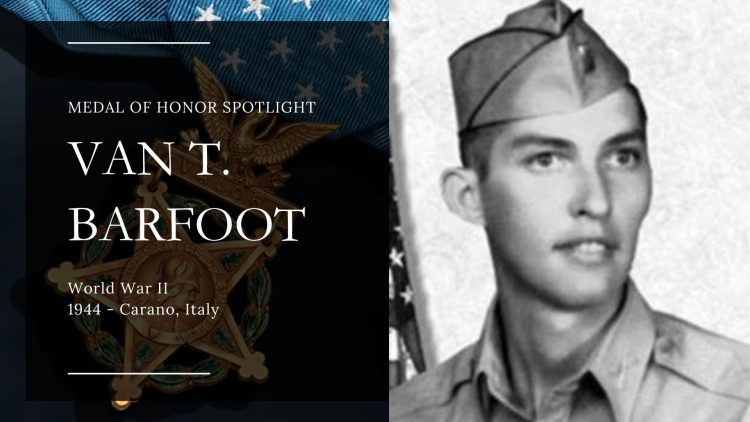
Van T. Barfoot newly promoted US Army Lieutenant circa 1944. (Wikimedia Commons)
On a spring morning in 1944, along the battered fields near Carano Creek in Italy, Technical Sergeant Van T. Barfoot rose from cover and moved alone toward the German defenses that had pinned down his platoon.
Advertisement
The ground ahead was mined and swept with machine gun fire, but Barfoot pressed forward. Grenade in hand, he silenced one enemy nest, then pushed into the trenches, capturing prisoners and cutting down positions that had stalled the advance. Before the day was done, he rescued wounded comrades under fire and stopped a German tank with a single bazooka shot.
His actions carried his unit through the stalemate and opened a path in one of the toughest fights of the Italian campaign.
Van T. Barfoot: A Farm Boy’s Journey Toward a Distant War
Van Thomas Barfoot was born on June 15, 1919, in Edinburg, Mississippi. He was one of eight children, with two brothers and five sisters.
Advertisement
The Barfoot family worked together on their cotton farm, where every child had responsibilities that built discipline and resilience. Through his mother’s side, Barfoot carried Choctaw heritage, a connection he quietly took pride in throughout his life, although he was not an enrolled member of the Choctaw Nation.
Barfoot attended school through the equivalent of eighth grade before devoting himself full-time to helping his family on the farm.
Advertisement
Entering the Army
In 1940, Barfoot enlisted in the United States Army. His first assignment placed him with the 1st Infantry Division, also known as the “Big Red One,” where he served in Puerto Rico and Louisiana. He was in training in Virginia when news of Pearl Harbor broke in December 1941, signaling that America would be fully drawn into World War II.
By mid-1943, he deployed overseas with the 157th Infantry Regiment of the 45th Infantry Division. He took part in some of the earliest Allied assaults on Fortress Europe, including the amphibious landings in Sicily and at Salerno.
In January 1944, his division hit the beach at Anzio, where months of brutal stalemate followed.
Advertisement
Heroism at Carano Creek
The defining moment of Barfoot’s military career came on May 23, 1944, near Carano, Italy, during the Allied breakout from Anzio.
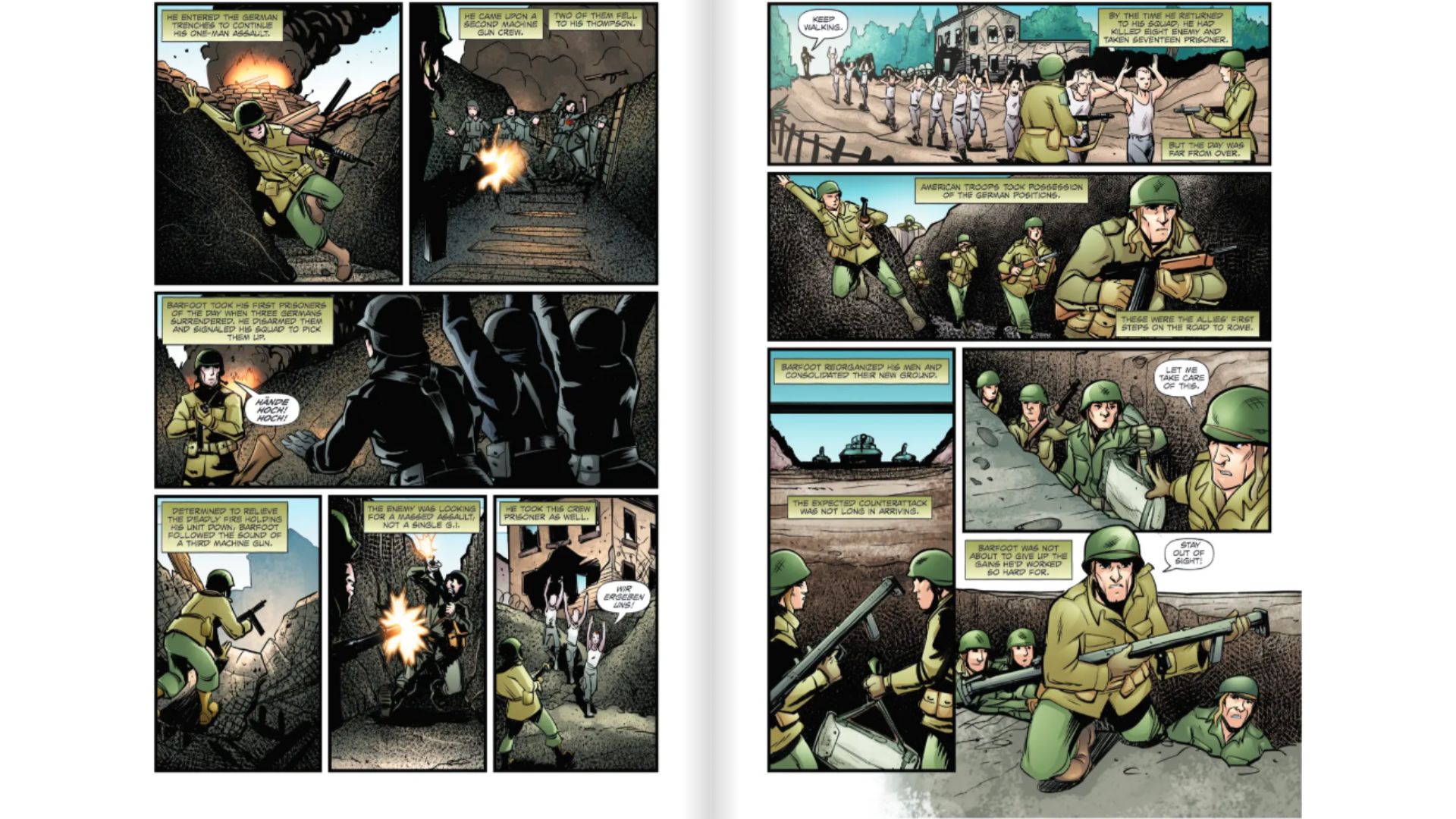
Serving as a technical sergeant, he volunteered to move alone against entrenched German defenses that were pinning down his unit. Crossing mined ground under fire, he destroyed a machine gun nest with a grenade, then fought his way through trenches in a one-man assault.
He knocked out additional machine gun positions, killed several enemy soldiers, and captured prisoners. Barfoot then returned across dangerous ground to help two wounded Americans to safety.
Page excerpt from AUSA graphic novel Vol. 7 Issue 3 featuring Medal of Honor recipient Van T. Barfoot (Screenshot)
Later that same day, he stopped an armored counterattack by disabling a German Tiger tank with a bazooka and driving off its crew. His actions cleared the way for his regiment to advance.
For his heroism, Barfoot received the Medal of Honor on September 28, 1944, becoming one of the war’s most celebrated soldiers. Other awards he received include the Silver Star, Legion of Merit (with two awards), Bronze Star, and Purple Heart (with three awards).
Continuing Service in Korea and Vietnam
Subsequent to his actions in May 1944, Barfoot was promoted to lieutenant as the 157th pushed on and prepared for another amphibious landing. By the fall of that year, he was in command of a company in southern France, leading his men during the final Allied push into Germany. His combat leadership carried through the closing months of World War II in Europe.
In the years that followed, Barfoot continued his military service. He fought in the Korean War and later served in the Vietnam War as a Deputy Aviation Officer, logging nearly two hundred combat hours in both rotary and fixed-wing aircraft. Toward the end of his career, he became a Senior National Advisor to the Army National Guard.
Barfoot retired as a colonel in 1974, completing a distinguished career that spanned three major conflicts.
Advocacy and Later Years
In retirement, Barfoot remained active as a leader and advocate. He supported veterans’ causes and spoke out on issues of equality and service.
In his later years, he gained national attention during a dispute with his homeowner association in Virginia over his right to fly the American flag on a tall flagpole in his yard. His determined stand prompted public support and changes to association rules regarding flag displays, demonstrating that even in civilian life, he stood firm for what he believed was right.
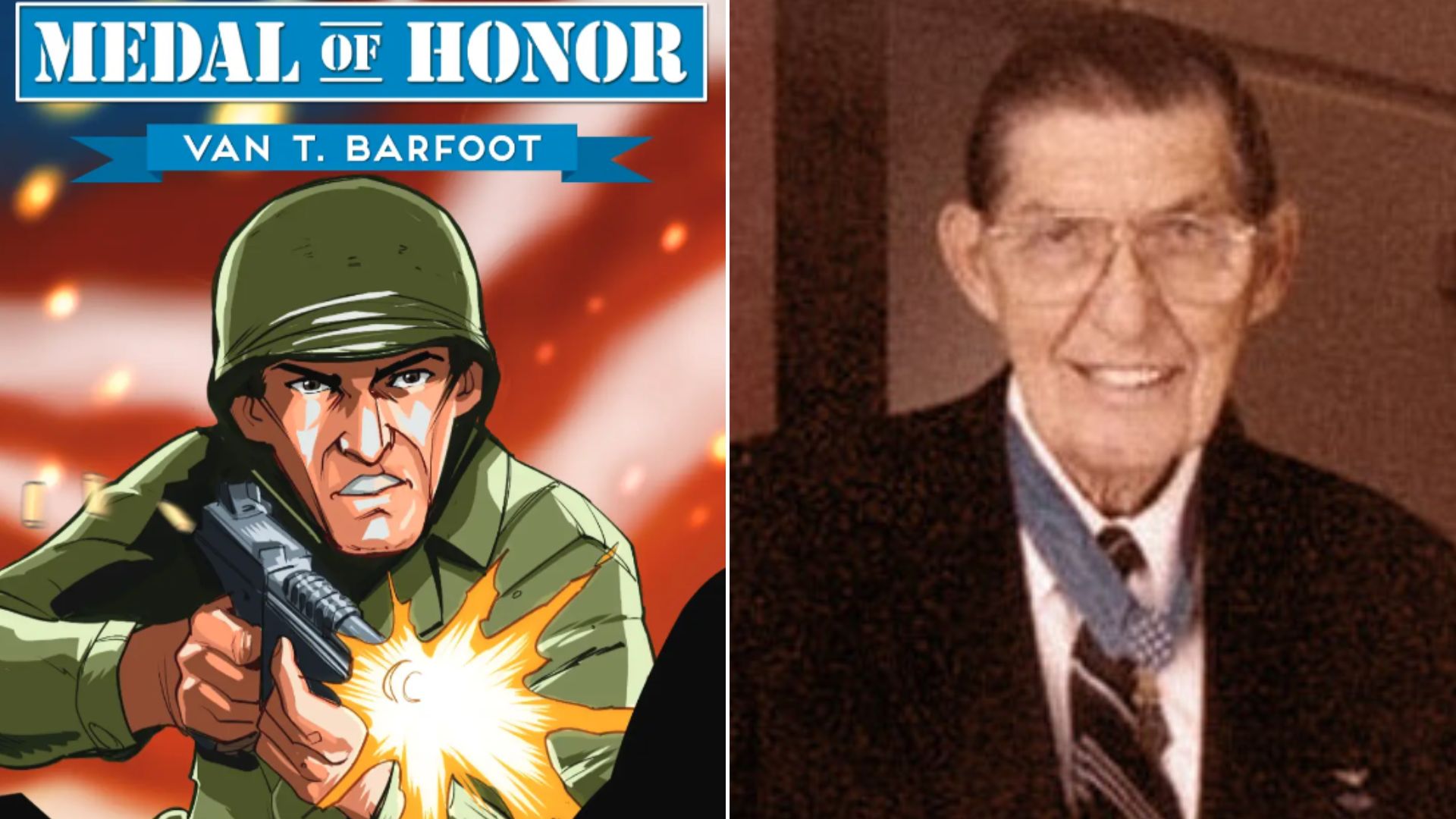
Van Thomas Barfoot (US Army)
Colonel Van T. Barfoot died on March 2, 2012, at the age of 92.
He is remembered not only for his extraordinary actions in combat but also for a lifetime dedicated to service, leadership, and integrity. His story remains an example of how ordinary beginnings can lead to an extraordinary life when shaped by courage and commitment.
Advertisement
What readers are saying
Generating a quick summary of the conversation...
This summary is AI-generated. AI can make mistakes and this summary is not a replacement for reading the comments.










COMMENTS