

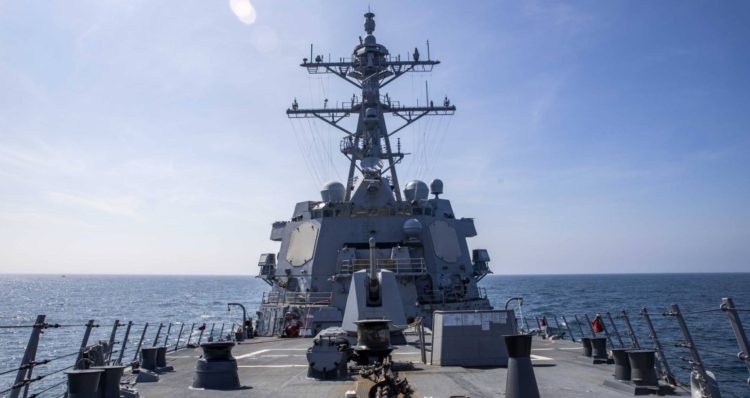
In a notable shift from its usual approach, the PLA released an official statement about the transit at 1:52 a.m. on Wednesday—much earlier than usual—indicating a more proactive stance in controlling the narrative surrounding U.S. naval movements. This rapid and critical response from China highlights the increasing tensions in the Taiwan Strait, where even routine naval transits can trigger diplomatic protests and heightened military readiness.
China, which views Taiwan as a breakaway province, has always been touchy about foreign military presence in the Taiwan Strait. This latest transit is likely to further strain the already tenuous relations between Washington and Beijing.
Taiwan’s Perspective: Walking a Tightrope
Taiwan viewed the passage of U.S. Navy ships through the Taiwan Strait in a generally positive light, seeing it as a reassuring presence amid ongoing tensions with China. Taiwan’s Ministry of National Defense confirmed that the vessels sailed from north to south beginning on February 10. Throughout the operation, Taiwan’s military kept a close watch on the surrounding airspace and waters, reporting no unusual activity. Officials emphasized that they had full control over the situation and that everything remained normal.
In response to China’s strong criticism of the transit, Taiwan’s defense ministry spokesman, Sun Li-fang, made a pointed remark, indirectly calling China the real “troublemaker” in the region. He noted that other neighboring countries understand who is responsible for stirring up tensions in the Taiwan Strait, implying that China’s aggressive actions speak for themselves.
Taiwan also reported a surge in Chinese military activity during the same 48-hour period that the U.S. ships passed through, detecting 62 Chinese military aircraft near the island. Despite this, Taiwan remained calm and focused on its ability to monitor and control the situation. While Taiwan didn’t explicitly state its approval of the U.S. naval presence, its response suggested a quiet welcome, seeing the transit as a necessary counterbalance to China’s growing military activities in the region.
The Bigger Picture: U.S.-China Relations Under Trump 2.0
Under President Donald Trump’s second term, U.S.-China relations have remained tense, with conflicts spanning trade, technology, and global geopolitics. His administration has doubled down on many of the policies that defined his first presidency, leading to further confrontations between the two superpowers.
On the economic front, Trump has intensified the trade war by imposing new tariffs on Chinese imports, including a proposed 60% flat tariff on all Chinese goods. These measures are meant to address trade imbalances and what the U.S. sees as unfair Chinese trade practices. In response, China has retaliated with its own tariffs on American goods and has restricted exports of critical rare earth materials, which are essential to many U.S. industries. This ongoing trade battle has disrupted global supply chains and created economic uncertainty for businesses and consumers in both countries.
Technology has also been a major flashpoint. The Trump administration has expanded restrictions on Chinese tech companies, particularly Huawei, citing national security concerns. The U.S. government is determined to limit China’s access to advanced American technology, further escalating tensions. Additionally, Washington has focused on countering alleged Chinese espionage, especially in sensitive sectors such as technology and academia.
Geopolitical rivalry has also intensified, particularly over Taiwan. The U.S. has strengthened its support for the island through arms sales and increased naval operations in the Taiwan Strait, directly challenging Beijing’s territorial claims. Meanwhile, Trump’s assertive foreign policy has tested U.S.-China relations while pushing China to strengthen ties with other nations like Japan and India, which had previously been more aligned with the Biden administration’s diplomatic efforts.
Looking ahead, Chinese analysts are largely pessimistic about the future of U.S.-China relations under Trump. They view his unpredictable and transactional approach as a serious obstacle to their plans and stability between the two nations. With economic, technological, and geopolitical conflicts showing no sign of easing, tensions between Washington and Beijing are likely to remain high in the years to come.
Summing Up
As the USS Ralph Johnson and USNS Bowditch have demonstrated, the Taiwan Strait remains a flashpoint in international politics. The U.S. Navy’s recent transit underscores America’s commitment to maintaining freedom of navigation in these strategic waters. However, it also highlights the delicate balancing act that the U.S. must perform in managing its relationships with both Taiwan and China.
In the coming months, all eyes will be on the Taiwan Strait, watching to see how these maritime maneuvers influence the intricate dance of diplomacy, power, and strategy in the Indo-Pacific region.








COMMENTS