In the harsh neon glow of a Kansas hotel room, a 28-year-old Guardsman inked a “covert relationship” with ghosts he thought were Russian agents, pocketed cash, snapped pics of Fort Riley, and tried to mail an American helicopter radio to Russia—only to learn later the feds were the ones writing the
Read the full article for more on:
Important insights and detailed analysis
Expert commentary on current events
Breaking developments and updates
Updating summary...
National Guard Soldier Busted for Trying to Sell American Military Helicopter Radio to Russia
Guy D. McCardle
Speed
1x
Listen
COMMENTS
In the harsh neon glow of a Kansas hotel room, a 28-year-old Guardsman inked a “covert relationship” with ghosts he thought were Russian agents, pocketed cash, snapped pics of Fort Riley, and tried to mail an American helicopter radio to Russia—only to learn later the feds were the ones writing the script.
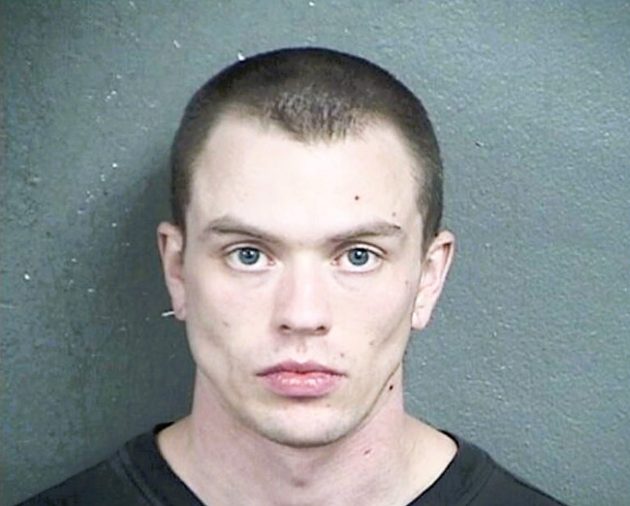
Army National Guard specialist Canyon Anthony Amarys, was arrested on October 28 in connection with his indictment for the attempted violation of the Export Control Reform Act. Image Credit: Wyandotte County Detention Center
The Catalyst:- The First Contact
In the strange twilight where espionage meets ill-advised ambition, Specialist Canyon Anthony Amarys, 28, of the Kansas Army National Guard, set into motion a chain of events that read like an espionage thriller gone embarrassingly off-script. In 2024, Amarys approached the Russian government via an overture, offering his services as a covert asset to Russian intelligence. Though he believed he was speaking with friendly operatives in Moscow, what he didn’t know was that his “Russian contacts” had sent his name straight to American authorities.
Advertisement
Yeah, something to keep in mind in case you ever get the itch to go rogue.
How Moscow Handed Him Over
Rather than clandestinely accept his offer and brew trouble, the Russian side, according to the indictment, forwarded the matter to U.S. counterintelligence. Subsequent federal filings show that authorities treated Amarys’s overture as an opportunity for a sting operation. The Russians, effectively uninterested in fielding a rookie asset, flipped the script and funneled Amarys to the American side. In short, Moscow washed its hands of the drama, and the U.S. intelligence community, aided by the Federal Bureau of Investigation and the U.S. Army Counterintelligence Command, stepped in to play handler.
The Meeting, The “Covert Relationship” Document
In February 2025, Amarys flew from New Mexico to Kansas, his destination: a hotel in Overland Park, to meet individuals he believed were Russian intelligence operatives. Instead, he met undercover federal agents. During the meeting, he signed a one-page agreement that formally acknowledged his “covert relationship” with what he believed to be a Russian intelligence service. In that document, he agreed to provide intelligence and material assistance: photographing the Fort Riley army base in Kansas (home of the 1st Infantry Division) and procuring for the Russians a controlled military helicopter radio. The writing was on the wall, and he signed it.
Advertisement
Cash payment, Radio Procurement & Base Photography
The sting functioned like this: At the February meeting, the undercover agents handed Amarys “thousands of dollars in cash” in order to enable him to purchase a helicopter radio, specifically a model used in U.S. military helicopters. By March, Amarys had bought the radio, travelled to Kansas to pick it up, and then attempted to ship it via the U.S. Postal Service to an address in Junction City, Kansas, outside Fort Riley, under the belief that it would be diverted to Russia via Romania.
On the day he picked up the package, Amarys also visited Fort Riley, entered the installation (or its environs) and photographed what he believed was “sensitive military technology” for the purported Russian intelligence operatives. He sent those photographs to the undercover agents later that day.
Advertisement
Radio Seized, Arrest Underscored
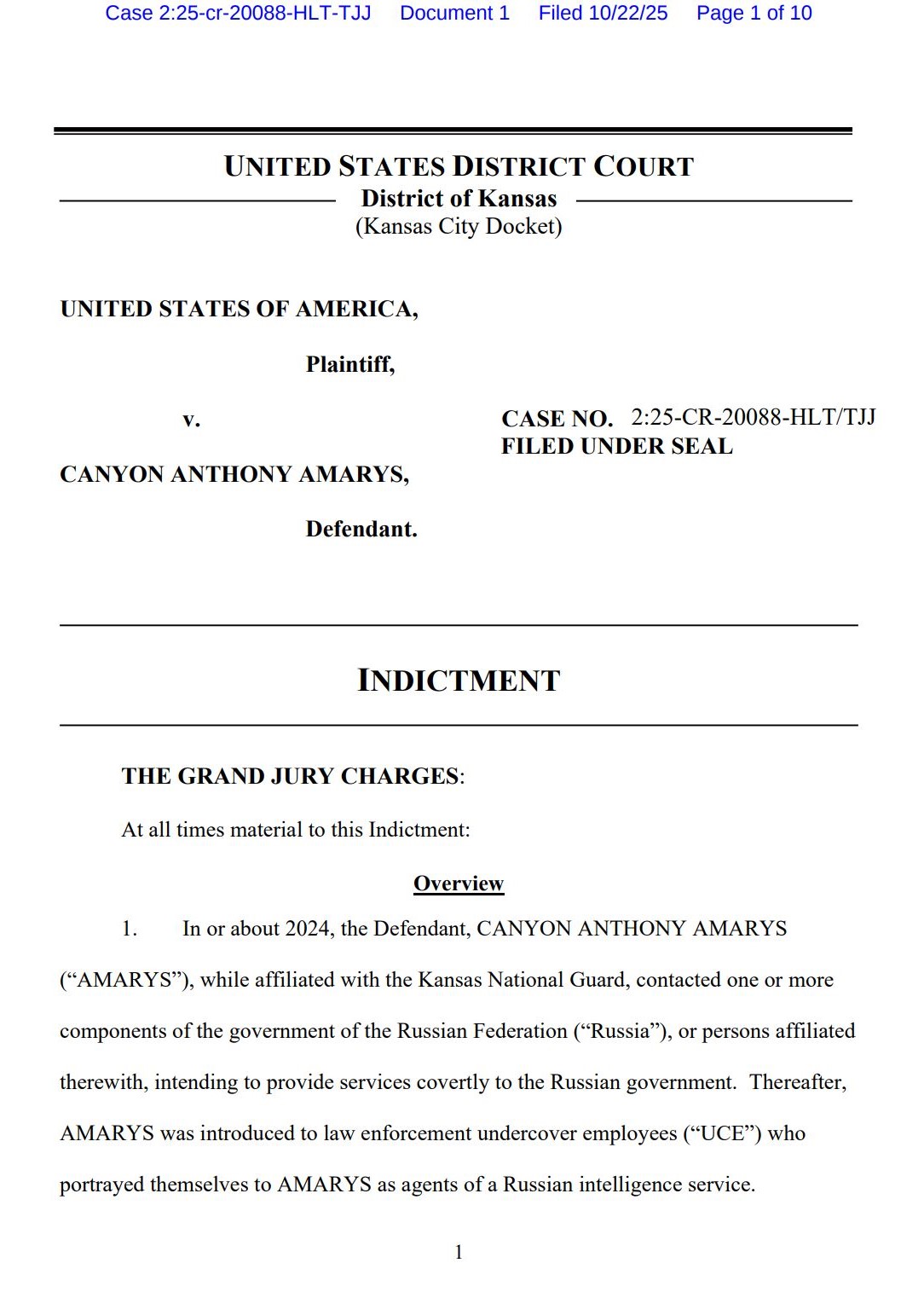
But the plan never reached fruition. The U.S. authorities, working the sting, conducted a court-authorized search and seized the helicopter radio before it could legally leave the United States. On October 28, 2025, Amarys was arrested and soon faced indictment for attempted export of a defense article under the Export Control Reform Act of 2018 (ECRA).
Charges, Legal Exposure & Why It Matters
The indictment charges Amarys with attempting to provide a military-helicopter radio to Russia, and with agreeing to act covertly on behalf of what he believed was a Russian intelligence service. Under ECRA and related regulations, willful export of defense articles without an appropriate license can carry up to 20 years’ imprisonment and fines up to $1 million per violation. While specific sentencing guidelines for his case have not been publicly calculated, the exposure is stark.
Beyond the raw numbers, the case reveals a chilling vulnerability: a member of the National Guard willing to sign off on a “covert relationship” to provide strategic U.S. military equipment and imagery to a near-peer adversary. The base photographs, the cash payments, the procurement of export-controlled equipment — it all could have slipped under the radar, had Amarys not met undercover agents instead of actual Russian operatives.
Advertisement
Final Thoughts: A Blot on Guard Service, a Cautionary Tale
In the space between patriotism and perfidy lies what appears to be a tragi-comically stupid miscalculation by Specialist Amarys. His outreach to Russian intelligence in 2024, the formalized agreement in early 2025, the cash consideration, the procurement effort, the Fort Riley imagery, the attempted export—each step was calculated. Yet each step was also its own undoing, because the “Russian” side he believed he was dealing with was the U.S. government wearing a different cloak.
The finger-pointing begins with how the Russian government elected not to exploit him, but to track him and deliver him into the hands of U.S. intelligence — a twist that speaks volumes about the evolving cold-war or post-cold-war playbook of counterintelligence. The case serves as a sharp reminder for all service members and contractors: when you sign a document pledging covert allegiance, when you receive cash in hand to procure military hardware, when you agree to photograph military installations for a foreign power—you’re not merely flirting with risk; you are stepping through the door of federal prosecutorial machinery.
And in the case of Canyon Anthony Amarys, the door closed on October 28 when he was taken into custody—and the clock on potential decades of incarceration began ticking.
Advertisement
What readers are saying
Generating a quick summary of the conversation...
This summary is AI-generated. AI can make mistakes and this summary is not a replacement for reading the comments.










COMMENTS