

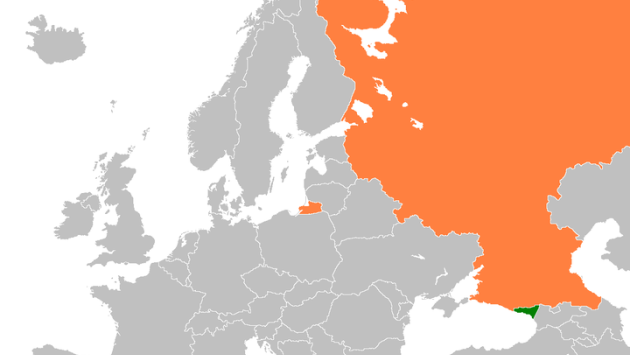
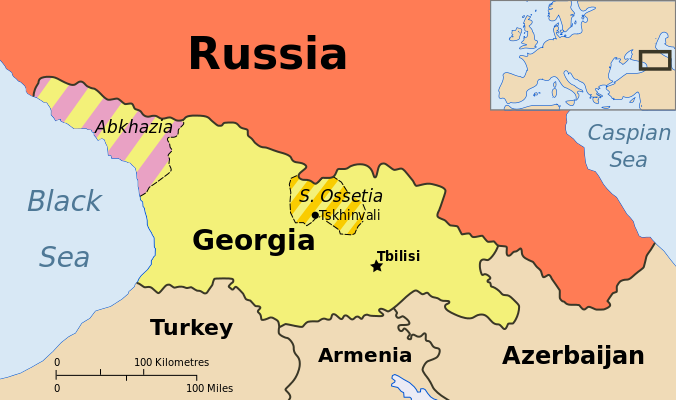
“The signing of this document will have a negative impact on the security situation in Georgia’s occupied territories as well as in the broader context of European security,” she said, adding that the deal infringed Georgia’s territorial integrity. (The Moscow Times, November 25)
NATO member-state officials, particularly those in the former Soviet republic states of Estonia, Latvia, and Lithuania, were notably disturbed by the agreement, again reinforcing declared fears of an encroaching Russian threat upon the post-Soviet space. Estonian Foreign Minister Keit Pentus-Rosimannus noted the violation of Georiga’s territorial integrity and highlighted the illegality of the agreement specifically on the grounds that it violated Georgian sovereignty:
“There is a threat that such activities will lead to the annexation of part of the territory of Georgia by Russia,” the Minister said.
“This step is a violation of Georgia’s sovereignty and territorial integrity and is contrary to international law, the commitment that Russia has made before the Council of Europe and to the so-called six-point peace plan [signed on August 12, 2008, just after Russia-Georgia war]”.
Pentus-Rosimannus estimated the agreement signed yesterday also damaged the Geneva negotiations process and thereby the security and stability of the entire region.
“Russia’s current activities in Abkhazia, including the erecting of border installations is illegal,” she said.
“We call on Russia to fulfil all of its 2008 ceasefire commitments including the removal of its troops to pre-conflict positions. Also, we consider it important that the representatives of the European Union observer mission have access to areas of Abkhazia.” (Agenda.ge, November 25)
Latvia’s president also cried foul, specifically addressing the impact of the agreement on stability:
Latvian President Andris Berzins said on Wednesday an agreement deepening cooperation between Russia and Georgia’s Abkhazia region threatened regional stability and security.
But, during a visit to the Georgian capital Tbilisi, he also said it was vital for Russia’s neighbors to look for ways to live beside it in peace…
“I consider this agreement … will negatively affect safety and stability in the region,” Berzins told a news conference with Georgian President Georgy Margvelashvili. (Margarita Antidze, Reuters, November 26)
Lithuania’s official statement denounced the agreement as well:
“We concur the 24/11/2014 statement of the High Representative of the European Union for foreign affairs and security policy Federica Mogherini stating that the so-called treaty ‘violates Georgia’s sovereignty and territorial integrity, contradicts principles of international law and the international commitments of the Russian Federation, including the 12 August 2008 Agreement and its Implementing Measures of 8 September 2008′,” the Ministry said.
Lithuania stresses the importance of the Geneva International Discussions in ensuring the security and stability in the region and reaching for peaceful resolution of the conflict. (The Lithuania Tribune, November 25)
The concerns communicated by officials in the Baltic states largely mirror the outrage expressed by Ukrainian lawmakers and government officials following the annexation of Crimea by Russia last March. Georgian government officials are now in almost full crisis mode, citing fears of an effort by Moscow to mimic the agreement with Abkhazia in Georgia’s other breakaway region, South Ossetia.
What and where next?
As Moscow continues to pursue policies of aggressive intervention in its near abroad, encroaching upon the territorial integrity of former Soviet republics such as Ukraine, Moldova, and Georgia, other states (particularly the Baltics) will increasingly feel threatened. As members of the Atlantic Alliance, the Baltic nations have their security underwritten by the other states in NATO.
As Russian interventionism, characterized by imperialistic policies and interference in the affairs of the other post-Soviet states, continues to cascade throughout the former Soviet republics, governments from Eastern Europe to Central Asia have expressed frustration and indignation with the seemingly unimpeded aggressive policies of the Kremlin in Ukraine and Georgia. Increasingly, observers in Moldova and the Baltics have girded themselves for much of the same out of Moscow.
(Featured photo courtesy of Wikimedia Commons)








COMMENTS