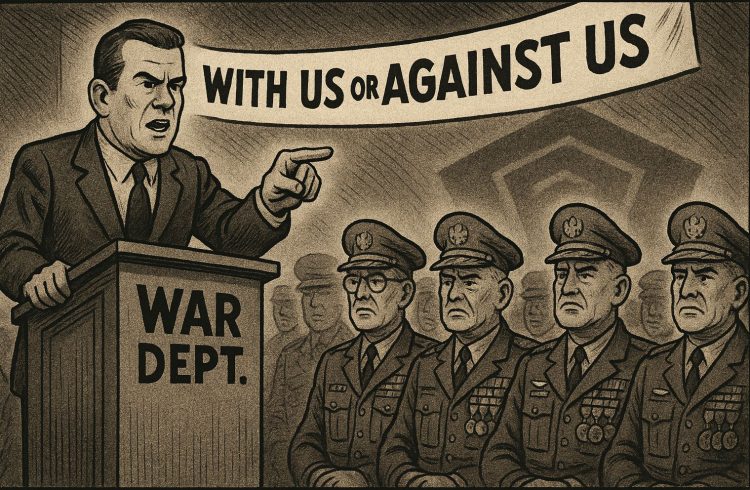
The order went out, planes were booked, and several hundred generals and admirals filed into an auditorium at Quantico last Tuesday. What they heard from Defense Secretary Pete Hegseth was part pep talk and part ultimatum. End the “woke garbage,” tighten grooming and fitness, and if the new edict makes your “heart sink,” submit your resignation. The room stayed stone still. The tremor came afterward.
The Ultimatum Heard ‘Round the Pentagon
Hegseth’s speech was blunt. He mocked “fat generals,” pledged to raise physical standards, further roll back diversity programs (if there were any left), loosen rules of engagement, and declared the “era of the Department of Defense is over,” rebranding it as the “War Department.” He pressed commanders to either align or get out. President Trump followed with a campaign-style address to the same audience. Media coverage and transcripts confirm the directives and the explicit invitation for any officer unwilling to carry them out to resign.
That show of force did not land in a vacuum. It sat on top of a rapid overhaul of the Pentagon’s inspector general system and leak crackdown proposals that include expanded NDAs and random polygraphs for thousands of staff. Critics argue this combination chills whistleblowing and shields misconduct. Several former officials and oversight advocates warned that the moves could silence legitimate complaints.
Perhaps that was objective. Perhaps not.
Who Is Heading for the Exits
Gen. Thomas Bussiere did not slam the door. He took the handle, looked back at the room, and set it down softly. Hours after Pete Hegseth told a packed house at Quantico that the “era of the Department of Defense is over” and that officers who could not get on board should resign, the Air Force Global Strike Command boss announced he would retire, citing personal and family reasons. He had been in line for Vice Chief of Staff of the Air Force until the White House pulled his nomination in September. The official storyline says life comes first. The calendar says this decision landed in the blast radius of a hard-edged speech that dared senior leaders to choose a side. That is the kind of timing no one in a nuclear enterprise forgets.
And of course, we know that Gen. Bryan Fenton relinquished command of U.S. Special Operations Command to Adm. Frank “Mitch” Bradley and retired after 38 years of service, but this was in the works long before SECDEF Hegseth announced his Quantico gathering.
Are currently serving flag officers openly saying they will resign because of Hegseth’s ultimatum? Not publicly. What we do have is a chorus of alarm from retired leaders and defense officials. Retired Lt. Gen. Ben Hodges publicly blasted the summons even before the meeting, sparking a public exchange with Hegseth. Retired Adm. James Stavridis called the spectacle political theater and argued the U.S. military remains lethal without a culture war reset. Other coverage captured current officials griping about a costly, security-awkward spectacle that “could have been an email.”
Why This Is Spooking the Ranks
The hot-button is not haircuts or PT scores. It is oversight. Hegseth’s new rules push IG offices to screen out complaints faster, raise evidentiary thresholds, and end some anonymity. He frames this as efficiency. Whistleblower advocates, former IG officials, and lawmakers see danger. If senior leaders believe they will be told to “carry on” while protections erode, the safest path may be to leave quietly rather than enforce policies they view as corrosive to good order, discipline, and lawful accountability.
Layer on talk of domestic deployment scenarios and a public scolding of the general officer corps, and morale becomes a live grenade. Analysts at CSIS flagged Trump’s rhetoric about using U.S. cities as training grounds. Stars and Stripes noted the stoic silence of senior leaders as Hegseth announced his rebranding and culture reset. Reuters captured the unsubtle line: “If you do not support the agenda, resign”.
Each of those signals pushes risk-averse professionals toward the door and hardens the cynicism among those who stay.
What It Means for the Fighting Force
In the short term, nothing will grind to a halt. The services are built for continuity. Commands hand off every week somewhere in the world.
Already have an account? Sign In
Two ways to continue to read this article.
Subscribe
$1.99
every 4 weeks
- Unlimited access to all articles
- Support independent journalism
- Ad-free reading experience
Subscribe Now
Recurring Monthly. Cancel Anytime.
The real cost comes in three places.
First, experience. Early retirements at the three and four-star levels ripple down. You lose mentors who shepherd colonels into their first star, and you narrow the pipeline for joint, cyber, and long-range strike expertise just as China, Russia, and Iran test seams. Bussiere’s portfolio includes nuclear deterrence and long-range strike. You do not swap that out like a spare tire.
Second, candor. If IG shields thin and polygraphs plus NDAs bulk up, leaders may choose silence over speaking hard truths. That can undermine pre-deployment risk reviews, mishap reporting, and the kind of brutal internal honesty that keeps troops alive. AP, Politico, and Reuters all reported warnings from oversight and legal experts on this exact chilling effect.
Third, trust. The armed forces function because apolitical competence is the coin of the realm. When cabinet officials stage partisan-flavored pageants for the cameras, junior officers learn the wrong lesson about how to earn stars. That does not build warriors. It builds courtiers.
The Bottom Line
There is no published list of generals who have resigned in protest.
What exists is a pressure campaign from the top, a set of oversight rollbacks, and a climate where some leaders will decide they can serve their oath best by stepping aside.
In wartime planning terms, that is attrition by policy choice.
And it risks leaving the United States with fewer seasoned commanders precisely when the world is starting to eat its own.










COMMENTS