
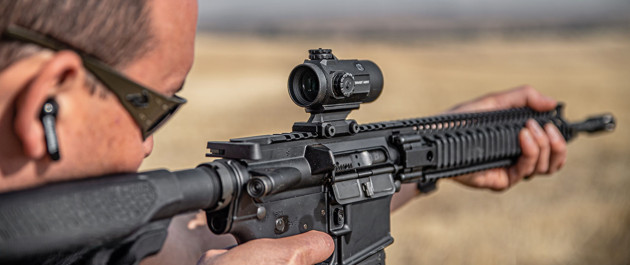
The AR-15 and the AR-10 look similar on the rack, but they feel different the moment you start running them with intent. One is built for speed and volume. The other is built for reach and authority. Treat them the same, and one of them will remind you, usually through weight, recoil, or missed follow-up shots.
These rifles are tools. The optic you mount on top decides how sharp that tool really is.
Two Rifles, Two Missions
The AR-15, as I’m sure most of you probably know by now, is most commonly chambered in 5.56x45 mm NATO or .223 Remington. It is light, controllable, and forgiving when the pace picks up. Recoil is mild, magazines are lighter, and long training days are easier on the body. This is why the AR-15 dominates training, home defense, and patrol-style roles. It rewards movement and speed.
The AR-10 predates the AR-15 and was the larger original design. Today, the term “AR-10” is often used as a shorthand for a .308-size AR-pattern rifle rather than a single standardized platform. Most are chambered in .308 Winchester or 7.62×51 mm NATO, with 6.5 Creedmoor now common in modern offerings. These rifles hit harder, carry farther, and demand more discipline from the shooter. The extra weight adds up fast, and more recoil punishes sloppy fundamentals.
The difference is not better or worse. It is about what the rifle is expected to do.
Red Dot Optics on the AR-15: Speed Wins Fights
A red dot on an AR-15 makes sense because the rifle itself is built for fast decision-making. A quality red dot gives you rapid target acquisition, both-eyes-open awareness, and minimal bulk. Inside practical distances, it is hard to beat.
Battery life and durability matter more than features. An optic like the Aimpoint Patrol Rifle Optic, with a rated 30,000 hours of constant-on runtime at a mid-level setting, removes one variable from the equation. Leave it on, confirm zero, and move on to more important problems.
Mount height matters. Absolute or lower-third co-witness heights are common, and the choice should match your irons and natural cheek weld. If you run night vision, make sure the optic supports compatible brightness settings.
For shooters who want more reach without turning the rifle into a science experiment, a flip-to-side magnifier behind the red dot is a proven option. You keep speed up close and gain identification and precision when distance stretches out. The trade is added weight and complexity.
Red Dot Optics on the AR-10: Controlled Speed
Putting a red dot on an AR-10 looks counterintuitive until you spend time in thick terrain or on close-range targets. When shots are inside practical distances, and the rifle already carries weight, a red dot keeps you efficient and composed.
The cartridge does not require a special red dot, but recoil and mass demand a solid mount and proper torque. Cheap mounts fail here. Your zero should be confirmed after hard use, not assumed.
Where the AR-10 excels is the dual-optic approach. A low-power variable optic handles identification and precision at a distance. A secondary red dot, offset or piggybacked, handles close work.
One optic for thinking, one optic for reacting.
LPVOs, Red Dots, and Reality
Low-power variable optics bring flexibility, but they come with tighter eye boxes and more demand on head position compared to red dots. That is the trade. Magnification and identification versus speed and simplicity.
There is no free lunch. Choose based on how the rifle will be used most often, not how it looks on a range bench.
The Bottom Line
The AR-15 paired with a durable red dot remains one of the most practical rifle setups available. It is fast, efficient, and adaptable. The AR-10 requires more deliberate optic choices and rewards shooters who respect its weight and recoil.
Pick the rifle based on the mission. Pick the optic based on how you intend to use that rifle. Then confirm everything under conditions that expose weakness, because theory does not survive recoil, rain, or bad footing.








COMMENTS