

But is it good or not? I believe it is but I sure hope all the lessons learned in Afghanistan are not going to be put aside. Those lessons could become very valuable in the event where any future wars would turn to a UW as the opposing country become weaker.
The main reason countries have Armed Forces is to protect their citizens and their rights against any outside or inside threats. One of them could possibly come from a country and not only from insurgents in foreign countries, so we need to be ready to fight back.
Combat veterans, but no CW experience
A good number of soldiers, who are now combat veterans, wouldn’t even be able to properly function in a CW, as most of their training was focused on the Global War on Terrorism (GWoT) fought in Afghanistan. This is very unfortunate but understandable at the same time, as the CF were stretched very thin as the combat deployments would come back every 2 years for most of the soldiers. Most of the money the National Defence had been poured into making sure our soldiers would be fully prepared to fight the Taliban. With a budget of 22.6 billion dollars in 2012, the money spent in Afghanistan was taking a huge chunk of the budget for logistical and operational reasons.
So while the Defence Budget was spent in Afghanistan, there was not enough money to keep the soldier back home trained to a certain degree in CW. There was still some sort of training made by the unit themselves to keep their soldier somewhat ready but nothing really serious. While pre-deployment would cover a small portion of CW manoeuvers, the remaining soldiers who were not scheduled to go would not get as much training.
I remember having privates and corporals in my platoon, who had between 2-6 years of service and 1-2 combat tours, that weren’t even qualified on basic winter warfare. We all know Canada is pretty cold in the winter eh! … So if anything would happen, these guys wouldn’t be ready. By having some CW training, this could be remedied pretty quickly. It is one thing to have combat experience in a certain type of warfare but we can’t neglect everything else. These soldiers would also become more proficient in their job as the knowledge they have would greatly increase.
Our home turf
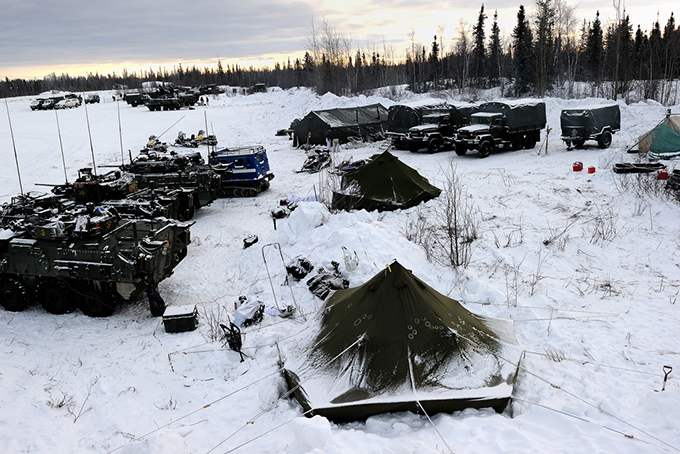
Our current Arctic situation is another example where CW would be applied. With vast areas that are non-populated and where almost no vegetation survives, there is a good possibility that the typical ‘’advance to contact’’ with tanks and artillery would be the main tactics used on the battlefield. While younger combat veterans are trained to kick doors and to sweep for IEDs, most of them aren’t ready for that.
Canada has to defend more than 9,984,670 km2 or 3,854,085 sq. mi. Most of the future conflicts would be fought in urban areas, but we still need to be able to conduct operations in the open fields. This is where CW becomes handy, as we can witness through the past wars.
A big problem with a lot of military strategists is that they want to reinvent the wheel instead of using the past lessons learned. Our conflict in Afghanistan was the first one we took part in as a combat element since Korea. I do believe there is a way to mix both the CW tactics and what we have acquired in Afghanistan.
As a matter of fact, this should be the future doctrine Canada adopts to ensure both preparedness against any threats while keeping the recent experience acquired by their soldiers.
Learning from our allies
Canadian Forces and the US Armed Forces have a very good relationship as two powerful allies. Multinational exercises are done every year between the two countries to make sure North America could withstand any threats. This is, in my opinion, the best possible future for both our country as neither one nor the other would tolerate an intrusion on their own soil. It is also important to share our experiences with our main ally as we could benefit from different area of specialisation such as winter warfare, amphibious attacks, strategic bombing, etc thus making both nations stronger and easier to protect.
Only the future will tell us what the best doctrines are that we should adopt, but until then, I hope our great military thinkers do not forget the experience we’ve acquired by shedding blood in Afghanistan. There is, I believe, a way to balance both CW and UW. We just need to carefully plan our actions and draw the lessons learned from past conflicts.








COMMENTS