The Beretta ARX160 was developed to address the limitations of older military rifles, emphasizing modularity, ambidextrous controls, and modern optics integration. Its design allows for quick component changes and adaptability to various mission profiles, making it a significant advancement in service rifle technology.
Key points from this article:
The ARX160 was developed under Italy's Soldato Futuro modernization program to meet the evolving needs of military deployments, particularly in Afghanistan.
How the ARX160's modular design allows for quick barrel swaps and adaptability to different calibers, which benefits military forces with varying ammunition supplies.
Why the ARX160's ambidextrous controls and piston-driven system are crucial for modern combat scenarios, enhancing usability for both left-handed shooters and in confined spaces.
Updating summary...
Beretta ARX160: Italy’s Modular Rifle Experiment and What It Got Right
Galen Fries
Speed
1x
Listen
COMMENTS
The Beretta ARX160 is a piston-driven, modular service rifle designed to fix the real shortcomings exposed by modern combat, emphasizing ambidextrous controls, adaptability, and ease of use while taking a different technical path than newer rifles like the UK’s KS-1.
Italian Army soldier carrying a Beretta ARX160 assault rifle. Image Credit: U.S. Department of War
The Beretta ARX160 was built to solve problems the Italian military ran into in the mid-2000s. Deployments to Afghanistan exposed the limits of older service rifles built for iron sights, unsuppressed fire, and fixed setups, and showed the need for modularity, ambidextrous controls, and easier mounting of modern optics and accessories.
Advertisement
Beretta certainly is not the only company trying to fix those problems. You can see the same pressures behind the UK’s move toward the Knight’s Armament KS-1 as the L403A1 Alternative Individual Weapon, especially the push for better ergonomics, modern optics integration, and rifles that behave when suppressed. On the outside, the ARX160 and KS-1 can look like they live in the same family photo, but they take different paths under the hood: the ARX160 uses a short-stroke piston and can fold its stock, while the KS-1 sticks with a refined direct-impingement system that is tuned for hard use, especially with a suppressor.
Developed under Italy’s Soldato Futuro modernization program, the ARX160 was intended to be a next-generation service rifle that could evolve with the fight rather than be replaced every time requirements changed.
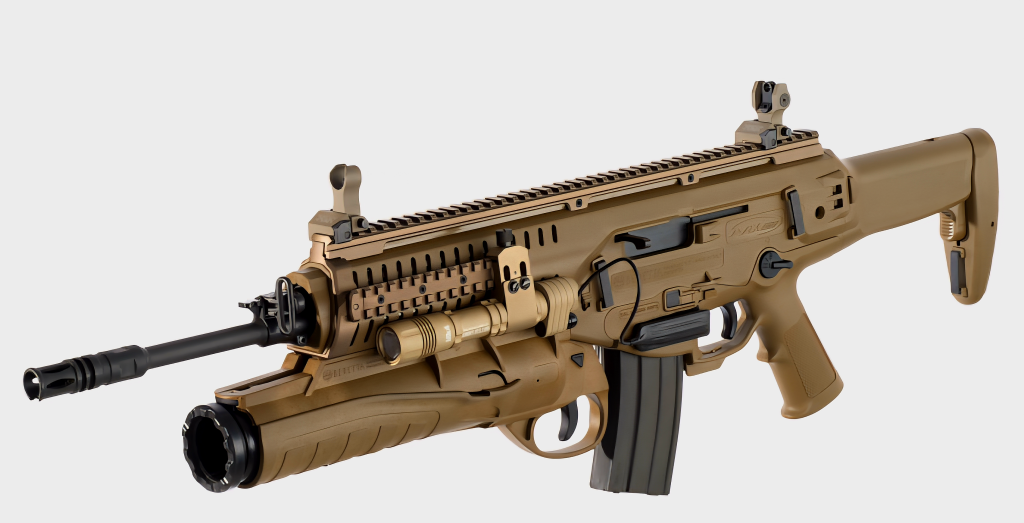
Beretta ARX160 with grenade launcher. Image Credit: Beretta
What the ARX160 is
At its core, the ARX160 is a modular, piston-driven assault rifle chambered primarily in 5.56×45mm NATO, feeding from standard STANAG magazines. It uses a short-stroke gas piston system, which keeps heat and fouling out of the receiver and improves reliability in dirty environments and during sustained fire.
Advertisement
In military and law enforcement configurations, the ARX160 is typically a select-fire rifle, most commonly set up for semi-automatic and full-automatic fire (exact selector options can vary by contract and user). The civilian version ARX100 rifles are sold as semi-automatic only.
Unlike older service rifles that were locked into one configuration for life, the ARX160 was designed around quick-change components, most notably its barrel. Barrel swaps can be done at the armorer or unit level without specialized tools, allowing the rifle to adapt to different mission profiles or future upgrades without replacing the entire weapon.
Advertisement
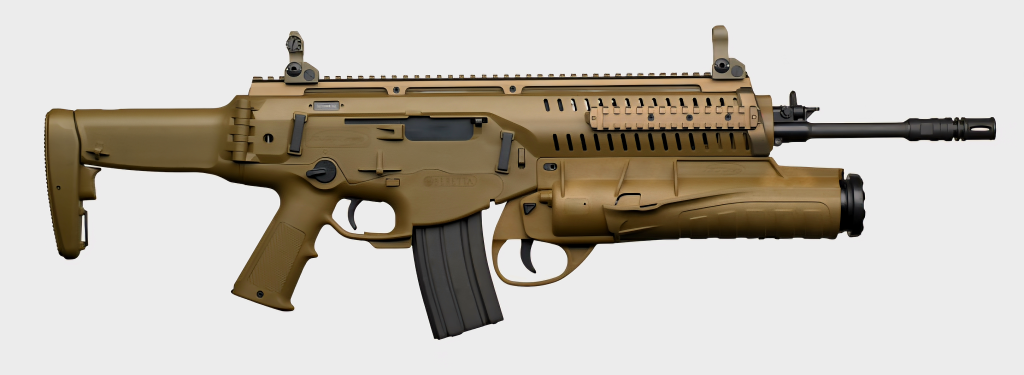
Beretta ARX160 with grenade launcher. Image Credit: Beretta
Ergonomics and ambidexterity
One of the ARX160’s defining features is its fully ambidextrous control layout. The safety, magazine release, bolt catch, and charging handle are mirrored or reversible, and the rifle can be configured to eject either left or right. That is an attempt to accommodate left-handed shooters, shoulder transitions, and modern movement around cover.
The stock telescopes like most modern AR-style rifles. Because the ARX160 is piston-driven and does not need a buffer tube, the stock can fold as well, making the rifle noticeably more compact when space is tight.
Modularity and accessories
The ARX160 has full-length Picatinny rail space for optics and accessories, plus room for lights, lasers, and foregrips. It also comes with integrated, adjustable iron sights marked to 600 meters, giving you a built-in backup sighting option that can cowitness with some optic mounts.
Advertisement
The rifle was also designed to accept the GLX-160 underbarrel grenade launcher, preserving a conventional infantry capability that many armies still consider essential.
Beretta also designed the ARX to swap calibers. Most rifles are 5.56 NATO, but the system can be converted to 7.62×39mm and other rounds, which matters for countries that have piles of AK ammo or supply chains that change from region to region.
Italy began fielding the ARX160 around 2008, ultimately procuring roughly 30,000 rifles across the Army, Navy, Air Force, and special operations units. The rifle saw operational use in Afghanistan, where its piston system, modular design, and ambidextrous controls were tested under real combat conditions rather than controlled ranges.
Beyond Italy, the ARX160 has been adopted by a wide range of forces, including Albanian special units, Algerian special forces and presidential guard elements, Kazakhstan special forces, the Egyptian Navy, Mexican federal police, and Turkmenistan’s military. In many of these cases, the appeal was adaptability, durability, and ease of maintenance.
Strengths and limitations
The ARX160 does several things well. It is reliable, tolerant of harsh environments, and genuinely ambidextrous. Its modular design reflects a forward-looking approach to service rifles that many armies were only beginning to explore when it entered service.
At the same time, the rifle’s polymer-heavy construction and unconventional ergonomics have drawn mixed reactions from end users. Some appreciate the weight savings and corrosion resistance. Others dislike the feel and balance compared to more traditional metal-receiver rifles. Like many modular systems, it trades some mechanical simplicity for flexibility.
Bottom line
The Beretta ARX160 represents a serious attempt to future-proof a service rifle rather than endlessly patch an old one. It is not perfect, and it is not universally loved, but it is a thoughtful, purpose-built system shaped by real operational requirements.
In that sense, the ARX160 stands as a snapshot of where Western infantry rifle design was heading in the late 2000s, and why many militaries began rethinking what a standard service weapon needed to be.
Advertisement
What readers are saying
Generating a quick summary of the conversation...
This summary is AI-generated. AI can make mistakes and this summary is not a replacement for reading the comments.











COMMENTS