

I was scared, but I told myself I had to get past that. When I did, I found there was also a part of me that was excited about whatever lay ahead. I knew my life had hit a major turning point. I’d had experiences most other sixteen-year-olds had not. Still, I was far from an adult. I didn’t even have my driver’s license yet.
Often, during those lonely nights, I thought about what had happened with my dad and me. On the one hand, it was a hard lesson in the demands of authority. My dad was right: There’s only one captain on a ship, just like there’s only one person in charge of a mission, a department, or any venture. At the same time, he was making the wrong decision. I had learned how to take orders during my time on the Peace, and that sense of respect for the chain of command would become a crucial trait later on during my service in the military. Still, as we shall see, there would be quite a few other occasions when I would feel it was my duty to challenge authority, despite my training, when my gut told me the guy in charge was leading us down the wrong path.
That catamaran was fast — way faster than any single-hull boat I’d ever sailed. It took us less than two weeks to make Hilo. A day before we reached our destination, I came up on deck from my stateroom on the port side of the boat. It was a gorgeous morning. As I stood on deck, something in the hull caught my eye. I bent down to look. Just above the waterline, a swordfish had rammed our boat during the night, spearing itself straight through the hull and breaking off the tip of his snout. That damn fish must have leapt clear out of the water to spear us. I grabbed my camera to take a picture of it. I still have that snapshot. The next day we breezed into the harbor at Hilo with a short length of swordfish beak jammed through our hull.
The image of that swordfish stuck in my mind as firmly as its beak stuck in the flank of the “Shilo.” What the hell was going on for that fish? What made it leap up out of the water to attack this strange, unknown vessel? Did it know it was going up against something more than ten times larger and heavier than itself?
And what future was I leaping out of the water to go up against?
Years later I would learn this odd factoid of biology: Although, like all fish, it is cold-blooded, the swordfish has special organs in its head that heat the eyes and brain as much as 60°F above ambient temperature. This greatly enhances the animal’s vision and therefore its ability to nail its prey. The falcon or eagle would probably be most people’s choice, but if you were looking for a totem to represent the idea of a sniper — especially a sniper who works in water — the swordfish would not be a bad pick.
Perhaps this had been a vision quest, after all.
Once we reached Hilo I made my way back to the mainland by plane and met up with my old boss, Bill Magee. As my mom had known would be the case, Bill was happy to see me and said I could go back to work for him and live on board. “Hey,” he said, “you’ve already got your schoolwork out of the way for the rest of the year. Why don’t you just settle into boat life?”
I can’t even imagine how my life might have turned out if he hadn’t made this kind offer.
Soon after I rejoined Captain Bill and the Peace, the Animals showed up for a few days of diving. This time one of them, a younger guy, brought a few friends with him. These guys were rugged. I didn’t know what they did, but you could see that whatever it was, they knew it inside and out. They weren’t muscle-bound showoffs or tough guys with attitude; it was more subtle than that. Being around them, you could just sense that there was something special about the way these guys carried themselves. It felt like they could take on a shark on a bad day and come out smiling.
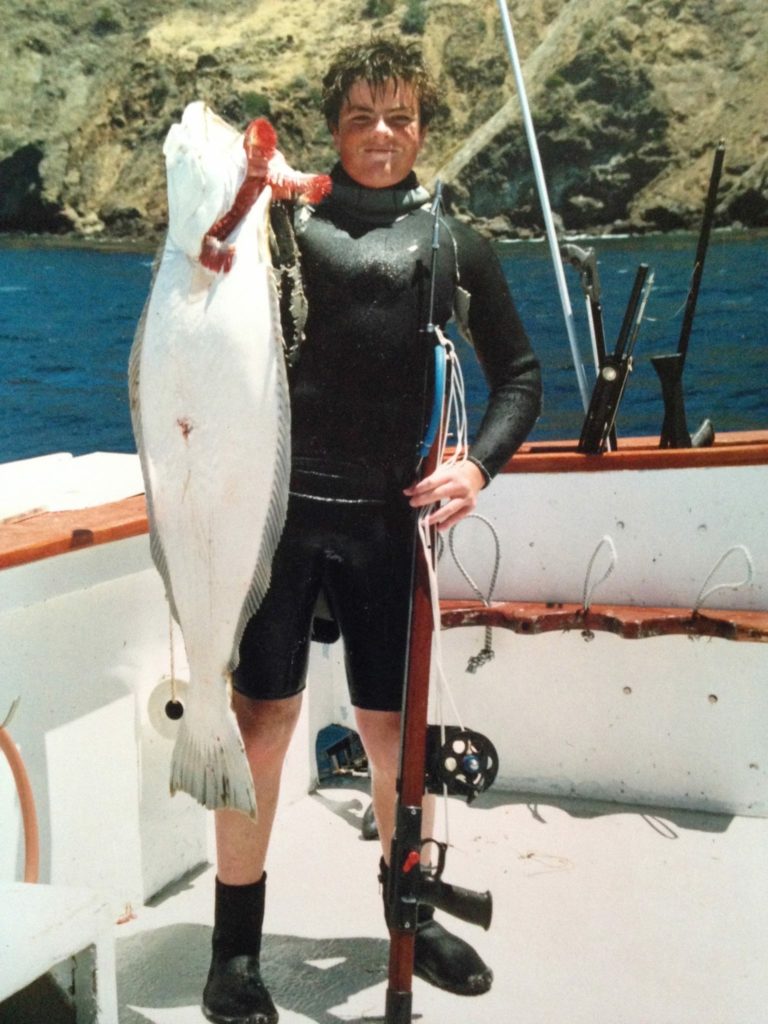
Photo: 50lb Halibut speared off Santa Cruz Island as a young 15-year-old deckhand.
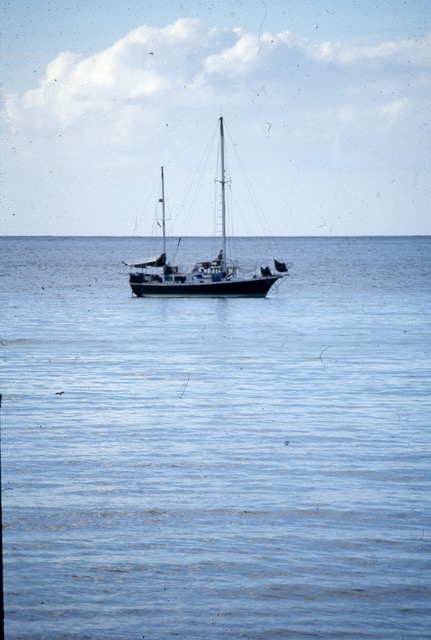
Photo: Our family Ketch, “Agio.”
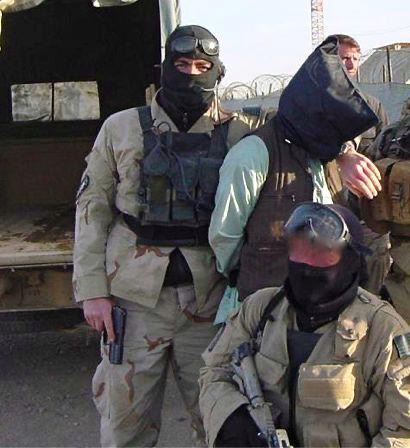
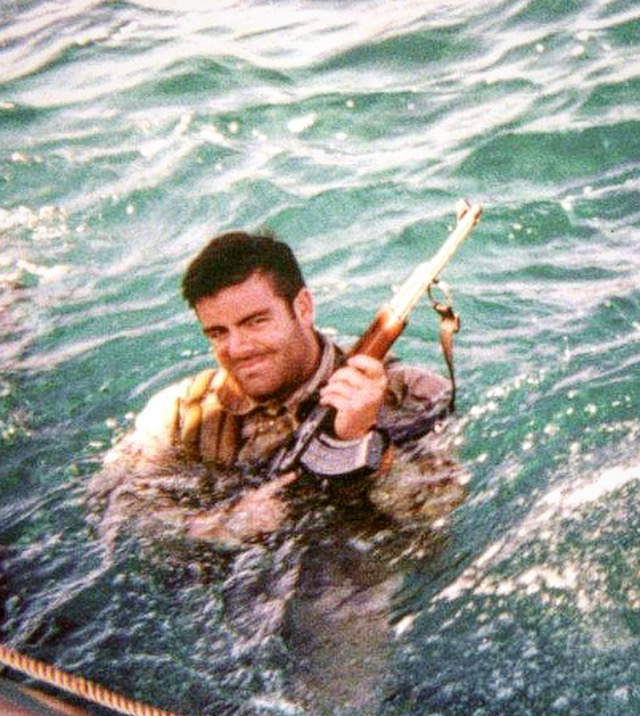
Photo: Author with a captured prisoner in Kandahar, Afghanistan
On our first dive, when these guys saw me, a 16-year-old kid diving with no buoyancy compensator and my twin steel 72s, they noticed. “Holy shit,” said one of them, “who is this kid?”
The two of us got to talking. He wanted to know how I’d come to be a deckhand, and I told him a little bit about my background.
“You know,” he said, “you should check out the seals.”
At least that’s what I thought he said. I had no idea what he was talking about. Seals? Was this guy seriously into seals, like whale-watching and shit? Was he making a joke?
“No,” he said, “not seals—SEALs.”
I still didn’t get it.
“Navy maritime Special Operations forces,” he explained. “SEALs. It stands for Sea, Air, and Land. SEALs.”
I’d never heard of them before.
“To become a SEAL,” he added, “you go through the toughest military training in the world.”
Now that got my attention. I didn’t know much about the military, but I had always been fascinated with aviation and wanted to be a pilot when I grew up, maybe even an astronaut. What he was describing intrigued me. “I love the water“, I thought, “and I’m a pretty good diver. That sounds like a hell of a challenge.”
The truth was, I knew I needed a plan, somewhere to go and something to aim at. At the time, when I wasn’t on the dive boat, I would surf and hang out with some guys around the harbor. They were starting to get into crystal meth. I had no interest in it — I would drink beer and that was the extent of it — but seeing them and where they were heading scared me. I knew that I had to get the hell out of there sooner or later if I wanted to make anything better out of my life.
From that point on, my goal was fixed: I was going to become a Navy SEAL.
I had no idea how hard it would be.
Fast forward, and my journey into the SEALs was far from traditional. I graduated with class 215 in 1998. Approximately 220 candidates started and, over six months later, just over 20 of us originals finished.
I was assigned to SEAL Team 3, my first choice. I had an amazing career up until 2006. Two deployments with ST3 to the Middle East (USS Cole in 2000) and Afghanistan in 2001-2002, followed by my last tour as a sniper instructor for both NSWG1 training and the Naval Special Warfare Center.
Towards the end of my tour, I started to see unit culture fray at the edges. I would see senior leadership looking the other way when guys tested positive for drugs or worse. Consequently, I decided to leave the community. I was a newly minted Chief Petty Officer at the time.
This routine of sweeping dirt under the carpet because, “he’s a good operator,” would start sending a poor signal to the community at large. It was the beginning of over a decade of culture rot. It took one of the military’s elite units, with a hard-earned stellar reputation, and destroyed it overnight. A reputation hard-earned with blood, sweat, and tears. From the UDT on the beaches of Omaha in WWII, to SEAL Team 1’s and 2’s stellar mission performance during the Vietnam War.
I was vocal about these issues after leaving the Teams but people weren’t ready to listen. Guys would come to me and the site with plenty of information related to war crimes, drug abuse, and the embezzlement of taxpayer money.
Rather than write about this, I took it to USSOCOM. It fell on deaf ears. “Who’s talking to you? Give us names!?”
I took a lot of heat for this. Teammates, some whom I thought were friends, turned against me. I became a polarizing figure in the community. “You’re bringing down the community talking about this stuff openly,” they’d whisper to me on late night uninvited calls.
That taught me a lot about life and taking a stand for what is right, even when it’s not popular. I don’t regret trying to flag these issues to USSOCOM when I was Editor of SOFREP in the early days. I’d do it all over again because it was the right thing to do, and sometimes the right thing isn’t the easy thing.
I love the Teams but hope they start taking corrective action and realize that it’s time to take a hard look in the mirror and rebuild our culture for the better.








COMMENTS