

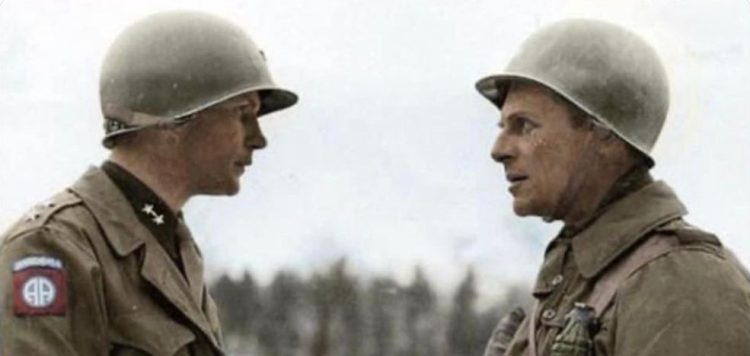
Ridgway dictated extensive night airborne operations as well as multi-echelon live fire exercises. There would also be extensive intramural athletics as well as tough PT, obstacle courses and road marches. Gavin would require assembled leaders to conduct unprogrammed patrols, ambushes and hasty operations to force them out of their comfort zones. Both would observe and critique units on the spot as well as evaluate leadership at all levels.
In this approach, the developed SOP’s, tactical proficiency and leadership ethos would be re-built. Key leaders at all levels fell out or were forced to conform. LTC Batchelor was relieved of the 505 and given an opportunity to command a battalion in the 508th PIR whose commander had been relieved. He was replaced by a new arrival, Col Bill Eckman. This was a conflict between Ridgway and Gavin as Gavin wanted him replaced by a proven Sicily vet, LTC Mark Alexander. Ridgway believed that “new blood” was essential for the 82d and the decision stood.
Col Millett was constantly overwatched by Gavin who spent considerable time with the junior levels to ensure compliance and competency. Lindquist was backstopped by several transfers from the 505. Both Ridgway and Gavin recognized that Lindquist’s PIR was exceptionally well-managed and wanted to develop a combat leader ethos through the transfers.
BG Taylor, the DivArty CG, was hastily transferred to the 101st to replace MG Bill Lee who suffered a heart attack. BG Howell, a combat inexperienced officer, was assigned by SHAEF to replace him.
Concurrent with this internal transformation, there was considerable turmoil, confusion and issues that had to be managed. SHAEF HQ proposed a number of Airborne “bright ideas” that had to be managed at the highest levels. Both Ridgway and Gavin spent significant time briefing MG Bradley on reasonable Airborne concepts as well as dealing with energetic VIP’s.
The newly arriving troop carrier wings were consistently poor in navigation, resulting in many misdrops and injuries. This reached such a point that by April, MG Ridgway banned airborne operations other than by exception. The M1A1 Deuce and Half would be the Airborne conveyance.
The Pathfinder’s, seen as a crucial part of the Division’s success, were fully integrated with the troop carrier wings for constant training with token troop loads. Major Jack Norton, the Division G3, assumed overwatch of the program and wielded more tactical authority over the troop carrier wings than a brigadier general.
SHAEF continued to pour Bigot intel and constantly changing objectives for the Division. Captain Bob Piper, commander Division HHC, was designated the primary Bigot Control Officer. His task was to absorb the daily intelligence stream, compare it with the tactical plan of the moment and then to brief the regimental Bigot controllers. This usually required two primary briefings a day as well as additional time to brief Ridgway and Gavin so they could approve and make adjustments.
The local British social schedule also impacted the program. Many of the landed estates as well as significant parts of the local communities, had been commandeered by the government to support the troop displacements. Much of the city of Leicester and several Lord’s and Ladies had been discomforted on behalf of the 82d Airborne.
The local civil leadership designed a number of routine high-ranking dinners and receptions for the displaced which would feature the senior Division personalities. This was viewed by SHAEF as mandatory mollification affairs. It took time away from observing division night operations and reducing opportunities to improve specific elements.
This very mixed environment was further exacerbated in early May by two significant events. Air Field Marshall Trafford Leigh-Mallory raised very serious reservations regarding the D Day jump arguing that it should be cancelled due to assumed (by him) casualties. Ridgway and Gavin spent significant time with Bradley explaining the value. Bradley agreed and made it a Yes or No decision by Ike with his strong requirement that it be a Yes. Within less than 15 days before projected D-Day, Ike said Yes. Back to work.
Intelligence received in late May, less than two weeks before D-Day, indicated that the Division objectives, centered around St Saveur De Vicomte, were now heavily defended and would result in major casualties if not outright defeat. Accordingly, Captain Piper arranged a briefing on this situation to the command group.
The staff was extremely concerned as any change to objectives would result in gross turmoil amongst the PIR’s as well as a significant work overload. MG Ridgway absorbed the new data and walked to the map.
He grasped the acetate cover with the PIR objectives, unpinned it and moved it due East to where the ovals for each PIR fell neatly on new ground-the 505 at La Fiere, the 507th at Amfreville and the 508th at Chef Du Pont. The only thing that would have to change would be the new DZ’s, the objectives (bridges and LOC’s), though different, would remain tactically the same. Problem solved.
By 25 May, the Division was settled into its several departure airfield sausages and was a reasonably united organization with a top to bottom understanding as to how to do Airborne business. Combat would prove the worth of Ridgway and Gavin’s methodology and core values. Values that remain today and are taken for granted by all who wear the Red Beret.
It was not always so, but between January and June of 1944, two distinct and highly professional personalities built what we enjoy today. We were fortunate in that their residue is a perpetual gift and seemingly always will be.








COMMENTS