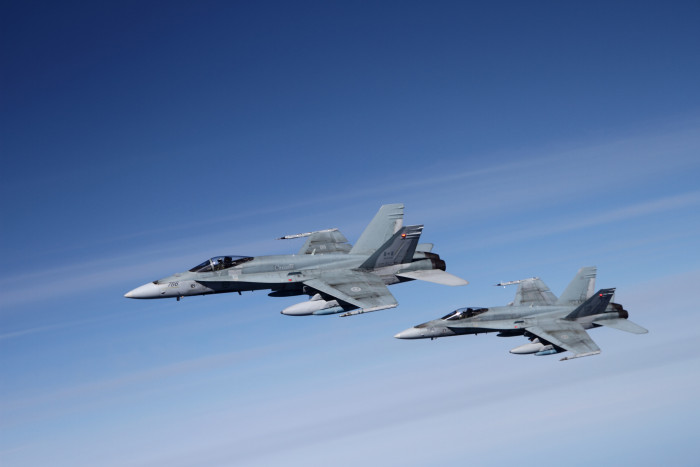
Canada’s Prime Minister announced today that the Royal Canadian Air Force will send 6 CF-18 fighter aircraft to Lask in Poland in enhance the readiness of NATO allies in Eastern Europe. Twenty staff officers will be also leaving Canada to join the Supreme Headquarters Allied Powers in Europe to assi
Read the full article for more on:
Important insights and detailed analysis
Expert commentary on current events
Breaking developments and updates
Updating summary...
Canada to Send 6 CF-18s Fighter Jets to Poland
Jonathan Wade
Speed
1x
Listen
COMMENTS
Canada’s Prime Minister announced today that the Royal Canadian Air Force will send 6 CF-18 fighter aircraft to Lask in Poland in enhance the readiness of NATO allies in Eastern Europe. Twenty staff officers will be also leaving Canada to join the Supreme Headquarters Allied Powers in Europe to assist NATO. “Canada continues to strongly […]
Canada’s Prime Minister announced today that the Royal Canadian Air Force will send 6 CF-18 fighter aircraft to Lask in Poland in enhance the readiness of NATO allies in Eastern Europe. Twenty staff officers will be also leaving Canada to join the Supreme Headquarters Allied Powers in Europe to assist NATO.
Advertisement
“Canada continues to strongly condemn Russia’s illegal occupation of Ukraine and its ongoing aggressive military provocation. Along with our NATO allies, we recognize the need to enhance security and stability in Central and Eastern Europe. To this end, Canada is offering the following capabilities to enhance the readiness of NATO allies: six Royal Canadian Air Force CF-18 fighter aircrafts and up to 20 staff officers to the Supreme Headquarters Allied Powers in Europe to assist NATO planning efforts. Canada’s offer has been well received by NATO. Canada remains steadfast in its support for Ukraine and will not stand idly by while its sovereignty and territorial integrity are threatened. Together with our allies, we will continue to monitor events closely and take coordinated action to enhance Europe’s security and show our support for the people of Ukraine.” [sic]
Canada was one of the first country to impose sanctions on Russia following the Crimea crisis. While Canada’s Foreign Minister John Baird ruled out a Western military intervention in Ukraine, NATO mobilised its troops to fulfill its commitment to ensure the security of its eastern European members. This will de facto ensure the presence of a quick reaction force in the area, should the Ukrainian situation change. The fighters would be Canada’s initial contribution to this increased presence.
“You can certainly be sure that Canada will take additional measures. We’ve already imposed a number of sanctions, and we will clearly be taking further action,” he said.
Advertisement
NATO to unfold additional resources to Eastern Europe allies.
NATO Secretary General announced today that NATO will also deploy supplementary resources to Eastern Europe allies, including more aircrafts and warships.
‘’You will see deployments at sea, in the air, on land to take place immediately. That means within days, pending of course practical… a number of practical considerations. But we have decided to implement immediately,’’ Rasmussen answered.
Rasmussen did not go into operational details, saying that NATO ‘’ will deploy enough to enhance our preparedness and enough to prepare for more if needed.’’
NATO also called on Russia to be part of the solution by stopping the destabilisation of Ukraine and pulling back the Russian military, which is estimated to be at around 40,000 troops, from the border. NATO also added that Russia would have to make clear that they don’t support the violence created by armed pro-Russian separatists.
Task Force Libeccio was the air detachment participating in the enforcement of the no-fly zone in Libya authorized by Resolution 1973, adopted by the U.N. Security Council on 17 March. The task force was named for the strong southwesterly wind that blows all year in the Mediterranean Sea.
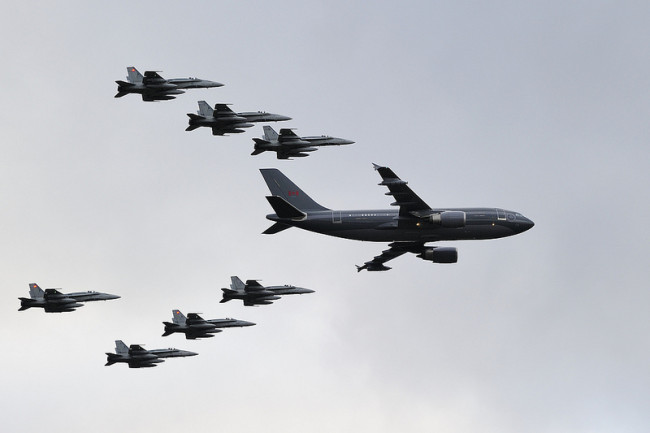
Canada sent 7 CF-18 jets (one was a spare) during the 2011 military intervention in Libya alongside 2 CC-177 Globemasters, 2 CC-130J Hercules, 2 CC-150 Polaris air-to-air refueling tankers and 2 CP-140 Aurora. Task Force Libeccio was based in Sicily, Italy.
An additional 6 CF-18 were placed on standby in Canada, ready to immediately deploy if called upon.
Lieutenant General Charles Bouchard, a Royal Canadian Air Force officer, was the overall commander of the Combined Joint Task Force Unified Protector for NATO mission in Libya
Up to 19,000 pounds maximum on nine stations – two wing-tip for Sidewinder heat – seeking missiles; two outboard wing for air- to-ground ordnance; two inboard wing for Sparrow radar-guided missiles, air-to-ground or fuel tanks; two nacelle fuselage for Sparrow missiles, or sensor pods; one centerline for weapons, sensor pods, or tank. Internal 20mm cannon mounted in nose.
(Featured image courtesy of the Royal Canadian Air Force)
Advertisement
What readers are saying
Generating a quick summary of the conversation...
This summary is AI-generated. AI can make mistakes and this summary is not a replacement for reading the comments.










COMMENTS