The Strait of Hormuz Is Not a Naval Battle. It’s a Choke Point.
The Strait of Hormuz has always looked like a naval battlefield on a map. Two narrow lanes of water, oil tankers threading through like fat steel needles, warships somewhere just beyond the horizon. It invites the imagination to picture something out of the age of sail or the great fleet engagements of the 20th century. Carrier groups maneuvering. Destroyers trading missiles. A classic clash of fleets.
That is probably not how this one unfolds.
Iran does not need to defeat the U.S. Navy in a traditional naval battle to cause serious disruption. It only needs to make the Strait too dangerous to use.
The playbook is not built around fleets. It is built around friction.
Sea mines laid quietly in the dark. Coastal anti-ship missile batteries positioned along the Iranian shoreline overlooking the shipping lanes. Swarms of inexpensive drones buzzing over the water looking for a tanker’s bridge, radar mast, or engine space. None of this requires sinking an armada. It only requires creating enough uncertainty that shipping companies start asking a simple question: Is it worth the risk?
If the answer becomes “no,” even temporarily, the consequences ripple outward fast.
The Strait of Hormuz is one of the most important energy choke points on Earth. According to the U.S. Energy Information Administration, roughly 20 percent of the world’s petroleum liquids consumption moves through that narrow corridor each day. A large share of global liquefied natural gas shipments also passes through the Strait, including major exports from Qatar.
When the flow through Hormuz slows or stops, markets do not react calmly. Insurance rates spike. Tankers anchor offshore waiting for guidance. Energy traders start recalculating global supply in real time.
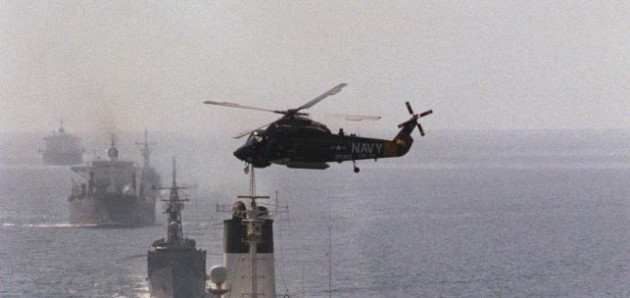
Mining the Strait does not require a dramatic moment. Mines can be laid quickly by a range of platforms, and clearing them is slow, deliberate work carried out by specialized mine countermeasure ships, helicopters, and divers. Every suspected mine forces ships to slow down or reroute. Even a single explosion can halt traffic while crews and insurers try to figure out what just happened.
Layer coastal missiles into that environment, and the waterway starts to resemble a shooting gallery. Tankers are large, slow, and predictable targets. A single successful strike does not need to sink a ship to create chaos. Fire and smoke on a supertanker is more than enough to shut down shipping while investigators and naval escorts sort out the threat.
Then there are the drones.
Already have an account? Sign In
Two ways to continue to read this article.
Subscribe
$1.99
every 4 weeks
- Unlimited access to all articles
- Support independent journalism
- Ad-free reading experience
Subscribe Now
Recurring Monthly. Cancel Anytime.
Iran has spent years building a large inventory of relatively inexpensive unmanned systems. They are cheap, expendable, and well-suited to harassment operations against shipping or naval escorts. A swarm does not need to be sophisticated. It only needs to be persistent.
The resulting drone storm would look nothing like a naval battle.
It would look like a siege.
And if the Strait of Hormuz turns into a battlefield of mines, missiles, and buzzing drone swarms instead of fleets, the objective will not be to win a naval battle.
The objective will be to make the water too dangerous to use.
Because when the tankers stop moving, the global economy feels it almost immediately.
Cyber Retaliation Watch: How This War Could Reach the American Home Front
When Americans think about war with Iran, they picture missiles, carrier groups, and fighter jets somewhere far away over the Persian Gulf.
What they usually do not picture is their bank app failing to load, their company payroll system freezing up, or a utility network suddenly running blind for a few hours.
But in a conflict like this, the cyber front is very real and every day Americans may end up feeling the pinch.
U.S. banks and financial institutions are already operating in a heightened alert posture as tensions escalate. Security teams across the financial sector are watching for a surge in Iran-linked cyber activity, something analysts say often follows major geopolitical crises. According to reporting from Reuters, the expectation inside the industry is simple: when a conflict like this starts, probing and disruptive cyber activity usually follows close behind.
The likely attacks are not Hollywood scenarios where the lights go out across half the country.
More often, they are persistent nuisance operations designed to cause friction. Distributed denial-of-service attacks that flood websites and mobile banking apps until customers cannot log in. Credential stuffing campaigns that use stolen passwords from previous data breaches to break into accounts. “Hack and leak” operations meant to dump embarrassing corporate data online and rattle markets.
None of these tactics requires a superweapon. They rely on scale, persistence, and patience.
Federal warnings about Iranian cyber activity have been circulating for years and are being resurfaced again in the current environment. Security advisories tied to the FBI note that Iranian-linked actors frequently exploit simple vulnerabilities first, unpatched software, outdated systems, and weak or reused passwords on internet-facing infrastructure.
In other words, the digital equivalent of checking whether someone left the door unlocked.
There is precedent for this kind of activity. U.S. authorities have previously linked Iranian hackers to major distributed denial-of-service campaigns that targeted the American financial sector, disrupting access to online banking services and forcing institutions to spend millions of dollars in mitigation and recovery.
The same investigation also revealed something more unsettling. Iranian-linked actors had gained access to the control system of a small dam in New York State, demonstrating that infrastructure connected to the internet can become a target even when the attackers are thousands of miles away.
That incident did not lead to physical damage, but it made the point.
The cyber front in a conflict like this is not about cinematic destruction. It is about pressure.
War does not always arrive with sirens and explosions.
Sometimes it arrives quietly, through frozen bank apps, stalled payment networks, and the sudden understanding that the battlefield now runs through the wires and servers that keep modern life moving.
America’s Water Systems: The Cyber Target Sitting in Plain Sight
If you want to find a domestic vulnerability that almost nobody thinks about until something breaks, start with water.
Not nuclear plants. Not aircraft carriers. Water.
Every city and town in America depends on a network of pumps, valves, sensors, and treatment systems that keep drinking water flowing and sewage moving out. For most of the last century, those systems were mechanical. Today, many are controlled by computers tied into digital networks, and that quiet modernization has opened a door that security officials have been warning about for years.
Federal inspectors have repeatedly found serious cybersecurity weaknesses inside U.S. drinking water systems. In some cases, operators were still using default passwords, shared logins, or accounts belonging to employees who no longer worked at the facility. It is the digital equivalent of leaving the keys in the truck and the engine running.
Water utilities are classified as critical infrastructure by the Department of Homeland Security. The same federal apparatus that monitors threats to the electric grid, transportation networks, and financial systems also tracks risks facing the nation’s water and wastewater sector.
The reason is simple. These facilities run on industrial control systems that manage the physical processes inside a treatment plant. Computers monitor pressure, regulate pumps, control valves, and manage the chemical dosing that keeps drinking water safe. Operators watch these systems on screens and adjust them in real time.
If someone gains access to those controls, they do not need to blow anything up.
They could potentially manipulate pumps, alter chemical levels, or feed operators false sensor data that hides what is happening inside the pipes.
This is not theoretical.
In February 2021, an intruder gained remote access to the computer system at the Oldsmar water treatment facility in Florida. The attacker attempted to raise the level of sodium hydroxide, an industrial chemical used in water treatment, from about 100 parts per million to roughly 11,000 parts per million. A plant operator noticed his mouse cursor moving on its own and reversed the change before the altered settings could take effect.
Two years later, hackers linked to an Iran-aligned cyber group targeted the Municipal Water Authority of Aliquippa, Pennsylvania. The attackers compromised a programmable logic controller at a pumping station and left a message on the device before operators shut the system down and switched to manual control.
Water service continued, but the breach exposed a familiar weakness. Many small municipal utilities operate on tight budgets with limited cybersecurity staffing and aging equipment connected to the internet.
Federal guidance for protecting these systems sounds almost boring in its simplicity: separate control systems from public networks, require multi-factor authentication for operators, patch software regularly, and maintain reliable backups in case systems have to be restored.
None of this involves exotic technology.
It is basic cyber hygiene.
And yet across thousands of small utilities, those basics are still catching up with reality.
War does not always arrive with sirens and explosions.
Sometimes it begins with someone, somewhere, logging into a system they should never have been able to reach.










COMMENTS