President Trump reiterated a strong stance against Iran, emphasizing military readiness but lacking a clear strategy or objective. The recent removal of Attorney General Pam Bondi amid internal pressures raises questions about the administration's direction as it navigates potential military action.
Key points from this article:
The removal of Attorney General Pam Bondi occurred just hours before Trump's speech on Iran, indicating internal turmoil within the administration.
How Bondi's controversial comments about Jeffrey Epstein's client list created a credibility gap, undermining the administration's narrative at a critical time.
Why the timing of Bondi's dismissal suggests a recalibration of leadership as the administration prepares for possible military escalation against Iran.
Updating summary...
Evening Brief : Trump Repeats Iran War Warning as Attorney General Pam Bondi Is Fired After Epstein Fallout
Guy D. McCardle
Speed
1x
Listen
COMMENTS
Trump repeats the same war warning on Iran with no clear endgame as he axes Attorney General Pam Bondi over Epstein fallout and failed prosecutions, raising a sharper question: is this escalation, or a housecleaning before something bigger?
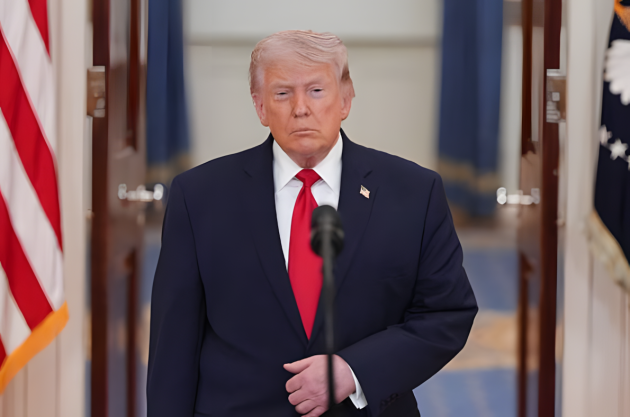
President Donald Trump delivers a measured but force-heavy address as questions grow over Iran strategy and sudden upheaval inside his own administration. Image Credit: Getty
Attorney General Pam Bondi is out, fired as President Trump doubles down on Iran war rhetoric with no clear end state. The timing is hard to ignore.
Advertisement
Trump Talks War Again, but the End State Is Still Missing
There’s a pattern setting in.
President Trump stepped up last night and delivered another force-heavy warning on Iran, the kind built on strength, consequences, and the promise that the United States will act if pushed. The language was familiar, the tone unwavering, the message unmistakable.
But once it was over, the same question lingered, unchanged:
Advertisement
What, exactly, is the objective?
Because a warning is not a strategy, and repetition doesn’t turn it into one.
Advertisement
A Message on Loop
If you’ve been tracking this over the past few weeks, you’ve already heard the core of it.
Iran cannot get a nuclear weapon. The United States will respond if necessary. Overwhelming force remains on the table.
That framework hasn’t moved.
Advertisement
What’s missing is any indication that something behind the scenes has shifted. No timeline. No operational signal. No sense of whether this is a prelude to action or an extended pressure campaign designed to hold the line without crossing it.
At a certain point, repeating the same warning starts to feel less like escalation and more like a holding pattern.
Say the United States continues its air campaign and dismantles Iran’s nuclear infrastructure. Facilities are hit, systems are degraded, and leadership is forced to respond under pressure.
Is that victory?
Because the core problem doesn’t disappear with the strike. Enriched material doesn’t vanish because buildings collapse. The technical knowledge doesn’t go away either. At best, it gets disrupted, delayed, or pushed somewhere harder to track.
Which raises the next question.
Do you follow that strike with boots on the ground to secure what remains? Do you accept that you’ve bought time instead of solving the problem? Do you escalate further if the program reconstitutes?
Without a defined end state, “winning” risks becoming a moving target.
The Problem With “Stone Age” Thinking
“Bomb them back to the Stone Age” lands as a line. It’s blunt, memorable, and built to signal resolve.
But it falls apart under scrutiny.
Does it mean destroying infrastructure? Collapsing the regime? Crippling the economy to the point of systemic failure?
And if you achieve that, what replaces it?
History doesn’t reward that kind of ambiguity. Power vacuums rarely stay empty, and the forces that fill them are often less predictable than the ones that were removed.
Breaking a system is easy. Controlling what comes next is not.
Signal Without Direction
None of this suggests the threat isn’t real. It is. And the possibility of intensified military action is clearly being kept close.
But right now, the messaging is stuck in place, high on intensity, low on specificity.
If there is a transition from rhetoric to execution underway, it hasn’t been telegraphed. If there’s a defined outcome the administration is working toward, it hasn’t been articulated in a way that clarifies the path forward.
So the speech lands where the last one did.
Not as a turning point, but as another signal in a series.
And until that signal is paired with direction, the central question doesn’t change:
What happens next?
Former Attorney General Pam Bondi is photographed during a Cabinet meeting at the White House on Thursday, March 26. Image Credit: Alex Brandon
From War Signals to Internal Shockwaves
Attorney General Pam Bondi is out. She was removed on Wednesday as pressure built inside the administration, with President Trump confirming the move publicly on Truth Social on Thursday. The timing lands hard. Her removal came just hours before Trump delivered his latest speech on Iran, a moment when the administration is signaling potential escalation overseas. This wasn’t a quiet personnel shuffle. This was a removal with a paper trail.
The Epstein Files Problem That Wouldn’t Go Away
The breaking point wasn’t vague internal friction. It was specific, public, and politically radioactive. Bondi went on record early in her tenure claiming Jeffrey Epstein’s client list was sitting on her desk, ready for review. That statement set expectations no one could walk back. They didn’t materialize. The Department of Justice later said no such list existed. The contradiction triggered a firestorm, not just outside the administration, but inside it. The perception took hold that something was being withheld, whether true or not. Inside Trump’s circle, that kind of unforced error is lethal. It created a credibility gap at the exact moment the administration needed control of the narrative.
“All Talk, No Action” and a Public Dressing Down
Then came the prosecutions. The DOJ under Bondi secured indictments against former FBI Director James Comey and New York Attorney General Letitia James. On paper, that’s a major move. In reality, both cases collapsed. A judge tossed them after ruling the acting U.S. attorney who brought the cases was unlawfully appointed. That’s not a minor procedural issue. That’s a failure at the foundation. Trump didn’t keep that frustration private. He took it to Truth Social, blasting the situation as “all talk, no action” and signaling that patience had run out. At that point, the outcome was predictable. You don’t publicly gut your Attorney General like that and then keep them in the chair.
Blanche Steps In, Zeldin in Consideration
This isn’t a mystery transition. Todd Blanche, one of Trump’s defense attorneys and current Deputy Attorney General, is stepping in as acting AG. This is about tightening control. Blanche knows Trump’s legal instincts because he’s defended them. He walks in aligned. Behind him, there’s already discussion of a permanent replacement. EPA Administrator Lee Zeldin is being considered, another figure closely aligned with Trump’s agenda. This isn’t a search. It’s a recalibration.
This Is Becoming a Pattern, Not an Exception
Bondi isn’t the first. Just weeks ago, Trump fired DHS Secretary Kristi Noem. Now the Attorney General is gone. Two cabinet-level removals in a short window isn’t random churn. It’s a signal. Trump cycles people when they stop producing results or drift out of alignment. Loyalty buys access, but it doesn’t guarantee survival. From the outside, it looks chaotic. From the inside, it functions as a pressure system. Perform, align, or get replaced.
Why This Reaches Beyond Politics
Here’s where this shifts out of politics and into national security. The Attorney General sits at the intersection of military authority, intelligence operations, and legal boundaries, especially in a moment like this. Targeting authorities. Surveillance thresholds. Detention policies. Interagency coordination between DOJ, DoD, and the intelligence community. All of it runs through that office. A new Attorney General, brought in for tighter alignment, can accelerate decisions, expand interpretations of authority, and reduce friction between agencies preparing for action. Or, if mishandled, create blind spots at exactly the wrong time. That overlap is where operations succeed or fail long before the first aircraft takes off.
The Timing Isn’t an Accident
You don’t remove your Attorney General in the middle of a geopolitical pressure cycle unless something has already gone wrong. In this case, we know what went wrong. Epstein fallout. Failed prosecutions. Public pressure from the President himself. But the timing still carries weight. The fix didn’t wait. It happened as the administration is signaling that something bigger may be coming. Which leaves you with a harder question than the headlines are asking: is this cleanup, or preparation?
Advertisement
What readers are saying
Generating a quick summary of the conversation...
This summary is AI-generated. AI can make mistakes and this summary is not a replacement for reading the comments.











COMMENTS