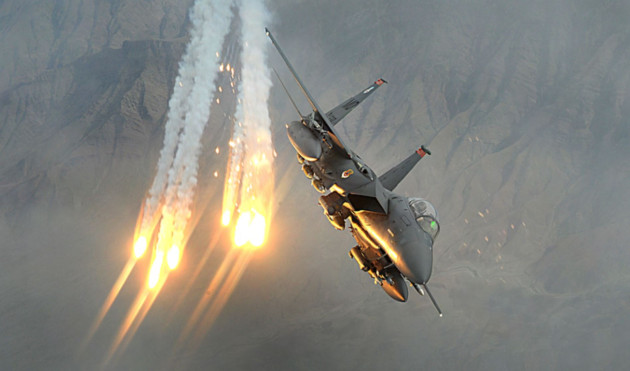
The United States just lost an F-15E over Iran, and now there is a race on the ground that matters more than the jet.
The Strike Eagle was shot down by Iranian air defenses during ongoing operations tied to Operation Epic Fury. Both crew members ejected. One has already been recovered by U.S. forces. The second is still missing, and the clock is running.
This is the first confirmed U.S. fighter loss to enemy fire inside Iran in this war. That alone marks a shift. Up to now, the air campaign has looked one-sided. This changes the tone immediately.
The fight now is not about air superiority. It is about who gets to that second airman first.
A second U.S. aircraft was hit as the rescue effort kicked off. An A-10 Thunderbolt II took Iranian fire while supporting the search for the missing F-15E crew member. The pilot flew his damaged Warthog out of Iranian airspace and all the way to Kuwait before ejecting. The aircraft went down in Kuwait. The pilot was recovered and is safe.
The rescue package took fire across multiple platforms. Two UH-60 Black Hawk helicopters were also hit. Service members sustained minor injuries. To be clear, this A-10 incident was not a second shootdown deep inside Iran. It was a hit during the recovery phase, and it unfolded while one American was still on the ground. U.S. special operations forces pulled one F-15E crew member out alive on Iranian soil.
U.S. combat search and rescue assets are still in motion. Think HC-130s, Pave Hawks, and whatever else can get in and out fast under threat. That tells you something important. Command believes the missing crew member is still alive, or at least alive recently enough to justify the risk.
There are unconfirmed reports of signals or a possible beacon hit tied to the second crew member. Nothing official. Nothing solid. But the fact that rescue operations are still active at this intensity suggests there is at least some kind of trail.
On the other side, Iran is not waiting. State media is actively calling on civilians to locate and capture the pilot. There are reports of cash bounties being offered.
That turns this into a ground hunt.
This is where SERE becomes real. The missing crew member is now operating alone in hostile territory, trying to stay hidden, avoid both military forces and civilians, and buy time. Every hour that passes increases the odds of compromise. Iran knows the terrain. They control the population. They can flood the area with search teams.
Already have an account? Sign In
Two ways to continue to read this article.
Subscribe
$1.99
every 4 weeks
- Unlimited access to all articles
- Support independent journalism
- Ad-free reading experience
Subscribe Now
Recurring Monthly. Cancel Anytime.
The U.S. has speed and capability. Iran has proximity and numbers.
That is the equation.
There is also a bigger signal here. Iranian air defenses just proved they can reach out and touch a fourth-generation strike platform in contested airspace. Whether that was a lucky shot, a system improvement, or a gap in U.S. tactics does not matter yet. What matters is that it happened.
What happens next is straightforward.
If the second crew member is recovered, this becomes a close call and a tactical lesson. If he is captured, this becomes a strategic problem overnight, with propaganda, leverage, and escalation baked in.
Right now, somewhere on the ground in Iran, one American is trying to stay alive long enough for the cavalry to arrive.
And both sides are moving fast.
Army Chief of Staff Fired Mid-War as Pentagon Reshapes Leadership
The Army just lost its top general in the middle of a war, and nobody is pretending this is normal.
Well, they did exactly “lose” him, like he went missing or something.
War Secretary Pete Hegseth forced Gen. Randy George into immediate retirement on April 2, cutting short a term that was supposed to run into 2027. Career infantry. West Point, class of 1988. Iraq and Afghanistan. Former senior military assistant to SecDef Lloyd Austin. Not a political outlier. Not a lightweight. Gone anyway.
Two other senior officers went with him. Gen. David Hodne, a four-star running Army Transformation and Training Command. Maj. Gen. William Green Jr., the Chief of Chaplains. Same day. Same decision window. All out.
The Pentagon offered no explanation. Spokesman Sean Parnell confirmed the move and issued standard gratitude. Nothing else.
That silence is doing a lot of work.
Reporting indicates the immediate friction point was a promotion list. Twenty-nine officers up for elevation. Hegseth blocked four. All four were Black or female. Take from that what you will. Most of the rest were white men. George pushed back and requested a meeting. Hegseth refused.
That detail is important, but not for the reason people want to argue about online. The takeaway is not the composition of the list. The takeaway is that the Army’s top uniformed officer challenged a decision and did not get a conversation. He got removed.
Compliance is now part of the job description.
This was not a one-off. Hegseth has already fired or sidelined more than a dozen senior leaders across the force. Chairman of the Joint Chiefs CQ Brown. Chief of Naval Operations Lisa Franchetti. Air Force Vice Chief James Slife. DIA Director Jeffrey Kruse. Others followed. This is a pattern.
Look at who steps in. Gen. Christopher LaNeve is now acting Chief of Staff. He is not a neutral placeholder. He was Hegseth’s personal senior military assistant at the Pentagon from April 2025 into early 2026. He was installed as Vice Chief in February. Confirmed less than two months ago. Commissioned out of Arizona ROTC. Former 82nd commander. Eighth Army in Korea. Known quantity. Known relationship.
Parnell described him as completely trusted to carry out the administration’s vision without fault.
That is the point.
This happened the day after the president addressed the nation on the Iran war. Operations are active. The 82nd is moving. Air defense and logistics are already in theater. The Army is not leading the fight yet, but the ground piece is building.
You do not reset senior leadership in that environment unless you intend to change how the institution responds.
In the short term, units keep moving. Orders still get executed. The war machine does not stop.
Long-term, the friction within the system is gone. The debates that used to happen behind closed doors get shorter or disappear. Decisions move faster. Alignment tightens.
It can also remove the brakes.
If this conflict expands and the Army is pulled fully into it, the force that shows up will not just be configured differently.
It will be led by officers who understand exactly what happens when they push back.
The question now is simple. When the next disagreement comes, will anyone still try?
Trump Seeks $1.5 Trillion Defense Budget as Cuts to Domestic Programs Ignite Fight in Washington
The war machine is open again, roaring like a drunk hot rodding a V8 at two in the morning, and President Trump now wants to pour $1.5 trillion into it.
That is the new budget request for fiscal 2027, a record-breaking defense ask that would shove military spending up by roughly 44 percent when combining the $1.15 trillion base request with a $350 billion reconciliation ask, while the base budget alone represents a 28 percent increase. The pitch is familiar. Iran is on fire. China is still the pacing threat. Russia is still in the room. The industrial base needs to move faster. Shipyards need money. Missiles need replacing. The Golden Dome needs to be built. Troops get a pay raise. The Pentagon gets everything it asked for and then some.
The administration says part of the bill gets covered by carving into programs it considers wasteful. That includes a proposed 10 percent cut to non-defense discretionary spending, with deep reductions aimed at agencies and programs tied to environmental regulation, education, health research, housing, and equity-focused initiatives, according to budget summaries. The White House budget documents use the word “wasteful” like a meat axe. Critics use different words. They call it ideological and reckless, and there is politics in the targeting.
That is where this stops being a dry budget story and turns into a fight over national priorities.
The administration is making a blunt argument. Cut the social programs, the climate programs, the research programs, the bureaucracy, and feed the warfighter instead. For Team Trump, that is not just bookkeeping. It is doctrine. They are trying to reorder the federal government around hard power.
The problem is that budgets are strategies in numeric form, and numbers this large tell you what Washington thinks the next few years look like. More missiles. More shipbuilding. More munitions production. More readiness spending. More war capacity. Less patience for anything that does not fit inside the administration’s definition of strength.
What happens next is simple.
Congress gets to wield the knife. Republicans will cheer the defense topline and then start fighting over what gets cut. Democrats will attack the domestic reductions and the deficit hit. The White House will call the cuts discipline. Opponents will call them vandalism. Both sides will claim the mantle of common sense.
And underneath all of it sits the real question.
When Washington says it is cutting waste to fund national defense, who gets to decide what counts as waste and what disappears once the war bill comes due?










COMMENTS