

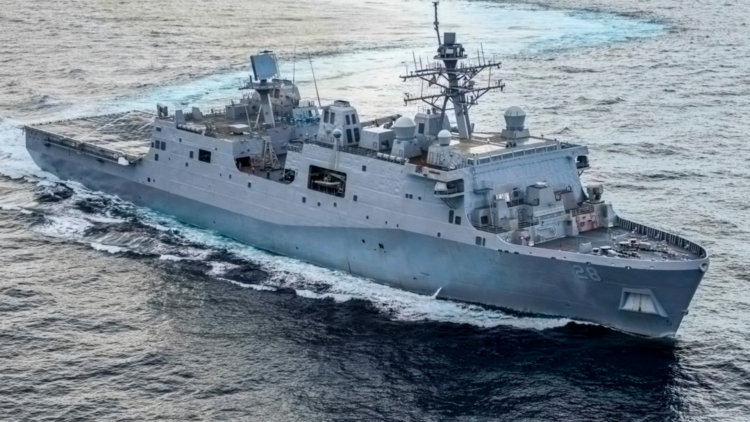
Kari Wilkinson, at the helm of Ingalls Shipbuilding, credited the synergy of Navy brass and industry stalwarts with turning visions of maritime mastery into steel-clad reality.
“Fort Lauderdale is a terrific example of what our collective team is accomplishing together,” said Wilkinson in a statement.
“LPD 28 demonstrates what Navy-industry collaboration can do to evolve a ship design to new requirements while maintaining the talented team that is demonstrating such efficiency and predictability in delivering on commitments. I couldn’t be more proud of their success.”
San Antonio-class: Sea Titans
The USS Fort Lauderdale is the latest titan in the San Antonio-class lineage, a fleet cornerstone in the Department of Defense’s playbook for amphibious assault in 21st-century warfare.
These vessels are the Navy’s muscle at sea, flexing their prowess in expeditionary and humanitarian missions, with a nod to Florida’s longstanding naval camaraderie.
These San Antonio-class giants, with the USS Fort Lauderdale standing tall among them, are more than just floating metal.
The U.S. Navy commissioned its newest Amphibious Transport Dock ship USS Fort Lauderdale (LPD 28) in a ceremony marking a series of events celebrating the ship and its namesake city. LPDs serve as secondary aviation platforms for amphibious operations.https://t.co/VSohtE2jkh pic.twitter.com/P9XygImnSR
— U.S. Fleet Forces (@USFleetForces) July 30, 2022
Spanning 684 feet (208 meters), cradling up to 600 souls, and decked with an arsenal that can deploy from sea to shore, it is a floating fortress.
The Osprey’s wings and the amphibious vehicles’ treads find a home here, ready to leap into action.
Engines and Arsenal
Four turbocharged hearts beat within, propelling these beasts beyond 22 knots (41 kilometers per hour).
But it’s not just about speed; it’s about safeguarding sea dominion.
The San Antonio-class doesn’t tread lightly, armed to the teeth with Bushmaster guns, missile launchers, and more – a testament to their dual creed of transport and defense.
HII has already handed over 11 San Antonio-class ships to the US Navy, with three more in the works: Fort Lauderdale (LPD 28), Richard M. McCool Jr. (LPD 29), and Harrisburg (LPD 30).
Moreover, construction of the 15th ship, Pittsburgh (LPD 31), is slated to kick off in the spring.
Fort Lauderdale pays homage to the city’s deep-rooted connection with the US Navy, stretching back to the 1830s. This bond includes a pivotal naval training hub during World War II, cementing its place in naval history.
The USS Fort Lauderdale’s triumph in the acceptance trials is a feather in Ingalls Shipbuilding’s cap and a stride forward for the San Antonio-class giants.
As LPD-28 edges closer to joining the Navy’s ranks, it stands as a beacon of naval engineering prowess and a promise of continued maritime dominance.
This isn’t just a ship; it’s a statement – of power, purpose, and the unyielding spirit of those who forge and wield it.








COMMENTS