

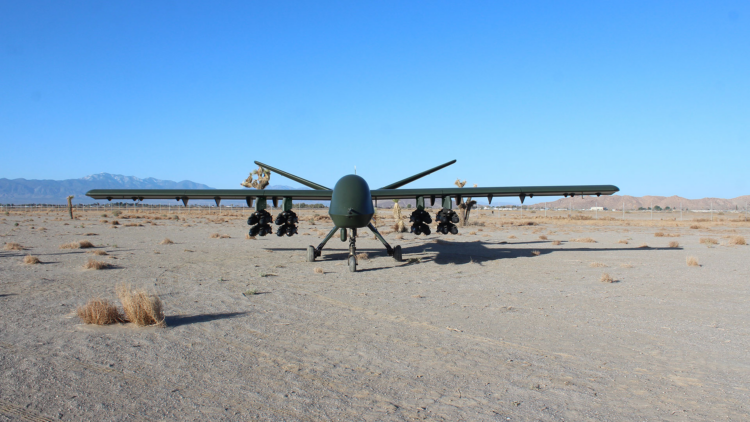
“We knew our STOL capability would enable a UAS to safely take off and land on the Prince of Wales. Seeing our Mojave operate successfully in this environment opens myriad new ways our aircraft can be used to support multi-domain naval operations,” said Blue.
Expanding Capabilities: Mojave and MQ-9B STOL Variant
The Mojave, originally designed as a STOL UAS demonstrator to prove operations at unprepared landing sites, shares key systems and components with GA-ASI’s revered Gray Eagle model.
It is the newest addition to the Predator-series family of UAS, designed for armed overwatch, attack, and armed reconnaissance missions. With these cutting-edge features, the Mojave brings forth a unique blend of capabilities that redefine expeditionary STOL performance.
Moreover, this unmanned aircraft leverages advanced systems derived from the MQ-9B Reaper and MQ-1C Gray Eagle-Extended Range, accumulating over 7 million operational hours, notable in combat scenarios.
Its standout STOL capability enables deployment from semi-improved runways and remote surfaces, potentially including aircraft carriers—which the Royal Navy recently has proven and tested.
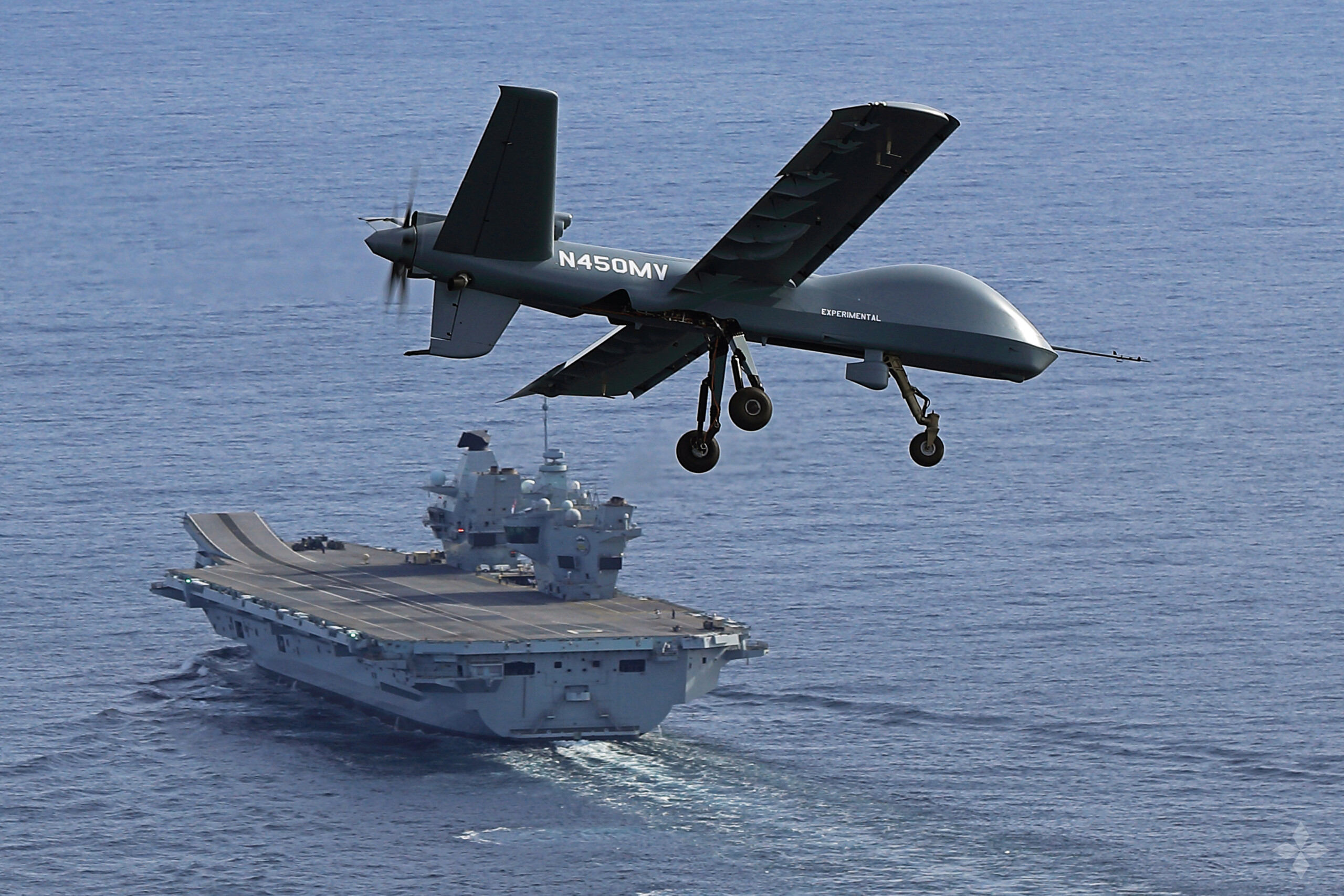
The Mojave’s doubled payload capacity of up to 3,600 lbs (1,633 kg), equivalent to 16 AGM-114 Hellfire missiles, and a versatile sensor suite enhances its efficacy in land and maritime missions.
Additionally, plans are underway to equip the larger, more capable MQ-9B aircraft, which includes SkyGuardian, SeaGuardian, and the new Protector RG Mk 1 delivered to the British Royal Air Force, with an STOL wing set option.
This variant, named MQ-9B STOL, is being considered by navies that operate aircraft from large flat-deck warships without catapults and arresting gear, including the Royal Navy.
General Atomics’ rich history in UAS technology reflects a commitment to innovation, transforming Predator-series UAS from Intelligence, surveillance, and reconnaissance (ISR)–centric platforms to versatile tools capable of both kinetic and non-kinetic operations for superior threat neutralization.
Royal Navy’s Perspective: A New Era in Maritime Aviation
Meanwhile, Rear Admiral James Parkin, Director of development of the Royal Navy, praised the trial as a significant milestone for European maritime aviation.
He highlighted the Mojave trial as the first instance of a remotely piloted air system of this size operating from an aircraft carrier outside of the United States, representing a pivotal moment in the evolution of the Royal Navy’s Carrier Strike Group.
This achievement also signals a transition towards a more versatile and dynamic crewed and uncrewed fighting force.
“The success of this trial heralds a new dawn in how we conduct maritime aviation and is another exciting step in the evolution of the Royal Navy’s Carrier Strike Group into a mixed crewed and uncrewed fighting force,” Parkin said in a statement.
Enhanced Versatility and Operational Scope
The incorporation of STOL capability in UAS presents a paradigm shift, enabling these aircraft to operate in previously inaccessible areas, including the landing and takeoff from aircraft carriers.
The MQ-9B STOL variant is expected to retain the same payload capacity and mission capabilities as the SkyGuardian and SeaGuardian models.
Its versatility spans missions such as maritime surveillance, Anti-Submarine Warfare (ASW), Airborne Early Warning (AEW), and surface strike, augmenting the effectiveness of naval operations.
Conclusion: A New Era in Naval Aviation
In conclusion, General Atomics’ successful demonstration of the Mojave’s STOL capability aboard the HMS Prince of Wales heralds a new era in naval aviation, unlocking unprecedented possibilities for unmanned aircraft to enhance maritime operations’ agility, effectiveness, and reach.
This groundbreaking achievement underscores the relentless pursuit of innovation within UAS technology, propelling naval capabilities to new heights and heralding a future where unmanned aircraft play a pivotal role in securing maritime superiority.
—
Check out:










COMMENTS