

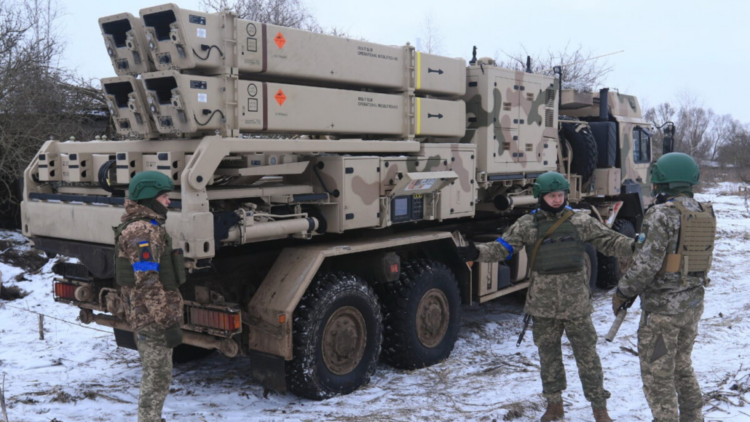
Since its introduction in the mid-2000s, this cutting-edge missile system has proven pivotal in countering airborne targets, including aircraft and missiles, emphasizing their crucial role in Ukraine’s defense strategy.
The IRIS-T system features infrared homing guidance technology capable of tracking and intercepting targets based on their heat signatures. It is also known for its agility, accuracy, and effectiveness in engaging targets within visual range.
Originally designed for fighter jets, particularly for integration with various aircraft platforms across different nations, the IRIS-T system has garnered attention for its reliability and performance in combat scenarios.
Additionally, its adaptability to different aircraft and its capability to counter diverse airborne threats, including maneuverable targets such as drones and sophisticated countermeasures, have contributed to its popularity among military forces seeking enhanced air defense capabilities.
IRIS-T SLM’s Superior Countermeasures Against Stealth Threats
The additional IRIS-T SLM Germany will transfer to Ukraine is a medium-range air defense system variant fielded in 2022.
Each IRIS-T SLM battery includes three truck-mounted launchers carrying eight missiles each, boasting a range of 40 kilometers (25 miles).
It also has a separate command vehicle, positioned up to 20 kilometers (12 miles) away, integrates multiple radar sources, and coordinates the simultaneous launch and tracking of all 24 missiles within the battery.
Notably, the IRIS-T SLM is adept at countering surface-to-air and cruise missiles, including low-flying, stealthy threats like the Russia Kalibr (3M54-1 Kalibr).
Germany’s Role as a Significant Contributor
Germany’s commitment to aiding Ukraine’s defense has been steadfast, with Defense Minister Pistorius’s visit marking the country’s continued support.
Since the conflict’s onset, Germany has maintained its status as a significant supplier of military equipment to Ukraine, demonstrating a consistent effort to bolster the latter’s defense infrastructure.
So far, the German government has sent substantial support to Ukraine’s defenses, including armored vehicles, air defense systems, artillery, engineering capabilities, protective gear, logistics, and combat resources.
Today, I also hosted German Defense Minister Boris Pistorius, who visited not only Kyiv but also Ukraine’s regions to support our people and our warriors.
We discussed Ukraine’s priority defense needs and the further strengthening of our capabilities.
I am grateful to Germany… pic.twitter.com/iVsxpeoUMp— Volodymyr Zelenskyy / Володимир Зеленський (@ZelenskyyUa) November 21, 2023
For the year 2023, funding for security capacity building reaches 5.4 billion euros ($5.89 billion), following a previous allocation of 2 billion euros ($2.18 billion) in 2022.
Furthermore, additional authorizations amounting to 10.5 billion Euros in subsequent years have been approved.
According to a press release statement, these funds primarily focus on providing military assistance to Ukraine while also replenishing Federal Armed Forces stocks for items delivered to Ukraine and contributing to the European Peace Facility (EPF).
Timeline and Delivery Status
The recent announcement of four additional IRIS-T systems represents the third batch provided by Germany since the conflict began.
Notably, three systems from the initial batch have already been delivered, with plans for the fourth system to follow this winter.
Moreover, a second batch comprising four systems is slated for delivery in 2024, reinforcing Germany’s ongoing commitment to fulfilling its aid promises.
~
Germany’s announcement of additional military aid serves as a testament to the nation’s unwavering support for Ukraine’s defense against Russian aggression.
The provision of IRIS-T systems and artillery ammunition underscores Germany’s commitment to enhancing Ukraine’s defensive capabilities amid the ongoing conflict.
As tensions persist, Germany’s continued involvement and contributions signify a crucial alliance in bolstering Ukraine’s resilience against external threats.
This structured approach to the article provides an outline of the critical points and their elaboration, allowing for the development of a comprehensive piece that covers Germany’s commitment to supporting Ukraine’s defense with additional military aid.
—
Check out:










COMMENTS