Tucker Carlson, Nick Fuentes, and the New Politics of Doubt
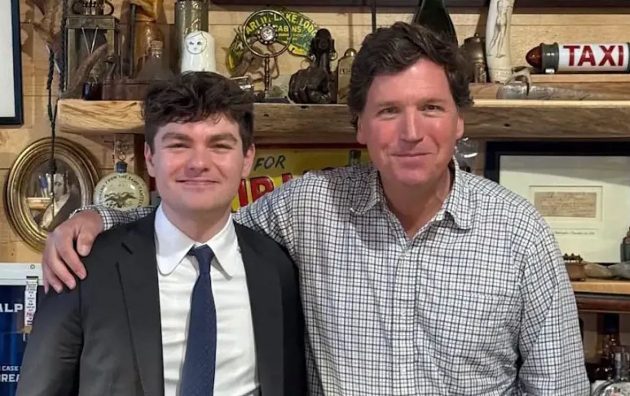
Watching Tucker Carlson argue with Piers Morgan about whether the United States and Britain should have intervened in World War II was no harmless historical digression. It showed how destabilization now works in the media age. Every major platform—from traditional networks to the fast-twitch churn of TikTok—shapes political identity as much as it reports facts. Carlson may not see himself as advancing the narrative of a foreign adversary; at this point that hardly matters. His exchange with Morgan, and his recent appearance with Nick Fuentes, functionally amplify the same revisionist line long favored by regimes that want the West divided, unsure of itself, and exhausted.
Carlson’s claim that America backed “the wrong side” by confronting Nazi Germany was not an exercise in historical curiosity; it was a reframing of the Western project. The Anglophone alliance did not take Berlin. It enabled the Soviets to take it. That distinction does not sanctify Stalin. It reflects the way coalitions behave when fascism threatens half a continent. Yes, Stalin killed more people. The numbers are clear. But it is easy, eight decades removed from the Wehrmacht’s advance, to pretend leaders had the luxury of perfect foresight. They did not.
The contrarian take on 1939–45 is not the real danger; historians debate that era with rigor. The danger lies in the pattern. The same claims now surface across the algorithmic landscape: the Allies were wrong to stop Hitler; the West should never have opposed Moscow; authoritarian regimes abroad are someone else’s problem. These ideas are no longer confined to the fringe. They show up under drone footage from Ukraine, in Instagram reels stripping geopolitics down to cynicism, and in the pseudo-philosophical commentary Carlson has made his calling card.
This erosion creates an ecosystem for smaller creators who amplify the message for clout or monetization. They recycle the same themes: Jews as villains in global affairs; dictatorships as efficient alternatives; democracy as a failed experiment. The packaging changes, but the substance does not. A generation is being taught to treat the principles their grandparents fought to defend as punchlines.
The ideas of Nick Fuentes are repugnant because they reject the moral architecture that makes pluralistic society possible. He has praised Hitler, denied the Holocaust, attacked Jews as a collective enemy, and presented authoritarianism as a cure for Western decay. This is not conservatism or populism. It is a politics of exclusion and hierarchy dressed as rebellion. Any mainstream figure giving this worldview oxygen is not being provocative. He is being reckless.
The wider ecosystem mirrors a tactic the Kremlin has used on its own population for decades: dissolve the idea of truth. If everything is a lie, then nothing is worth defending. If every institution is corrupt, then no institution deserves loyalty. If history is propaganda, then the sacrifices that shaped our national identity lose their meaning. Russia perfected this at home. It is one of the few exports the regime reliably pushes abroad.
The goal is not persuasion. It is exhaustion. Bury people under enough doubt and you hollow out the space where civic identity lives. You do not need Americans to admire authoritarianism. You only need them to stop believing in anything better. A country that cannot anchor itself in a shared story becomes vulnerable to whatever certainty fills the void next. Today that certainty often comes from regimes that see a fractured West as a strategic prize.
I have seen what happens when a society’s center collapses. In Ukraine, it began with corrosion long before the tanks arrived. A decade of narrative warfare convinced millions that their institutions were hopeless, their identity fractured, and their future already slipping away. By the time Russian artillery hit the outskirts of major cities, much of the groundwork had been laid. You can weaken a nation long before you occupy it.
This is where these debates push us—not toward honest inquiry or historical clarity, but toward national self-erasure. If you can make Americans doubt the morality of defeating Nazi Germany, it becomes far easier to make them doubt the value of defending a democracy under attack today. If you can convince them that every Western institution is a scam, you win the strategic contest before a shot is fired.
This is the quiet front of modern conflict: the fight over meaning before the fight over territory. The voices urging Americans to abandon their own story are not foreign propagandists. They are pundits with professional studios, massive platforms, and followings that stretch across generations.
We do not need to silence them. We need to understand what their message does to a country. A nation that stops believing in anything will stand for nothing. And once it reaches that point, it does not need an external enemy to defeat it. It has already done the work itself.
Already have an account? Sign In
Two ways to continue to read this article.
Subscribe
$1.99
every 4 weeks
- Unlimited access to all articles
- Support independent journalism
- Ad-free reading experience
Subscribe Now
Recurring Monthly. Cancel Anytime.










COMMENTS