

The world was surprised by the seemingly unthinkable shoot-down of a U.S. stealth bomber by the Serbs, who achieved a major propaganda coup. But a few weeks later, Serbian air defenses struck again.
“Start Finding Me, Boys”
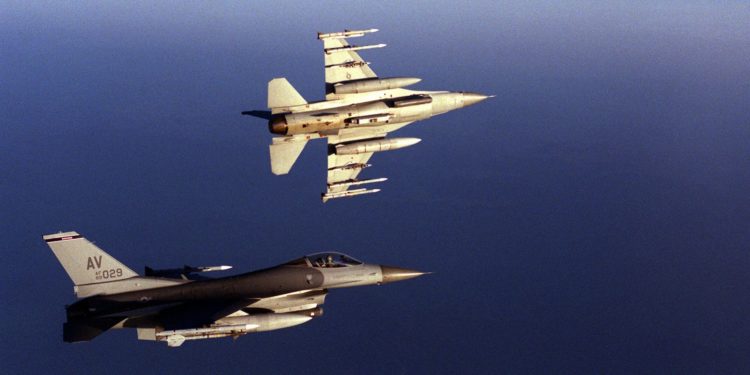
On May 2, 1999, Lt. Col. David Goldfein was flying his F-16 Viper fighter with the call sign “Hammer 34” on a night combat sortie over Serbia, hunting for enemy anti-aircraft missile batteries.
The goal was to establish complete air superiority before targeting Serbian forces en masse.
Goldfein’s unit, the 555th Fighter Squadron, had found a way to target enemy surface-to-air systems by using the F-16’s infrared targeting pod to locate heat signals from the batteries and then using the AGM-88 High-speed Anti-Radiation Missile to destroy them.
Suddenly, a surface-to-air missile struck Goldfein’s F-16, causing considerable damage. At first, the aircraft was still flyable, so Goldfein started to return to base.
“Start finding me, boys,” Goldfein said over the radio as he struggled to keep his jet aloft. Then the engine went out, forcing Goldfein to glide before finally ejecting over Serbian anti-aircraft positions.
Once on the ground, Goldfein started escaping and evading the Serbian forces who were pursuing him. Meanwhile, an Air Force special operations combat search-and-rescue team had launched in helicopters and was coming to his rescue.
On their way in, the rescuers took heavy anti-aircraft fire while trying to determine Goldfein’s exact position. It was a race for time on who would get to the American pilot first.
In the end, it was the U.S. commandos who whisked Goldfein away as the Serbs reached the area and began firing at them.
Goldfein went on to a long career, rising to the rank of four-star general and becoming chief of staff of the Air Force, the service’s top uniformed officer.
“Because of this combat rescue team, I was able to return to my family 20 years ago today,” Goldfein said on the anniversary of his rescue in 2019. “We will always be thankful for their sacrifice and courage. The night I was shot down, Airmen & Soldiers flew through enemy airspace, risking their lives to save mine.”
Interestingly, the same anti-aircraft battery, commanded by Zoltan Dani, a Serbian officer, shot down both U.S. aircraft, and the same U.S. Air Force officer, Lt. Col. Stephan Laushine, commander of the 55th Special Operations Squadron, led both rescue missions.
The Agency Behind the Scenes
Instrumental in the quick recovery of both pilots were the updated procedures put in place after the Gulf War in 1990-1991.
Numerous agencies, including the Joint Personnel Recovery Agency (JPRA), which was created in 1999, led a campaign to update and improve Personnel Recovery and Combat Search-and-Rescue doctrine and procedures.
“The changes we made after the Gulf War directly impacted combat search-and-rescue operations in the Balkans. Take for example Vega 31 and Hammer 34. The CSAR was quick and effective. We managed to get them out without any serious issues. But to get there, we had to do a lot of changes and work,” a retired JPRA officer told Insider.
The JPRA is the agency responsible for the return of U.S. troops and government employees trapped in non-permissive or semi-permissive spots. Its primary customers are Air Force pilots, special operations troops, and the intelligence community.
“During planning, we ensure we can get everyone out. It does require additional work, but it’s worth every minute,” the retired JPRA officer said.
There is always a combat search-and-rescue and personnel recovery window for every air sortie or special operations mission, especially in a semi- or non-permissive area of operations.
Although that requirement can be restrictive and seen as risk-averse, it provides peace of mind to pilots and commandos, knowing that someone is coming for them if the worst happens.








COMMENTS