

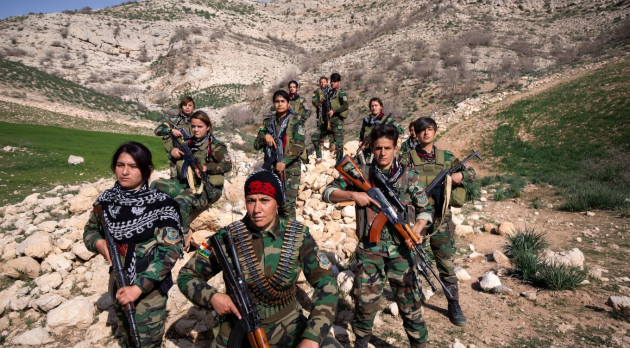
What comes out of Iran after Operation Epic Fury concludes remains uncertain. What is less mysterious is the composition of the regime’s opposition. The resistance to the Islamic Republic is not a unified movement. It is a patchwork of factions with very different goals, levels of organization, and willingness to use violence.
Some operate in exile. Some operate in the streets. A few operate with rifles in the mountains.
To understand whether regime change in Iran is even plausible, it is necessary to examine who these actors actually are and what they are capable of.
Kurdish Armed Movements: The Only Organized Insurgents
Among the factions opposing Tehran, Kurdish militant organizations represent the only groups with a sustained tradition of armed insurgency.
Several Kurdish parties maintain guerrilla formations along Iran’s northwestern frontier, operating largely from bases in Iraqi Kurdistan. The most prominent organizations include the Democratic Party of Iranian Kurdistan, PJAK, and factions of Komala.
Collectively these groups field an estimated 1,500 to 3,000 fighters.
Their operations are typical of small insurgent movements: ambushes, cross-border infiltration, sabotage attacks, and sporadic clashes with Iranian security forces. Kurdish fighters are experienced in mountain warfare and have maintained insurgent networks for decades.
Measured purely by battlefield competence, Kurdish militants are likely the most operationally capable armed opposition associated with Iran.
Yet that capability exists within strict limits, and the risk of political backlash is significant. Iran’s relationship with Kurdish communities is historically complicated, and an armed Kurdish uprising could ignite nationalist sentiment across the country. Rather than fracturing the state, such a conflict might reinforce the regime’s claim that it is defending Iran’s territorial integrity.
Force Balance: Kurdish Fighters vs. Iranian Security Forces
Even if Kurdish militant groups attempted to escalate their operations, they would face a stark imbalance in manpower and resources.
Iran’s internal security architecture is built around the Islamic Revolutionary Guard Corps and its auxiliary paramilitary network, the Basij.
The IRGC Ground Forces alone are estimated to include roughly 100,000 personnel, with additional regional brigades tasked with counterinsurgency operations in Kurdish provinces.
That means Iranian security forces likely outnumber Kurdish insurgents by an order of magnitude.
Iranian units possess helicopter mobility, artillery support, hardened bases, and extensive intelligence networks. Kurdish fighters, by contrast, rely primarily on light weapons and mountainous terrain.
This does not make insurgency impossible. Guerrilla warfare has historically thrived in such terrain. But it does limit what Kurdish groups could realistically achieve without substantial outside assistance.
A Long Memory of Abandonment
Kurdish skepticism toward outside patrons is shaped by a long historical memory.
During the early 1970s, Kurdish forces led by Mustafa Barzani received covert assistance from Iran and the United States in a rebellion against Iraq. The effort collapsed abruptly in 1975 when Iran and Iraq signed the Algiers Agreement, ending Tehran’s support for the Kurdish uprising.
With Iranian backing gone, American assistance vanished as well.
Barzani wrote to Washington in desperation as the rebellion collapsed:
“Our movement and people are being destroyed in an unbelievable way with silence from everyone.”
A subsequent congressional investigation into the operation concluded bluntly that “even in the context of covert operations, ours was a cynical enterprise.”
Secretary of State Henry Kissinger later defended the decision with a remark that has echoed in Kurdish political discourse ever since:
“Covert action should not be confused with missionary work.”
Episodes like this explain why Kurdish movements often approach Western promises with caution.
The dynamic repeated itself during the Syrian war against ISIS. Kurdish fighters formed the backbone of the ground campaign that dismantled the caliphate, operating alongside U.S. forces and receiving American air support.
Yet the alliance existed within geopolitical constraints.
Turkey, a NATO member, views Kurdish militant groups tied to the PKK as terrorist organizations. Turkish concerns about Kurdish autonomy have repeatedly shaped U.S. policy in Syria.
For Kurdish leaders, these episodes reinforce a familiar lesson: partnerships with outside powers are tactical and temporary.
Monarchists and the Diaspora Opposition
If Kurdish militants represent the most capable fighters, monarchists represent the most visible political opposition.
The central figure of this movement is Reza Pahlavi, son of the last Shah, Mohammad Reza Pahlavi.
Pahlavi has attempted to position himself as a transitional political figure rather than an autocratic monarch, advocating for a democratic referendum that would allow Iranians to decide their future system of government.
Support for the monarchist movement is strongest within the Iranian diaspora across North America and Europe. In exile communities, the Pahlavi name retains symbolic resonance as a reminder of Iran’s pre-1979 modernization.
Inside Iran, however, the movement lacks an organized military wing or institutional infrastructure capable of challenging the state.
This creates a paradox.
Monarchists possess visibility, international connections, and financial resources. But they lack the armed networks typically associated with revolutionary movements.
(Author’s note: An absolute banger of a protest anthem. The London-based Iranian rapper 021Kid released this track, which circulated widely across Instagram and helped energize diaspora demonstrations in January while the regime was violently suppressing protests inside Iran.)
View this post on Instagram
The Fragmented Pro-Democracy Movement
The largest opposition force inside Iran is neither Kurdish insurgents nor the monarchists. It is the diffuse network of civil protest movements that have periodically erupted across the country.
Major protest waves over the past two decades have mobilized millions of Iranians demanding political reform, economic relief, or systemic change.
Yet these movements share a central weakness: they lack centralized leadership.
Prominent reformist figures such as Mir-Hossein Mousavi have spent years under house arrest, and newer protest movements have relied on decentralized organization rather than formal political structures.
Without leadership, underground networks, or armed protection, these movements remain vulnerable to repression by Iran’s internal security apparatus.
The result is a resistance ecosystem in which the factions with the broadest public support possess the least military capability. At least for now. Whether outside powers attempt to alter that balance is unclear. The United States previously supported and trained Syrian rebel groups through regional programs, an effort that ultimately demonstrated how quickly such initiatives can produce unintended consequences.
The Limits of Air Power
This brings us back to the question raised at the beginning of this article.
Air power can weaken a regime. It can destroy military infrastructure and degrade the ability of security forces to operate. What it cannot do is construct the political alternative that must ultimately replace a regime.
Given what we know about the current Iranian resistance landscape, that alternative remains uncertain.
The aspiration for a freer Iran is real. Millions of Iranians have risked their lives to express it. But aspirations alone do not produce political transitions.
History suggests that slogans are rarely enough to dismantle entrenched security states.
If Iran is ever to move toward a different political future, it will not be because bombs fell from the sky. It will be because Iranians themselves created a political movement capable of replacing what came before.
At the moment, that movement remains fragmented.
The Worst-Case Scenario
Strategists often discuss the best-case scenario in which sustained military pressure weakens Tehran and eventually opens space for a democratic transition. But serious analysts also consider the opposite outcome.
A recent analysis in War on the Rocks outlines a darker possibility: sustained strikes and economic collapse could fracture Iran into competing armed factions rather than producing a coherent successor government. In such a scenario, separatist movements, militant networks, and rival security forces could compete for power across different regions of the country.
The result would not resemble a clean political transition. It would resemble fragmentation.
Iran is not Libya, but it is also not immune to the dynamics that have destabilized other states following the sudden collapse of centralized authority. With a population of ninety million people and a strategic location at the center of the Middle East, the consequences of such instability would extend far beyond Iran’s borders.
A fractured Iran could produce large refugee flows, disrupt global energy markets, destabilize neighboring states, and create new openings for extremist groups seeking to exploit chaos.
For policymakers and observers alike, this raises the question that matters most.
The issue is not simply whether the Islamic Republic can fall.
The issue is what replaces it.








COMMENTS