

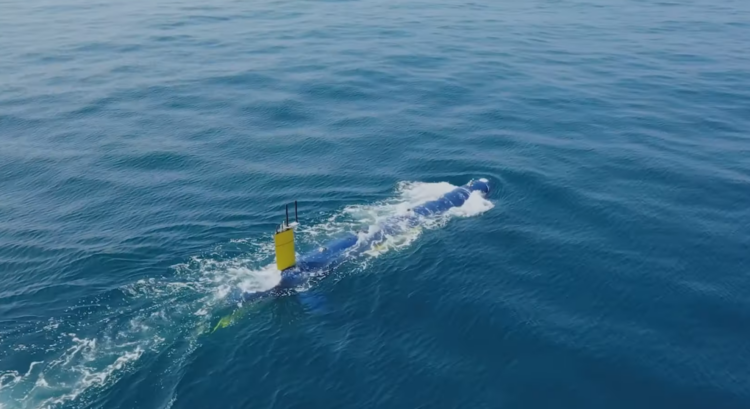
IAI’s BlueWhale Submarine
Israel first introduced BlueWhale AUV in 2022, intending to use the unmanned submarine for covert intelligence-gathering missions, intelligence gathering, mine detection, anti-submarine warfare, and other maritime operations.
Its features include an electric motor, various sophisticated sensors, and a communication system allowing it to transmit real-time data.
The submarine can reportedly reach a maximum speed of 7 knots (8 miles/h) and an endurance of around 2-3 weeks of autonomous operation of up to 1,000 nautical miles without refueling. In addition, it can effectively perform deep water dive more or less 19,700 feet (6,000 meters) below the surface. It is portable and can fit in a 40 ft (12 m) shipping container.
IAI and Atlas Elektronik to develop "BlueWhale" unmanned submarine for detecting underwater threats.#IADN pic.twitter.com/G3G9SVkebm
— News IADN (@NewsIADN) May 11, 2023
The BlueWhale AUV has a telescopic mast equipped with radar and an electro-optical system, providing superior stability than traditional masts. Its design incorporates versatility, compactness, and ease of transport, enabling easy extension and retraction for detecting sea and coastal targets. This design feature also minimizes the possibility of damage caused by high winds. Through this mast, the LAUV will be able to gather critical information, which satellite communications will transmit in real-time to command posts stationed anywhere in the world.
Other notable features in this sophisticated LAUV include sonars: towed and flank array, capable of receiving information on both sides of the platform to support submarine detection and acoustic intelligence-gathering data. Furthermore, naval forces consider these two sonars a must-have warfare tool as they enable the detection and tracking of both enemy and friendly ships and submarines.
Meanwhile, the BlueWhale AUV can perform mine detection through a dedicated synthetic aperture sonar (SAS) and ensures safe transit underwater and near the sea surface with its sensor suite.
The Quest for Autonomy
Israel’s defense industry has been thriving for years, becoming a hub for several innovative companies specializing in developing military equipment, including submarines.
The country’s first exploration of AUV began with the Dolphin-class submarine, built by a German shipbuilding company in the 1980s. Back then, the ship class subs were powered by air-independent propulsion (AIP), allowing the vehicle to operate underwater for extended periods, and featured several types of sensors and weapons like torpedoes and missiles.
The new millennium came, and with it, the new Sa’ar 6-class submarine of the Israeli Navy, which was bigger and better than its predecessor thanks to a new version of the AIP system that allowed even way more extended periods underwater.
The arrival of the BlueWhale AUV indicated not only progress in the modernization of its Navy but also a boost in Israel’s military capabilities. Like most of the countries that seek to upgrade to a more powerful, more capable, and reliable autonomous submarine, Jerusalem also strives to achieve these benefits to reduce the risk of its men, increase operational flexibility, cost reduction, and improve intelligence gathering, particularly in high contested areas that manned subs usually cannot reach.
Overall, the BlueWhale AUV can potentially become a powerful military asset in the Israeli Navy’s arsenal, enhancing the efficiency of its naval fleets by serving as a force multiplier for various maritime operations and interests.
—
Book Recommendation: Check out “The Submarine and the Spies” by Jane Hampton Cook, an enthralling historical fiction novel about friendship and vigilance during the American Revolution in 1776.








COMMENTS