

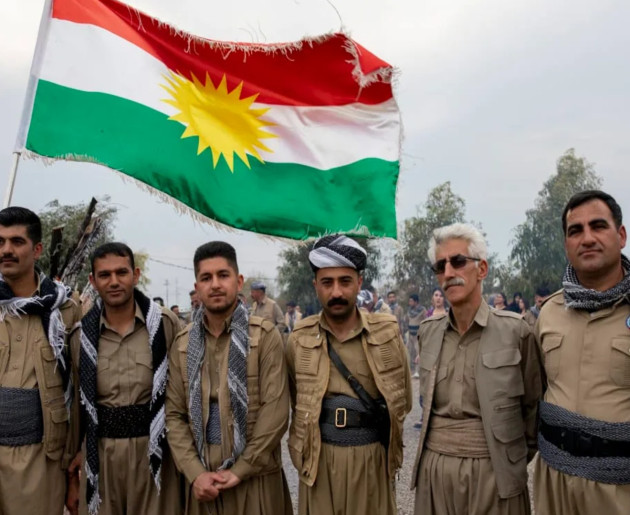
Kurdish militant groups have long been viewed by Tehran as potential conduits for outside influence. Several organizations operating in Iraqi Kurdistan advocate autonomy or regime change inside Iran’s Kurdish regions. Iranian officials accuse these groups of coordinating with external intelligence services, though those claims remain contested.
The current strikes signal that Iran is prepared to act beyond its borders when it believes threats are emerging from neighboring territory. Iraqi officials have historically protested such operations, arguing they violate Iraqi sovereignty, though Baghdad has limited capacity to control all armed factions operating in remote northern regions.
Kurdish Opposition Groups Signal Broader Ambitions
The strikes also come amid growing discussion among Kurdish opposition movements about expanding their role inside Iran.
Several Kurdish political organizations operating from Iraqi Kurdistan have indicated they may seek to coordinate broader action against Iranian security forces in Kurdish-majority areas inside the country. Among the most prominent of these groups is the Democratic Party of Iranian Kurdistan (PDKI), one of the oldest Kurdish political movements in Iran and a long-standing opposition organization with deep roots among Iran’s Kurdish population.
The PDKI has historically advocated autonomy or federal arrangements within Iran rather than full independence. Its leadership has argued that armed resistance may become necessary if peaceful political reform remains unattainable.
Other Kurdish organizations are also involved in discussions about cooperation. The Komala Party of Iranian Kurdistan, another established Kurdish opposition group with a more left-leaning orientation, has recently joined discussions about forming a broader coalition among Kurdish factions.
Many of the fighters associated with these groups are Iranian Kurds who have lived for years in exile or within cross-border militant networks based in northern Iraq. Their proximity to Iran’s Kurdish regions has long made them a potential internal pressure point for the Iranian government.
Debate Over External Support and Strategic Risks
Claims circulating among some opposition figures suggest that outside funding or logistical support could be directed toward Kurdish militant organizations seeking to expand operations. Such claims remain difficult to independently verify, and Western officials have not confirmed any direct involvement.
The possibility of an armed Kurdish insurgency raises complex political questions inside Iran. Kurdish parties command meaningful support in Kurdish-majority provinces, but their influence remains largely regional. Many Iranian opposition figures outside Kurdish communities fear that empowering ethnic militias could trigger fragmentation or internal conflict.
Iranian authorities have repeatedly warned that they would respond aggressively to cross-border militant activity. The Islamic Revolutionary Guard Corps has previously targeted Kurdish opposition bases in Iraqi Kurdistan with missile and drone strikes, arguing that such groups represent a direct security threat.
(Editor’s Note: As of 02:45 EST on March 5, 2026, no official statements have been issued by the U.S. government confirming a ground operation. However, a U.S. official speaking informally with Fox News indicated that such an operation may be underway. Details remain unclear and have not been independently verified.)
Pentagon Says U.S. Munitions Stocks Sufficient for Ongoing Operations
Pentagon officials said this week that U.S. forces currently have sufficient munitions to sustain ongoing operations against Iran despite concerns about the pace of missile and interceptor usage during the early stages of the conflict. Senior defense officials stated that both offensive and defensive stockpiles remain adequate for current operational requirements, while declining to discuss specific quantities for operational security reasons.
Military leaders acknowledged that the campaign has involved extensive use of precision weapons and air defense interceptors as Iranian forces launched hundreds of ballistic missiles and thousands of drones during the opening phase of the confrontation. Officials said the United States retains enough precision munitions to continue prosecuting the campaign, though analysts note that prolonged operations could eventually place pressure on missile inventories and defense industrial production capacity.
Ukraine Offers Drone Interception Expertise to Gulf States
Ukraine has offered to share its battlefield experience countering drone attacks with Gulf states facing similar threats from Iranian unmanned systems. Ukrainian officials say the country’s air defense forces have developed extensive operational knowledge intercepting large numbers of drones during the war with Russia, particularly Iranian-designed Shahed systems used in mass attack waves.
Kyiv has signaled that this expertise could be transferred to partners in the Middle East through training, operational guidance, and technical cooperation. Ukrainian defense officials argue that years of defending cities and infrastructure from drone barrages have produced practical experience that could help other countries improve air defense networks against low-cost unmanned threats.
The proposal reflects Ukraine’s growing effort to translate wartime technological experience into defense partnerships abroad. Gulf states, many of which already face missile and drone threats from Iranian-aligned groups, are viewed as potential partners for cooperation in counter-drone defense and early-warning systems.
The Pentagon and at least one Gulf government are in talks with Ukraine to buy Ukrainian drone interceptors -FT
The countries are looking to Ukraine’s low-cost options for shooting down Iranian attack drones. pic.twitter.com/o8slzO2VXu
— OSINTtechnical (@Osinttechnical) March 5, 2026
Drone Strike Reported on Azerbaijani Territory
A drone struck Azerbaijani territory near the border with Iran this week, according to Azerbaijani officials, raising concerns that the expanding regional conflict could spill into the South Caucasus. Authorities said the unmanned aircraft impacted in the country’s southern region, though initial reports did not indicate large-scale damage or casualties.
Officials said the incident is under investigation as security services work to determine the origin of the drone and whether it crossed the border during ongoing military activity linked to the Iran conflict. The development has heightened alert levels along Azerbaijan’s southern frontier as regional governments monitor the possibility of further cross-border incidents.

Expanding Pressure Across the Latin American Front
Large sections of Cuba lost electricity this week after a failure at the Antonio Guiteras thermoelectric plant triggered a cascading collapse across the island’s already fragile national grid. The blackout left Havana and much of western Cuba without power, forcing emergency measures to stabilize the system while authorities began a slow process of restoring electricity.
Cuba’s electrical infrastructure has been operating near its limits for years. Much of the country’s generation capacity relies on aging thermoelectric plants, many built during the Soviet period and now running with limited maintenance and scarce spare parts. Chronic fuel shortages have compounded the problem. The result has been a pattern of recurring outages, rolling blackouts, and growing instability across the national grid.
Grid Failure Triggers Nationwide Blackout
The collapse appears to have begun when the Antonio Guiteras plant abruptly shut down following a technical failure, reportedly linked to a boiler malfunction. Grid operators responded by disconnecting additional plants to prevent equipment damage and stabilize the remaining network.
Those defensive shutdowns accelerated the loss of electricity and spread outages across multiple provinces. Within hours, much of western Cuba was without power.
Electricity authorities moved to isolate sections of the grid and gradually restart generators as engineers worked to stabilize supply. Restoration has been uneven. Some areas regained limited service within hours, while others faced extended outages as the system attempted to rebalance production and demand.
For ordinary Cubans, the blackout immediately disrupted daily life. Refrigeration systems shut down in residential neighborhoods. Traffic signals and public transportation slowed or stopped in urban areas. Hospitals and other critical facilities switched to backup generators while authorities prioritized restoring electricity to essential infrastructure.
Two-thirds of Cuba, including Havana, hit by blackout.
Daily power outages of up to 20 hours are the norm in parts of the island, which lacks the fuel needed to generate powerhttps://t.co/9nWIis5SwJ pic.twitter.com/JJWBfUJSB7
— AFP News Agency (@AFP) March 5, 2026
Energy Shortages Reflect Structural Economic Strain
The grid collapse reflects deeper economic pressures facing the Cuban government. Fuel imports have become increasingly difficult to secure as financial constraints and sanctions complicate procurement. Limited access to foreign currency has also restricted the island’s ability to purchase spare parts needed to maintain aging power plants.
Electricity shortages have therefore become a structural feature of the Cuban economy rather than an isolated technical problem. The grid operates with minimal reserve capacity, meaning the loss of a single major plant can trigger widespread disruption.
Authorities have frequently imposed scheduled power cuts in recent years to conserve fuel and maintain system stability. Since late 2024 the island has experienced several large-scale grid failures alongside frequent rolling outages. The latest blackout underscores how fragile the system has become.
Tourism Collapse Tightens Cuba’s Hard-Currency Crisis
Tourism, a key source of foreign currency for Cuba, has declined sharply over the past year, particularly among Canadian visitors, historically the island’s largest tourist group. Total arrivals in 2025 fell to roughly 1.8 million, far below pre-pandemic levels that once exceeded four million.
The drop is worsening Cuba’s economic strain. Tourism provides hard currency used to import food, fuel, and industrial goods, and declining revenues are making it harder for the government to finance fuel purchases needed to keep the country’s fragile energy system running.
U.S. Security Operation Expands in Ecuador
While Cuba faces mounting economic strain, another development in the region highlights a different dimension of pressure across Latin America.
Washington has authorized expanded security cooperation with Ecuador aimed at assisting the country’s campaign against powerful criminal organizations operating across its territory.
The effort focuses on intelligence sharing, surveillance support, and operational coordination targeting drug-trafficking networks. U.S. personnel are expected to operate alongside Ecuadorian security forces in supporting roles, assisting with intelligence analysis and operational planning.
Ecuador has emerged as a major transit corridor in the global cocaine trade. Criminal organizations exploit the country’s Pacific ports and container shipping infrastructure to move narcotics toward international markets.
Violence tied to those networks has surged in recent years. Ecuador has experienced prison riots, assassinations, and coordinated attacks linked to competing criminal groups.
Authorities have repeatedly declared security emergencies while deploying the military to assist police operations. The expanded partnership with Washington reflects the government’s effort to strengthen its capacity to disrupt trafficking networks and restore state control over critical infrastructure.








COMMENTS