The U.S. is in exploratory talks with Iranian Kurdish armed groups for potential coordinated ground operations in western Iran as Iran expands its attacks on American diplomatic targets. This shift could introduce a ground dimension to the ongoing conflict, which has primarily involved airstrikes.
Key points from this article:
The U.S. is discussing intelligence sharing and logistical support with Iranian Kurdish groups for potential operations against Iranian security forces along the Iraq-Iran border.
How the U.S. engagement with Kurdish forces could pressure Iran to divert Revolutionary Guard units from other operations, potentially altering the conflict dynamics.
Why the escalation of Iranian attacks on U.S. diplomatic facilities marks a significant shift in the conflict, prompting heightened security measures at American embassies and consulates in the region.
Updating summary...
Morning Brief: Kurds Weigh Ground Operations in Iran as Asian Markets Plunge and Russia Faces Heightened Geopolitical Pressure
Benjamin Reed
Speed
1x
Listen
COMMENTS
U.S. discussions with Iranian Kurdish forces highlight possible ground ops; Asian stocks slump on oil shock; Russia feels rising diplomatic pressure amid widening Iran conflict.
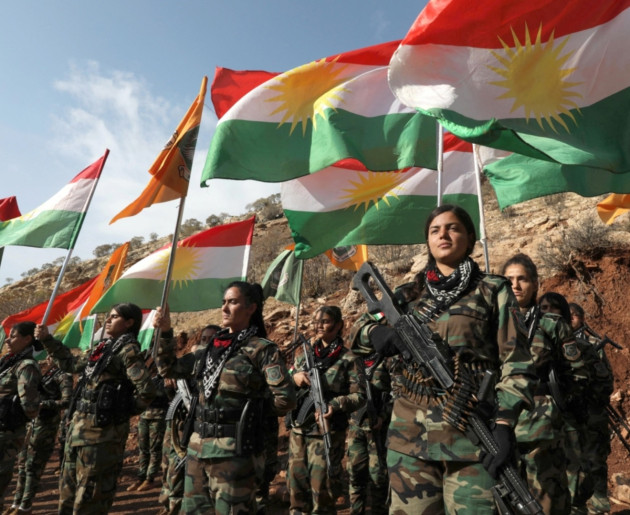
Fighters from the Kurdish Peshmerga affiliated with the Iranian separatist Kurdistan Freedom Party stand at a military base near Erbil, Iraq. Photo: AFP
U.S. Explores Kurdish Ground Option as Iran Expands Attacks on American Diplomatic Targets
The United States is holding active discussions with Iranian Kurdish armed groups about the possibility of coordinated ground operations inside western Iran, as Tehran broadens its retaliation to include American diplomatic facilities in the Middle East.
Advertisement
Officials familiar with the talks say the engagement remains exploratory but has intensified over the past 24 hours. The discussions focus on intelligence sharing, logistical corridors, and potential material support for Kurdish formations positioned along the Iraq–Iran border. No U.S. ground troops are slated for deployment, and no cross-border assault had begun as of early Wednesday.
The talks come as the joint U.S.–Israeli air campaign against Iranian military infrastructure enters a sustained phase. Over the past day, U.S. and Israeli aircraft have continued strikes against missile storage sites, air defense batteries, and command facilities across multiple provinces. U.S. military leadership has described the tempo as steady and deliberate, aimed at degrading Iran’s retaliatory capacity while avoiding civilian infrastructure where possible.
The Kurdish option represents a potential shift from stand-off strikes toward localized ground pressure.
Advertisement
Kurdish Ground Variable Under Active Review
Iranian Kurdish groups operating from Iraqi territory maintain light infantry forces capable of conducting cross-border raids against security installations in Iran’s western provinces. These units possess detailed familiarity with mountainous terrain along the Zagros range and have historically carried out limited insurgent activity against Iranian security forces.
Officials briefed on the talks describe the current phase as contingency planning rather than imminent execution. Kurdish leaders have requested intelligence support and defensive materiel, arguing that coordinated pressure could force Tehran to divert Revolutionary Guard units away from other operational priorities.
Advertisement
Any Kurdish engagement would likely consist of targeted strikes against local security posts, IRGC facilities, or lines of communication rather than attempts to seize major urban centers. Sustained territorial control would require force levels beyond current Kurdish capacity.
Iranian state media has warned that external backing for armed Kurdish groups would constitute direct aggression. Security forces in western provinces have reportedly increased patrols and force readiness in response to the reporting of U.S.–Kurdish contacts.
The decision calculus remains fluid. Kurdish participation would introduce a ground dimension into a conflict that has thus far been dominated by airpower and missile exchanges.
Advertisement
Internal Security Pressure Inside Iran
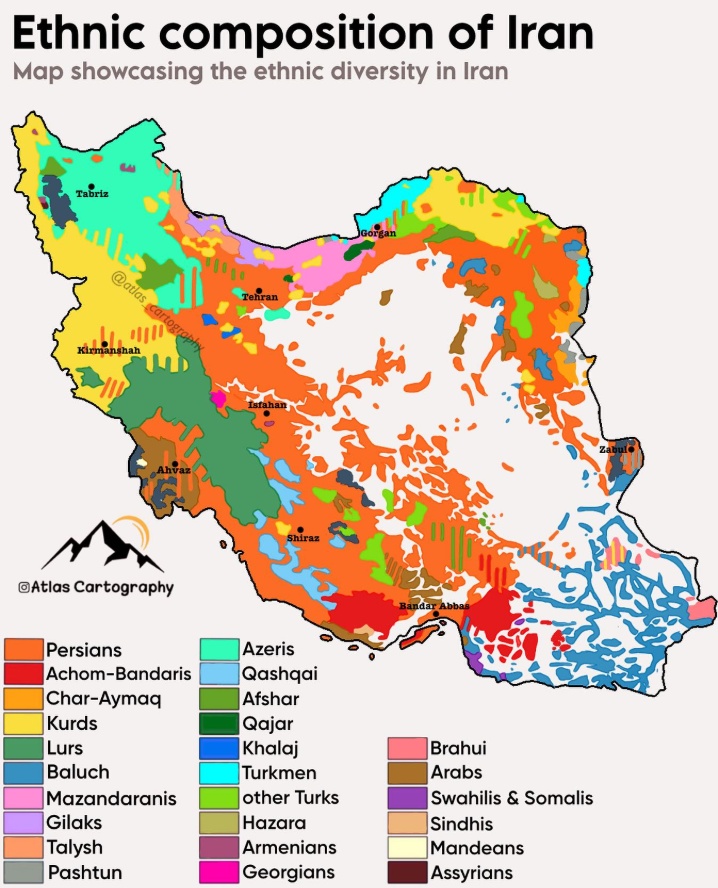
Security forces in western Iran have reportedly increased checkpoints and internal patrols amid concern over potential Kurdish mobilization. Iranian authorities have historically treated Kurdish provinces as sensitive security zones and have deployed Revolutionary Guard units there during periods of unrest.
There are no confirmed reports of coordinated Kurdish incursions as of publication. However, the intensification of U.S.–Kurdish discussions signals that Washington is evaluating ground-based leverage alongside continued air operations.
For military planners, the question is whether localized Kurdish operations would materially alter Iran’s force allocation or merely harden Tehran’s internal security posture.
Map showing the ethnic composition of Iran. Source: Instagram @atlas_cartography.
Iran Targets U.S. Diplomatic Infrastructure
Within the last 12 hours, Iran has expanded its retaliation beyond military facilities, striking near American diplomatic compounds in the region.
U.S. officials confirmed that Iranian missiles and drones targeted areas in proximity to U.S. diplomatic facilities in at least two Middle Eastern capitals. Damage assessments remain ongoing. There have been no confirmed fatalities among diplomatic staff, but protective protocols were activated and personnel were moved to hardened positions.
The strikes follow earlier Iranian attacks on U.S. military bases in the Gulf and come amid heightened security postures at American embassies and consulates across the region.
State Department officials described the attacks as deliberate attempts to broaden the theater of pressure. Emergency response teams were deployed, and additional security elements have been placed on standby.
The targeting of diplomatic infrastructure marks a notable escalation. While embassies and consulates operate under layered security frameworks, missile or drone impacts near such facilities carry political as well as operational implications.
Regional Airspace and Force Protection Measures
Airspace across portions of the Gulf remains restricted following renewed missile activity overnight. Several regional governments have issued updated advisories, and commercial carriers continue rerouting traffic away from high-risk corridors.
U.S. Central Command has raised force protection levels at installations throughout the region. Additional missile defense systems remain active, and naval assets in the Gulf have adjusted posture amid ongoing Iranian threats.
Iranian officials have continued public messaging framing U.S. and Israeli operations as acts of aggression and have warned of further retaliation if strikes persist.
Israeli F-35 Shoots Down Iranian Yak-130
An Israeli F-35 fighter jet shot down an Iranian Yak-130 aircraft during ongoing operations, according to Israeli defense reporting. The Yak-130, primarily an advanced trainer capable of light attack missions, was intercepted in contested airspace. The incident marks a rare air-to-air engagement in the current conflict and underscores Israel’s continued reliance on fifth-generation aircraft to maintain aerial superiority.
(Editor’s note: Reporting remains preliminary as of 0400 EST on March 4, 2026. If confirmed, this would mark the first air-to-air kill by an F-35 against a piloted enemy aircraft.)
The IDF says an Israeli Air Force F-35I shot down an Iranian Yak-130 over Tehran just a little while ago. pic.twitter.com/fmApscSEiz
Overnight, U.S. and Israeli aircraft struck additional Iranian missile launch sites and storage depots. Defense officials said the campaign has significantly degraded portions of Iran’s integrated air defense network, though Iran retains substantial retaliatory capability.
Military planners are assessing Iranian force disposition following the strikes. The focus remains on limiting Tehran’s ability to project missile and drone attacks while avoiding rapid escalation into a broader regional ground conflict. As of Wednesday morning, the conflict remains defined by sustained airstrikes, expanding Iranian retaliation, and active consideration of proxy ground options along Iran’s western frontier.
The U.S. administration has increased briefings to congressional leadership as the operational scope expands. Pentagon officials emphasize that current objectives center on degrading Iranian military infrastructure rather than territorial occupation.
US/Israeli airstrike this morning in Tehran, targeting an Iranian site in the government and military-heavy District 4. pic.twitter.com/uWKAM0aj9n
Qatari authorities announced the arrest of 10 individuals accused of participating in an alleged espionage network linked to Iran, according to state-aligned Gulf reporting within the past 24 hours. Officials said the suspects were detained following a counterintelligence operation targeting what investigators described as surveillance and information-gathering activities connected to sensitive infrastructure and diplomatic facilities.
Doha has not publicly detailed the nationalities of those arrested but stated that the case involves coordination with regional security partners.
The arrests come amid heightened Gulf security conditions following Iranian missile and drone activity across the region, underscoring concerns among U.S.-aligned states about covert Iranian operations operating alongside overt military escalation.
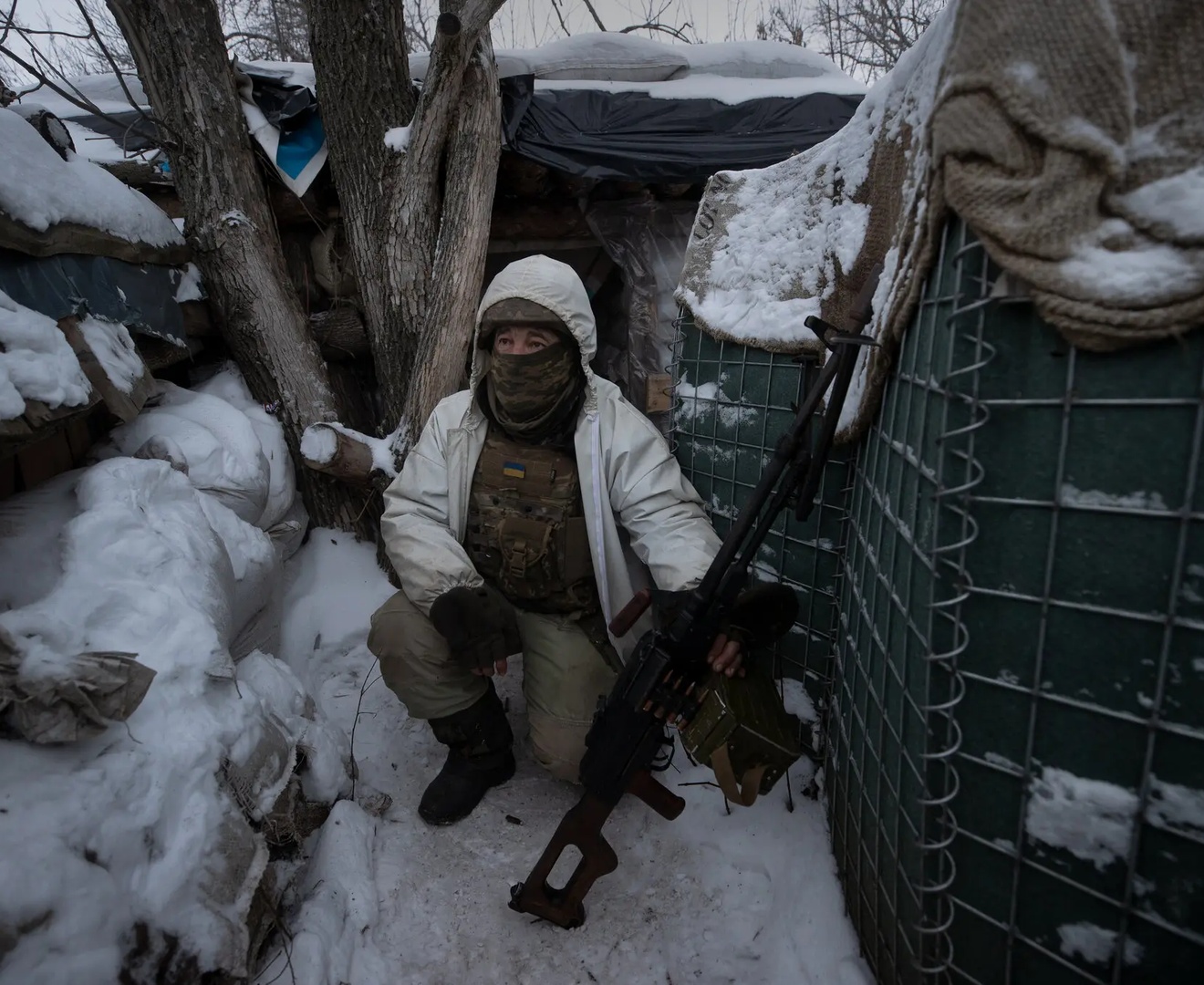
A Ukrainian soldier at a frontline position in eastern Ukraine. Photo: Tyler Hicks/The New York Times
Moscow Maintains War Effort as Global Pressures Mount
Russia continues military operations in eastern Ukraine while publicly maintaining that negotiations remain in its interest, even as a broader U.S.–Israeli military campaign unfolds against Iran.
Kremlin officials in recent days reiterated that dialogue with Ukraine would serve Russian interests. Those statements come as combat activity remains concentrated along established front lines in the Donetsk region.
The widening conflict in the Middle East has generated commentary inside Russia’s political sphere. Some nationalist figures have argued that expanded U.S. military engagement elsewhere could affect Western focus on Ukraine. However, there has been no formal Kremlin announcement linking developments involving Iran to any change in Russian military posture in Ukraine.
Moscow continues to frame the war as a long-term security confrontation centered on Ukraine’s relationship with Western institutions.
Hardline Commentary Without Policy Shift
Russian nationalist commentators have called for intensified operations in Ukraine amid rising global tensions. Their statements suggest that Western political and military attention may be divided across multiple theaters.
There has been no public directive from the Kremlin announcing operational acceleration tied to those developments.
Russian officials have not declared additional mobilization measures, force expansions, or new campaign objectives in response to events in the Middle East.
Military production and force generation systems remain structured around sustaining ongoing operations rather than launching a sudden large-scale offensive.
Incremental Advances Continue in Donetsk
Combat activity remains concentrated in eastern Ukraine, particularly in Donetsk oblast.
Russian forces continue gradual advances in sectors near Lyman and along the Pokrovsk axis. Operations rely heavily on artillery, glide bombs, and drone-supported infantry assaults against entrenched Ukrainian defensive positions.
The pace of advance remains incremental.
There is no indication of a marked acceleration in Russian operations following recent geopolitical developments outside the theater.
Ukrainian forces continue defensive operations aimed at slowing Russian progress while preserving manpower and equipment. The conflict remains defined by trench systems, layered fortifications, and sustained artillery exchanges.
Negotiation Signaling Persists
Russian officials continue to state that negotiations remain possible under conditions they describe as addressing the underlying security structure of the conflict.
Kyiv and its Western partners reject those terms.
Maintaining negotiation language allows Moscow to preserve diplomatic positioning while continuing combat operations.
At present, battlefield geography and operational tempo remain consistent with recent months.
The war continues along established lines.
Kabukicho in the Shinjuku district of Tokyo, Japan. Photo: Starcevic/Getty Images
Asian Equities Slide as Energy Shock Ripples Across Region
Asian markets sold off sharply Wednesday as escalating conflict involving Iran pushed oil and natural gas prices higher and injected fresh volatility into regional currencies and equities.
South Korea’s Kospi index recorded one of its steepest single-day declines in years, triggering market circuit breakers as investors exited risk assets. The Korean won weakened significantly against the U.S. dollar, reflecting concerns over the country’s heavy dependence on imported energy. Technology and export-oriented shares led the downturn.
Japan’s Nikkei index and benchmarks in Hong Kong and Taiwan also moved lower. Investors cited rising crude prices and uncertainty surrounding maritime transit routes as key drivers of the risk-off shift.
Energy markets remain the central transmission mechanism of the crisis. Brent crude traded near multi-month highs as concerns mounted over shipping security through the Strait of Hormuz, a maritime chokepoint that handles roughly one-fifth of global oil and liquefied natural gas flows.
Insurers and shipping firms have reassessed transit risk following Iranian strikes and heightened naval activity in the Gulf. Even without a formal closure of the strait, elevated threat levels have increased freight costs and introduced a geopolitical risk premium into oil contracts.
For Asian economies, which rely heavily on Gulf energy imports, even temporary supply disruptions translate directly into higher input costs for manufacturing, transportation, and power generation.
Natural gas prices have also climbed as traders price in potential LNG export interruptions from the region. Asia accounts for a large share of global LNG demand, amplifying exposure to Gulf instability.
Currency Pressure and Inflation Concerns
The strengthening U.S. dollar added further strain to Asian currencies. Import-dependent economies face the dual challenge of higher energy bills and currency depreciation, raising concerns about renewed inflationary pressure.
Central banks across the region now face a more complicated policy environment. Sustained energy inflation could force tighter monetary conditions even as equity markets weaken.
Energy Producers See Selective Gains
While broader indices declined, energy producers in several Asian markets recorded modest gains in response to higher crude prices. Oil and gas companies in India and parts of Southeast Asia outperformed as investors rotated into energy exposure.
Market participants remain focused on the durability of the Middle East conflict and whether energy flows through the Gulf remain stable in the coming days.
For Asia, the episode underscores the structural sensitivity of its economies to energy shocks emanating from the Gulf region. Volatility in oil, gas, and currency markets is likely to remain elevated as military developments continue to shape investor sentiment.
Advertisement
What readers are saying
Generating a quick summary of the conversation...
This summary is AI-generated. AI can make mistakes and this summary is not a replacement for reading the comments.










COMMENTS