


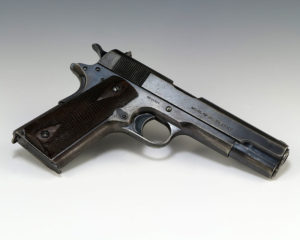
The Army used the M1911 during the Punitive Expedition in Mexico in 1916 when General Pershing, who had fought the Moro tribesmen in the Philippines, chased Pancho Villa across northern Mexico.
About 68,000 of the Colt pistols were in service when the United States entered World War I in 1917. The need to greatly expand the armed forces went hand-in-hand with the need to produce more weapons. So, production was expanded from Colt and the government’s Springfield Armory to Remington-UMC and North American Arms Co. The government also awarded contracts to the National Cash Register Company, the Savage Arms Company, the Caron Brothers Manufacturing of Montreal, the Burroughs Adding Machine Co., Winchester Repeating Arms Company, and the Lanston Monotype Company.
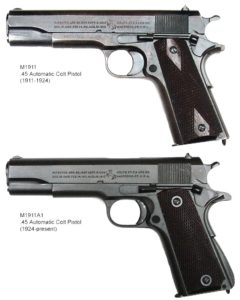
The post-World War I years saw some small changes in the overall design. These changes to the pistol consisted of a shorter trigger, cutouts in the frame behind the trigger, which made it easier for a shooter with smaller hands to handle the weapon, an arched mainspring housing, a longer grip safety spur (to prevent hammer bite), a wider front sight, a shortened hammer spur, and the elimination of the “Double Diamond” reliefs on the handgrips. These changes were completed by 1926 and the pistol was then referred to as the M1911A1.
Nearly two million M1911A1 sidearms went into combat during World War II. The U.S. government made so many M1911s during the war that they canceled orders for new pistols and opted to repair the existing M1911A1s with the vast stockpile of spare parts that they had amassed.
The pistol became a favorite of GIs in every theater from Europe to the Pacific. Many of our allies also got their hands on the pistol as the Special Operations units of the British army, Special Operations Executive (SOE) and their Commando units loved the reliability and stopping power of the .45 caliber Colt. The only changes made during the war to the pistol were that it was given a parkerized finish rather than being blued, and its wooden handgrips were switched out for brown plastic.
The M1911A1 continued to serve through Korea and Vietnam and was still the official sidearm of the military in the 1980s. However, Congress decided to adopt a 9mm pistol that used the standard NATO cartridge. It was during that time when Washington was worried about the “Russian Horde” storming across Western Europe and they opted for a larger ammo capacity and a standard cartridge rather than reliability and stopping power.
The Air Force ran the first tests for the new pistol during the Joints Service Small Arms Program (JSSAP), allowing only 9mms. It ended up selecting the Beretta 92S-1. The Army contested the results and decided to adopt the Beretta 92F. Production began in 1985.
Although the tests showed issues with the Beretta, as metal fatigue caused slides to crack, the two branches still opted for the Beretta over the (in my opinion) superior Sig Sauer P226. The military had replaced its old warhorse with a sleek race car that was always in the shop. It also had a trigger pull length of a friggin’ football field.
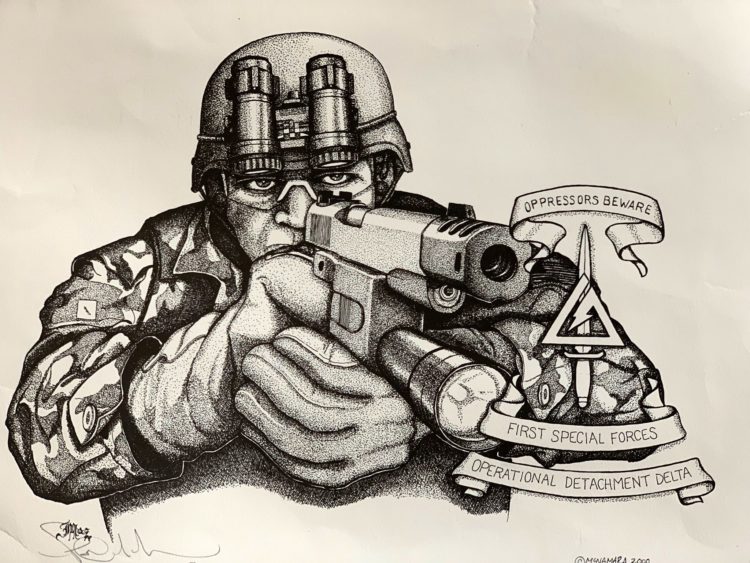
The Navy SEALs would stop using the 92F after one of their own operators was injured by a slide coming apart. They opted, smartly for the P226. The Army’s Delta Force and the FBI’s Hostage Rescue Team, as well as several American large cities’ SWAT Teams, decided to stick with the M1911A1. So, the people who actually would be most inclined to use a pistol in combat stuck with either the M1911A1 or the Sig Sauer P226 over the Beretta. Are we seeing a trend here?
The M9 (as the Beretta was named) didn’t fare any better in the minds of the conventional troops. A report by the CNA Corporation, conducted in 2006, showed that the M9 had the lowest levels of user satisfaction and soldier confidence of any small arm in the inventory.
A whopping 26 percent of the troops who took the poll claimed their M9s had malfunctioned in combat, with 15 percent claiming that their M9s could not fire an entire magazine without jamming at least half the time.
The military (finally) saw to it and the M9 was replaced with the Sig Sauer P320, known as the M17 Modular Handgun System, in 2017.
After going with the M1911A1 for 75 years, the replacement M9’s service life was about 30 years. However, unlike the wave of former GIs who rushed out to buy M1911A1s in the civilian world, the market for the M9 will likely amount to very little.








COMMENTS