

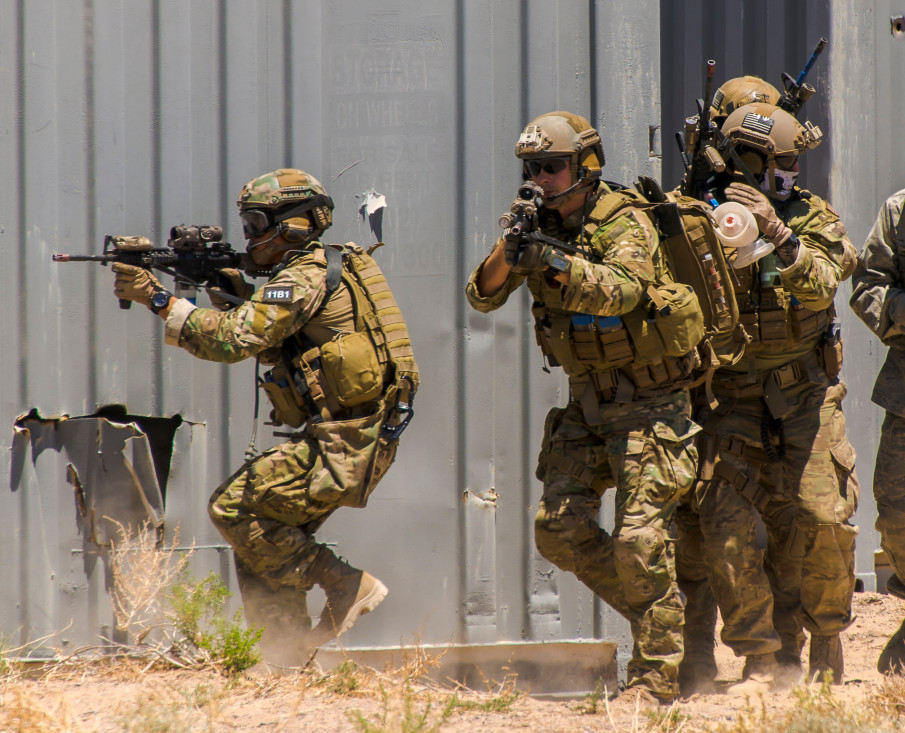
I get it. I have been in that seat sitting on the firebase or sitting in the team room saying: “Hey, we know exactly where this piece of shit that killed our brother is sleeping. We’ve got guns and trucks and hate. Let’s go roll him up.” We are the tool of choice for state-sanctioned violence. I realize that, because of politics and poor decisions, it is often muddled and poorly employed, but we (and the politicians) have to be accountable to the people.
The decision for war, to sue for peace and everything in between is a value judgment. Politicians going back millennia were constrained by the cost of war, casualties and the appetite of the masses. I am merely suggesting that it is not new, and that, as a unique American advantage, we have formalized the structure for civilian primacy over the military.
The volunteer, professional military is an advantage because our warfighters are not rounded up in times of national emergency to be put on the front lines to trade their jobs in factories or offices for a uniform and a rifle. We are allowed to be death dealers on the reg. It allows our military to, in theory, devolve command authority to lower units, and to give Blaber’s proverbial “man on the ground” to wield his fire team.
Nealen’s lament is accurate, but to say that risk aversion is a new advent is wrong. Our military is extremely hierarchical and micromanaging (as are all militaries, to a greater or less degree), but it has largely always been that way. The myth of the sua sponte soldier is just that – a myth. The audacious acts of previous wars were often executed contravening orders of a higher command. Should the risk aversion stop? Yes. Should authority devolve? Yes. Is it a new quality emerging in our society and body politic? No.
The final point in Nealen’s article is about prizing technological advantages over an adversary to the detriment of the true source of combat power — the infantryman clawing for unholy ground face-to-face with the enemy. His supreme point is training is the matter and compares the dollar-for-dollar investment in flawed military hardware acquisition programs to training dollars spent on the ground warfighter. The analysis of where money being spent is superb, and hits on points about rifle marksmanship, equipment and the silly involvement of platoon sergeants conducting PCIs instead of delegating it to squad and team leaders.
From my limited fields of fire, I see this result evolving out of the two points that I made above. Simply, that risk aversion is a long-standing feature of military strategy and doctrine, and that since the dawn of time, soldiers have been thwarted and poorly employed by politicians.
In this all-volunteer, professional fighting force, people are a precious resource. Conscripts of wars past faced some pretty awful conditions, and their lives were not valued very highly in the conduct of war. Global standoff capability, advanced situational awareness systems and battlefield survivability go hand-in-hand to the success of the soldier. As important as it was for the infantryman in Saipan to make the air war over Japan successful, the Joint Strike Fighter gives our ground pounder relative advantage in the fight.
The underlying point is that technology is much overrated in what our military needs. However, for our ground forces, the technology that will allow our guys to survive the fight (though horribly scarred) will lead to technology to survive and stay in the fight. The iron-man suit seems like far-fetched overstretch, but the principle behind it is not all bad. Relieve heavy loads, give the man on the ground access to information to enhance his war-fighting capability and give him protective armor that will allow him to get back up after being hit. This is only a narrow facet.
In addition, it is part of an ever-increasing effort to leverage relative superiority into each and every fighting element. In SOF, we always talk about surprise, speed, violence of action and security as being the most successful elements of any direct action. How do those come about? The warfighter has to rapidly observe the enemy, orient to the battlespace, decide on a course of action and then quickly act. I am not going to rehash Boyd’s Law or the OODA loop, but it is safe to say that we can only gain relative superiority through surprise, speed, violence of action and security. And we can only do that if we can more quickly enable the soldier on the ground to make effective decisions and close with and destroy the enemy.
How does this all link together? Risk aversion, retranslated, is the strategic ability to marshal combat power at a decisive point. Our political (and military) leaders may be risk averse because of careerism, politics, body counts and the like, but more importantly, it is because they have judged a point in the engagement, the operation, or the campaign, to be decisive. The technology and the soldier survival/SA systems are designed to maximize maneuverability toward this relative superiority.
And here is where the caveats come. Nealen is right. No soldier ever needed anything other than water, a rifle, a knife and ammunition for a fight. Training is truly undervalued. The military-industrial complex has, to rephrase him, pissed away good money for bad. We are at a point in our history where we ought to step back and return to our military’s core functions. We are straddling too many worlds: one of next-generation warfare, one of war with a conventional enemy, one in the current fight – all in an environment of budget sequestration. Our civilian and military leaders are doing a shit job of balancing all of these priorities and maintaining the health and morale of the force.
Some of his arguments are overlapping, but Nealen’s central point holds true. Our war-making capabilities are hamstrung; our leaders do not take risks when risks are needed and our technology fetish risks losing our fighting edge. Re-read Nealen’s series, read the QDR, our national military strategy and look at the summary of DoD’s budget. We have to continue to have this conversation. Many of us have felt for some time that our backs are up against the wall.
(Featured Image Courtesy: DVIDS)








COMMENTS