The last time a rising power gambled on a surprise strike to shove America out of the Pacific, it torched an anchored fleet, killed 2,403 Americans, and rewired the world order overnight.
Read the full article for more on:
Important insights and detailed analysis
Expert commentary on current events
Breaking developments and updates
Updating summary...
Remember Pearl Harbor: From Battleship Row to China’s New Challenge in the Pacific
Guy D. McCardle
Speed
1x
Listen
COMMENTS
The last time a rising power gambled on a surprise strike to shove America out of the Pacific, it torched an anchored fleet, killed 2,403 Americans, and rewired the world order overnight.
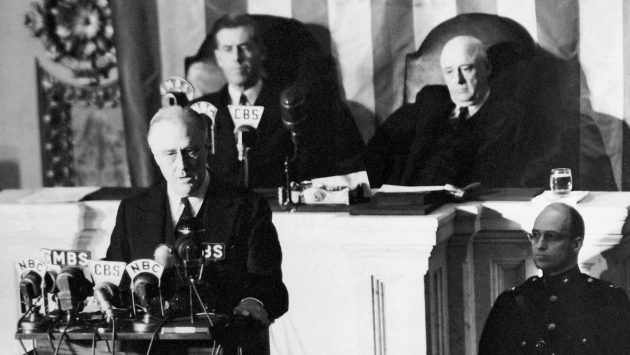
FDR delivers his famous "Day of Infamy" speech to Congress. Image Credit: Wikimedia Commons
A Quiet Sunday Before the World Shifted
Just before 8 a.m. on December 7, 1941, the United States slept through the last minutes of an older. seemingly more simple world. The Pacific Fleet rode calmly at anchor. Sailors on Arizona, Oklahoma, and other ships carried out the ordinary rhythm of a Sunday morning: cleaning stations, breakfast, and the sense that tomorrow would look a lot like yesterday. They had no reason to expect that within minutes, steel, fire, and noise would rip the sky apart.
Advertisement
When the first Japanese aircraft dropped out of the clouds over Oahu, the attack struck with a mix of precision and raw savagery that shocked even those executing it. Torpedoes cut through shallow harbor water that many believed protected the anchorage. Bombs punched through decks that had never been hardened for what was coming. The fleet’s battleships, long symbols of American sea power, were suddenly caught in a furnace they could neither outrun nor outfight.
In those frantic hours, young men who had enlisted for steady pay and a sense of duty found themselves hurling ammunition by hand, dragging shipmates through smoke, and firing weapons so hot they nearly fused in place. On the Arizona, more than a thousand never had the chance to reach a battle station. On the Oklahoma, entire compartments flooded before crews could escape.
In the chaos, individual acts of courage defined the day: machine gunners fighting until their positions burned around them, medics improvising aid under falling debris, officers and enlisted alike refusing to abandon their shipmates even as decks tilted and flames took hold.
By the time the last wave of Japanese aircraft withdrew, 2,403 Americans were dead and 1,178 wounded. The attack was short, brutal, and total in its shock.
In that horrible and unexpected destruction lay the first hints of the world that would emerge.
#Hoboken Day704: Take a moment to remember the over 2,400 Americans who died on December 7, 1941, @ Pearl Harbor. That strike pulled America into WWII & changed the course of history. A day of sacrifice, courage, and a reminder that freedom always comes at a cost. pic.twitter.com/N2a9FLWaJI
— Paul Presinzano 1st Ward City Councilman (@presinzano4hob1) December 7, 2025
The Strike That Rewired the Century
Pearl Harbor not only launched the United States into global war. It reshaped the nation into something different: a military-industrial giant capable of projecting power across oceans and sustaining campaigns that helped defeat Nazi Germany in May 1945 and force Japan’s surrender by early September 1945. The attack forced abrupt clarity on leaders who had spent years debating the cost of involvement overseas. The same country that could barely agree on aid to Britain in November 1941 united almost instantly once the smoke lifted over Oahu.
More subtle changes took root as well. The primacy of battleships faded as aircraft carriers became the beating heart of modern naval warfare. Intelligence sharing gained new urgency. Industrial capacity became a strategic weapon. And the United States found itself accepting a new role, not only as a participant in global affairs, but as the central balancing power across regions that once seemed remote.
That transformation still shapes American strategy. The echoes are unmistakable.
A Rising Power Tests the Pacific Again
The last time a rising power launched a surprise strike to break American influence in the Pacific, the world changed overnight. Today, another rising power continues to build a navy at record speed, pressure neighbors, and test the boundaries of regional order. China’s push into the South China Sea and its constant pressure on Taiwan are not accidents of geography or national pride. They are strategic moves by a state positioning itself for a future where it expects greater control of maritime trade routes and regional security choices.
The pattern feels familiar. Japan in 1941 convinced itself that war with the United States was unavoidable, that waiting would only allow its rival to grow stronger, and that a sudden blow might keep America out long enough for Tokyo to secure dominance. That idea was deeply flawed and tragically short-sighted. Yet it grew from a similar environment of resource concerns, competition, and national ambition.
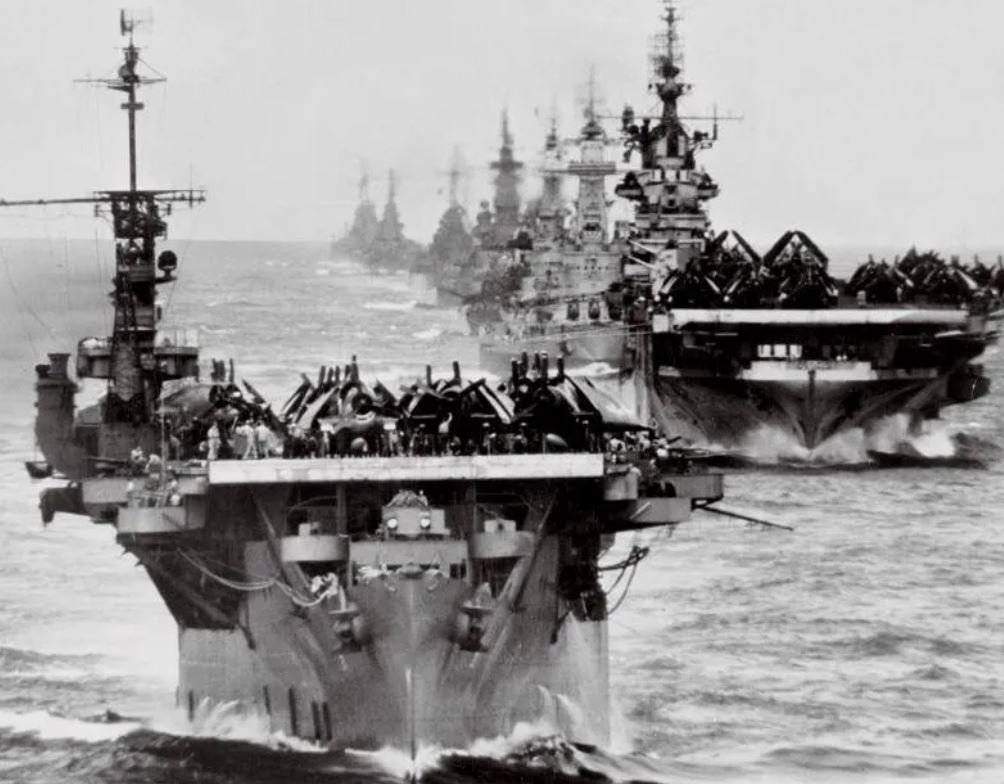
The USS Independence leads a naval flotilla patrolling the Pacific during World War II. Image Credit: midwaycurrents.org
Today, the pieces look different, but the board is nearly the same. Satellite surveillance, hypersonic weapons, cyber attacks, and drones have replaced torpedoes and dive bombers. A strike on a carrier group or a sudden move on Taiwan would not require a fleet steaming across the Pacific. It could unfold in seconds, before any camera phone or patrol aircraft recorded the first shot. A modern “Pearl Harbor moment” might begin inside a server farm, a satellite link, or the electronic guts of a missile battery.
The larger truth remains unchanged: miscalculation between rivals in the Pacific can redraw global power faster than anyone believes possible.
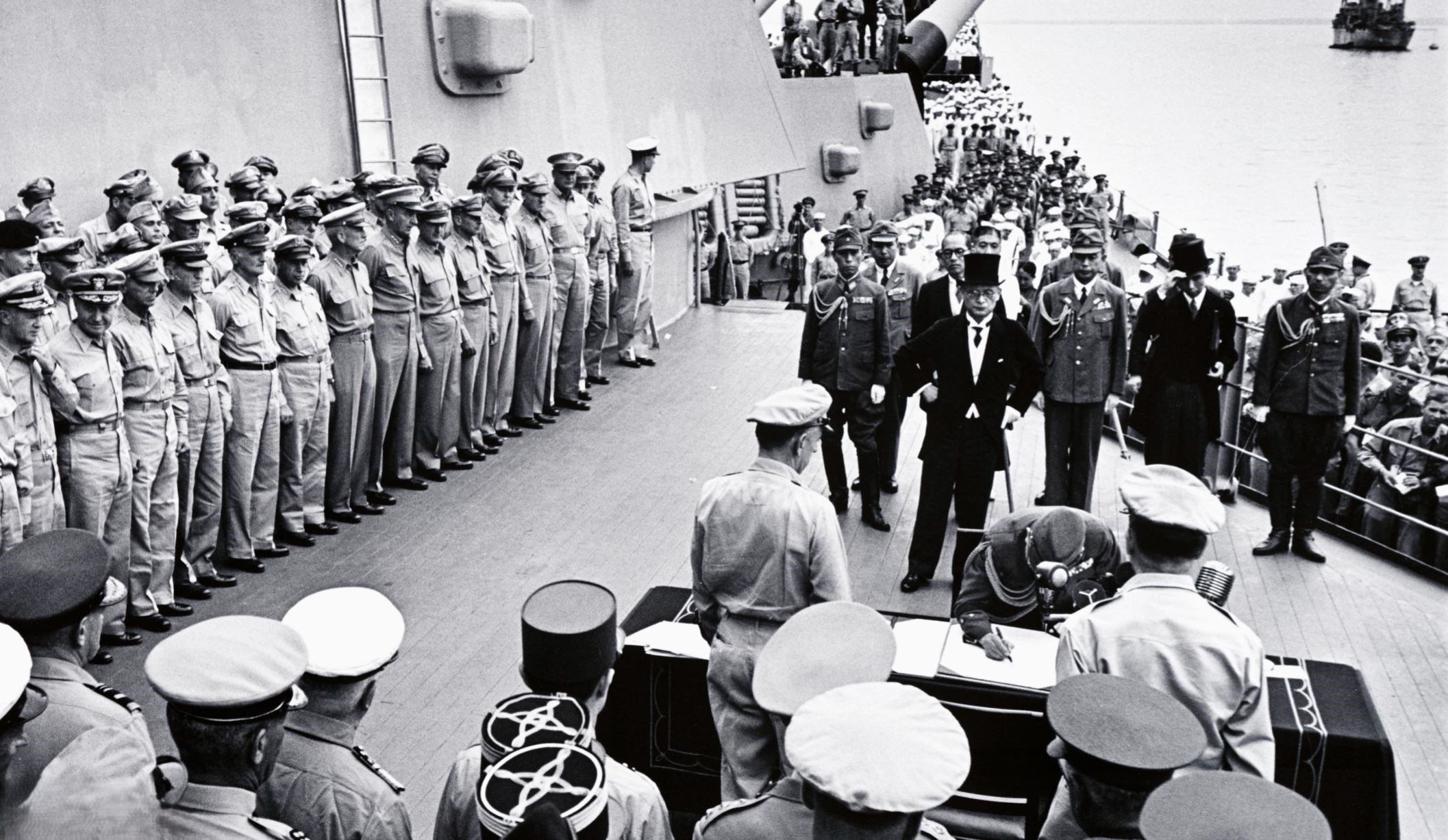
September 2, 1945. The Japanese surrender to US forces on the deck of the USS Missouri. Image Credit: Americanhistory.si.edu
What the Past Still Teaches
Pearl Harbor reminds us that strategic competitors often misunderstand each other in the critical hour. It reminds us that warnings are easy to ignore when they challenge our sense of comfort. It reminds us that an attack which aims to weaken American resolve often achieves the opposite.
Most of all, it forces a hard question that reaches across generations. If a sudden crisis struck tomorrow, would the United States rally with the same unity and purpose it showed in the days after the attack? Or would hesitation and argument fill the space where clarity once lived?
That question is the real legacy of Pearl Harbor. And the answer will set the course of the century now unfolding across the Pacific.
Advertisement
What readers are saying
Generating a quick summary of the conversation...
This summary is AI-generated. AI can make mistakes and this summary is not a replacement for reading the comments.










COMMENTS