

After evacuating at Dunkirk he searched for more action. He read a notice asking for volunteers for Commando training. He didn’t know who they were or what they did, but the name sounded adventurous, and once he passed the rigorous training he found a home worthy of his talents. And it was here that the nicknames ‘Mad Jack” and ‘Fighting Jack’, were born.
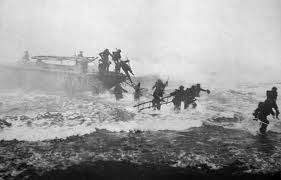
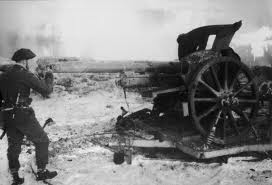 The first action came in 1941, in a raid against Norway. As leader of No 2 Commando he was tasked with taking out artillery on the small island of Maaloy just off the coast. At the head of his men he blew a march from his bagpipes as the landing craft approached, then as the ramp dropped, hoisted his sword in the air and shouted “COMMAANDOOOOO!” and leaped into the surf, the bagpipes dirge stopping only when he hurled a grenade and charged with his men following, resolute and ready behind him.
They took the garrison by surprise and made quick work of them. Two hours later headquarters received a message: “Maaloy battery and island captured. Casualties slight. Demolitions in progress. Churchill”
Command pinned the Military Cross and Bar on his chest.
Back in action again in September 1943 during the invasion of Salerno, Churchill received another award for bravery when he attacked an artillery battery pinning down British forces that were situated in the town of Piegoletti.
Outnumbered by over 3 to 1, he ordered his 50 men to approach from 4 sides in the middle of the night. At once, they screamed their name as loud as their leader and stormed the startled enemy under the urging of the sword. Shots tore into the Germans and confusion reigned as the British assailed them as an unstoppable wave. And after a short fight, they took stock of their reward. 136 prisoners and an unknown number dead, all due to their commander’s tactics.
His best was yet to come.
One night by himself, with just his sword, Jack captured a German sentry, used him as a shield and paid a visit to several guard posts. When he got close enough he shoved the sword into their chests warning them of the consequences of crying out. He repeated this routine several more times over the hours, gaining prisoners each time until he returned to his lines with a take of 42. Not once did any ever try to escape.
Afterward, when questioned how he pulled off such an unheard of feat Churchill replied: “I maintain that, as long as you tell a German loudly and clearly what to do, if you are senior to him he will cry ‘jawohl’ (yes sir) and get on with it enthusiastically and efficiently whatever the situation.”
Case closed.
Next, in May 1944 his unit deployed to Brac, an island off Yugoslavia, to support Marshal Tito’s partisans. Here, fighting at a location called point 622, the fearless Brit watched his entire command get killed, wounded and finally, surrounded.
After a leading a group of 6 that was killed when a mortar shell burst amidst them leaving only himself alive, he sat down and played a sad tune on his bagpipes as the Germans approached, threw a grenade and knocked him unconscious.
Taken to Berlin for interrogation, then to Sachsenhausen concentration camp in Austria, he seemed just another number to his SS captors. That all changed in September when he crawled under the wire and through a drain with a fellow officer and made good his escape. Gone for days, they tried to make it to the Baltic coast and almost did, getting captured in the coastal town of Rostock.
Realizing the trouble on their hands, in April 1945, the Germans sent him to Tyrol, a concentration camp for problem inmates. But the war was winding down, and a delegation of prisoners relayed fears of execution to a visiting army unit. They moved in, sympathetic Germans protecting them against other Germans who canceled their planes and ended up leaving just before the war ended.
Once free, Churchill set off alone on a southern hike into Italy. After several days he met up with an American armored column in Verona, after having walked some 93 miles. They sent him back to England where he eagerly awaited his next assignment.
He deployed again to Burma, then India. Ready for the new enemy, he heard of the Atomic bombings and eventual Japanese surrender. Depressed, as others celebrated, Churchill reckoned, “If it wasn’t for those damn Yanks, we could have kept the war going another 10 years.”
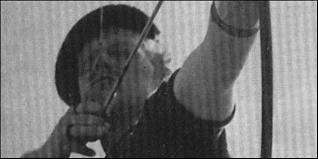
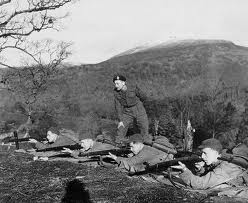 Absent of a war, he acted as a movie extra, appearing in Ivanhoe as an archer, then shipped off to airborne school in 1946 where at 40, he earned his qualification. He posted to Palestine as second in command of the 1st battalion Highland Light Infantry.
In 1948, he achieved another accomplishment when he coordinated evacuation of several hundred Jewish citizens from Haddasah hospital. after an infamous massacre of a convoy of which he tried to help.
With his best days behind him, in his final years of service, he instructed at a land-air warfare school in Australia, where he discovered his next passion, surfing.
After retiring in 1959, at the rank of lieutenant colonel with 2 awards of the Distinguished Service Order, he continued his unique way of doing things by tossing his briefcase out the train window every day on the ride home. Conductors asked why he did this, and he said he was tossing it into his backyard so he wouldn’t have to carry it from the station.
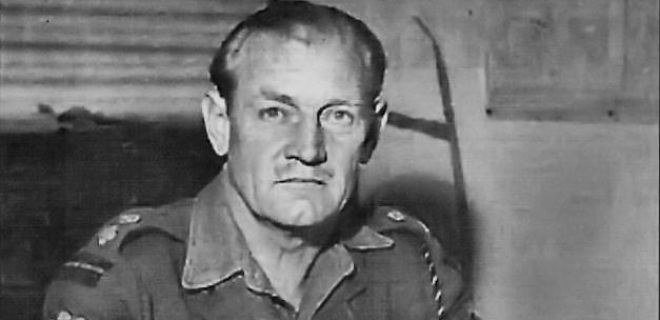
Eccentric to the end, Jack Churchill defined what it was to be hardcore. Fear was just a word for him. He thrilled for the hunt, vanquished his enemies in a manner like the Knights of old, and lived to tell about it as one of the greatest British soldiers of any War. For those who read of his exploits, this man didn’t just live the army, he was the army.
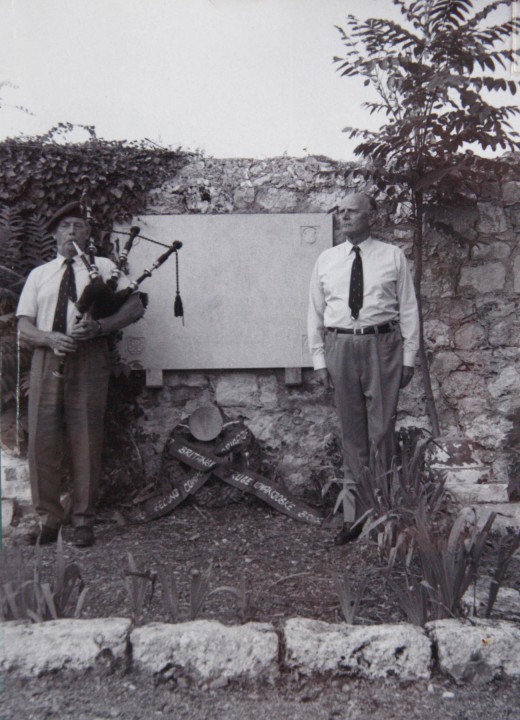
Jack Churchill died in 1996 at the age of 89.








COMMENTS