

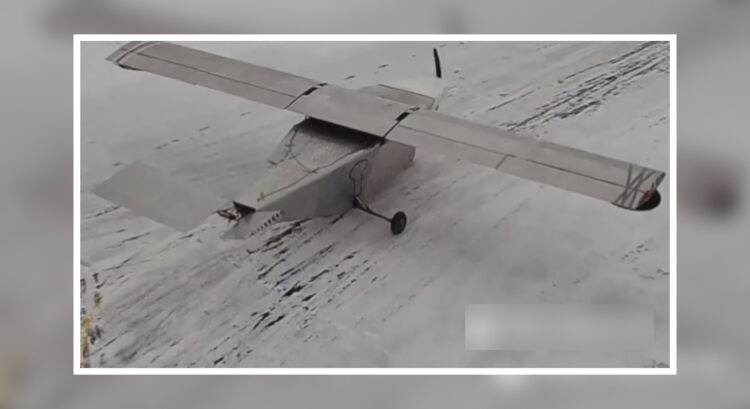
Moreover, the drone has a reported cruising speed of about 195 km/h and a cruising ceiling of 3,000 meters (9,843 ft).
“TrAMP is entering the final stage of preparation for test flights – a regular engine with a large three-blade propeller will be installed on the aircraft in the near future, standard landing gear instead of technological ones used for ground taxiing,” an informed source told RIA Novosti. “The drone is completing the ground test program – dozens of taxi runds have already been completed, the control system has been worked out onboard.”
The unnamed source also confirmed the TrAMP drone would most likely make its maiden flight by April, a little later than the originally planned first flight, due to specialist shortage. He explained that the developers required specific personnel to execute the flight.
Information on the latest Russian drone first surfaced last month, making headlines on an apparent transport UAV capable of flying long distances while carrying heavy cargo.
Developers said that the technology could serve multi-role, both military and civilian purposes, all thanks to its large cargo compartment. Military troops can load large items with a parachute, which the drone would then drop through the hatch doors below. Likewise, it can be employed in surveillance operations or as an aerial bomber. As the drone is fitted with a modular design, operators can quickly replace its parts, including its wings, engine, and landing gear, during crunch time.
Meanwhile, civilians can employ the transport drone to monitor extensive landscapes and/or the agriculture sector since specific equipment like radar, optical, and cartographic sensors can be fitted on the aircraft.
Nevertheless, with the ongoing conflict, many speculate that the TrAMP drone will definitely make an appearance in Ukraine, perhaps as supply transport, recon, or bomber.
Drones Play a Vital Role in Modern Conflict
Sergey Chemezov, director of the Rostec state corporation, announced in January that the company was developing reconnaissance and strike choppers capable of swarming enemy troops, in partnership with Russia’s Ministry of Defense.
“Small tactical copters are also being created that are capable of conducting reconnaissance, automatically detecting the enemy, and directing artillery. Can drop grenades and strike as part of a swarm,” said Chemezov via RIA News.
Drones, as witnessed on the Ukrainian troops’ side, could also be a game-changer for the Russian army in its quest to exert its dominance over Kyiv.
Russia broke a weeks-long stalemate in late February by launching a new wave of Iranian-supplied drones in Ukraine. According to reports, Ukrainian troops shot down 11 of 14 Shahed drones, including all nine attempted bombing strikes in Kyiv. Unfortunately, the remaining three lethal drones hit targets in the central city of Khmelnytskyi, causing explosions that killed two rescue workers and injured three others.
Nonetheless, the frequency of drone assaults from the Russian army has significantly declined so far, this year perhaps taking an indefinite pause after its failed attempt to destroy Ukraine’s electricity infrastructure in October through showers of bombings until early January. According to some intelligence officials, Russia’s cruise missile stockpiles are dwindling, which might be one of the reasons why Moscow has increasingly turned to acquiring and using considerably cheaper Iranian drones.








COMMENTS