
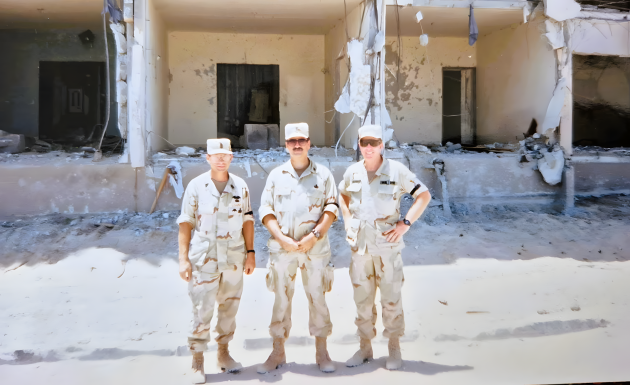
** Editor’s Note: The following document was written by Sergeant Major (Ret.) Mike Vining following his work on the Downing Assessment Task Force investigating the June 25, 1996 truck bombing at Khobar Towers in Dhahran, Saudi Arabia. Vining served as the task force’s principal explosives investigator. The text below reflects his technical observations and account of the investigation. – GDM
—
Downing Assessment Task Force
Dhahran, Saudi Arabia
5 July – 20 September 1996
By Mike R. Vining, SGM USA (Ret.)
Facts surrounding the bombing incident:
At 2149 hrs (local time), 25 June 1996, a 4,000-gallon capacity Mercedes-Benz tanker truck backed up against the chain-link fence and a row of jersey bounce barriers that were 54 feet in front of Building 131, Al Khobar Towers, Dhahran, Saudi Arabia. This area is a housing complex for the King Abdul Aziz Air Base that serves the U.S. Air Force’s 4404 Composite Wing Group (P) as an office and housing complex for 2,900 personnel.
The building complex was built in 1979. S/Sgt Alfredo Guerrero, a guard on the rooftop of Building 131, saw what was happening. He and two other guards started the evacuation of the building. Two Saudi guards approached the truck, and the two occupants fled in a car that followed the truck. At some point in time, a delay system was initiated, either electronic or possibly a chemical delay pencil (no evidence was found at the scene).
At 2155 hrs (local time), the explosive-laden truck detonated, with the center of the crater being 80 feet in front of and slightly to the right side of the center of the building. The truck had a slight angle towards the east wing of Building 131.
S/Sgt Guerrero was on the seventh floor when the bomb detonated. The detonation resulted in 19 U.S. fatalities and 488 U.S. casualties (109 seriously wounded), of which 58 were hospitalized. Twelve that were killed were from the 33rd Fighter Wing “Nomads,” Eglin AFB, Florida; five from the 71st Rescue Squadron, 1st Rescue Group, Patrick AFB, Florida; one from the 55th Contracting Squadron; and one from the 88th Civil Engineer Group. Saudi local casualties are said to be at 347 with no fatalities. Approximately 90% of the injuries were from glass fragments.
The buildings had no emergency lighting, intercom system, or fire alarms.
Buildings 131 and 133 are eight-story “T” shaped structures constructed of 5 1/2” precast concrete wall panels and 6 1/2” floor panels. The floors are marked G (Ground), to floors one through seven. Vertical panels are bolted together, one-way floor slabs have approximately two-inch bearing areas on walls, walls and floor slabs are tied together with U-shaped rebar, threaded with either cable or rebar, and grouted joints. The building’s exposed surface facing towards the outer perimeter contained approximately 18% glass. The exterior walls of the common rooms that contained the patio doors are approximately 55% glass. Glass windows and patio doors did not contain any (2 to 14-mil) Shatter Resistant Window Film (SRWF)/ Fragment Retention Film (FRF). The patio door was 84” x 32” x 7/32” of annealed glass that would fail at 0.6 psi.
From residue analysis, the explosive is thought to be U.S.-manufactured Composition C-4, like what is used by the military. No aluminum clips were found at the scene. U.S. military Composition C-4, 1 1/4 lb., M112 blocks use the metal clips to tie off the Mylar wrappers on each of the blocks. U.S. Composition C-4 can be found in forty-pound bulk containers, or 2 1/2 lb., plastic-cased, M5 and M5A1 blocks.
The FBI found RDX, HMX, and Apalite (used in the binder). As far as the FBI knows, only U.S. Composition C-4 has traces of HMX in it. Other foreign countries that have products similar to Composition C-4 have no HMX in them. The odd thing is that after a normal detonation of Composition C-4, no traces of HMX residue remain. The backfilling of the tank with water/sewage may have caused a cooler detonation, thus allowing for HMX residue to remain behind. Gas cylinders of an unknown number and filler were found in the debris. The compressed flammable gas is thought to have provided an enhanced thermal effect (probably negated by any water in the tanker), but did not contribute to the blast.
It is thought that the tanker truck was backfilled with sewage and water. Eyewitnesses claimed that after the detonation, it smelled like a barnyard. FBI post-blast analysis also indicated that it was filled with sewage and water. A significant amount of sewage/water would have provided tamping, which would have directed a large proportion of the blast energy downward, thus enhancing the crater’s size disproportionately to the amount of explosives used.
The Defense Special Weapons Agency (DSWA) does not share this opinion. They state that the tamping would only increase the crater by less than 10%. The apparent crater diameter was 55 feet, with a depth of 16 feet, and an estimated volume of 28,000 cubic feet. The water table is at five feet below the surface. The blast reflection off the water table (density boundary) would also help to widen the crater’s size disproportionately. The water/sewage would have a somewhat greater effect in reducing the intensity of the air blast due to the energy absorbed by the phase change from water to steam.
The average ground cross-section appears to be:
- Three inches of pavement.
- Seven inches of base course (appears to be gap-graded gravel, 1” gravel with sand, missing sizes 1/8” to 1/4”).
- Medium brown marl sand to an average depth of seven feet (measured from pavement surface), overly fine gray sand with some shell pieces.
- Geological studies indicate that limestone may exist at a 20-foot depth.
The estimates on the amount of explosives have varied from 3,000 to 40,000 pounds. The initial onsite estimates range from 3,000 pounds to 5,000 pounds. The current FBI and Task Force assessment is 5,000 pounds, and the current DSWA estimate is 28,000 pounds.
The DSWA estimate is based on the crater size and window breakage modeling using 3-D air blast propagation models. The DSWA explosive yield is also based on crater volume and window damage, which indicates a yield of 20,000 to 40,000 pounds. Further post-blast analysis and testing need to be done in order to determine a more exact amount of explosives that was used in the bombing.
A tanker truck with a 4,000-gallon water capacity equates to 33,320 pounds of load. DSWA estimates the truck would hold 27,000 pounds of weight. If the entire tank volume was filled with an explosive that had a solid density of 1.6 gm/cc, that would equal 53,312 pounds. Subtracting a 10% void for the explosive in chip form, this would result in an explosive weight of 47,981 pounds. This supports the DSWA’s high estimate of 40,000, but it would only be speculation if the vehicle’s suspension would be able to carry anything much more than 31,000 pounds.
Using 30,000 as a maximum load weight, and if the vehicle contained 5,000 pounds of explosive and 25,000 pounds of water and sewage mix, that would be a 1 to 5 ratio. This would provide a considerable tamping factor and would direct the blast downward. The height of burst assumed by DSWA is five feet and three and a half inches. That is assuming the truck was full of explosives, otherwise the height of burst would be lower. The height of burst is measured from the center of the explosives to the ground.
The crater size can be duplicated using “ConWep” based on a six-foot above the surface detonation on wet sand using 15,000 pounds of Comp B explosives. The apparent depth is 16 feet two and a half inches, the apparent diameter is 55 feet and seven and a quarter inches, the apparent volume is 19,620 cubic feet, and the window breakage range is 3,053 feet. DSWA estimates the apparent volume to be 28,000 cubic feet, plus or minus 15%. This is 30% larger crater volume than I calculated.
Structural Damage:
- Building 131, 80 feet from the center of detonation, had a catastrophic wall failure on the north side (side nearest the blast). The south wing received minor damage. Building 131 showed no progressive collapse. Outside walls of the northeast and northwest wings were pushed outward approximately four feet, causing one to two floor slabs in the NE and NW bedrooms on floors G to six to collapse. The north walls were blown into the building on the first four floors, along with portions of the jersey bounce barriers that were near the detonation. In the common rooms (two per floor on the north side) with sliding glass doors and windows as the north wall (leading to patios), the first “solid” wall was the south wall of the room. This wall was usually fractured and penetrated. Eighteen fatalities were located in this building.
- Building 133, located 330 feet west of the center of detonation, received major damage and will require expensive repairs. The wall facing the detonation (east wall) deformed outward as much as 1.75 inches. A vertical crack runs from floor two to seven of the building on the east end. The wall deformation results in the loss of support for the floor slabs, making the floors unsafe for continued occupancy. Of the row of air conditioning units closest to the detonation, only floors one, two, and five were blown in. One of the fatalities was located in this building.
- Building 127 (450 feet away), 128 (320 feet), and 130 (300 feet) received minor damage and can be safely placed back in use. The west wing of building 127 that faced towards the detonation received a vertical crack from floor one to six.
- Trees and vegetation beyond 150 feet were not denuded of leaves by the blast.
Glass Windows and Patio Doors:
The window and patio doorframes were anchored into the concrete panels by 1/4” screws that were screwed into plastic inserts embedded in the concrete. The window glass was 5/32” thick, and the patio glass was 7/32” thick. At 0.3 psi, 10% window glass breakage is expected. Nearly 100 percent of the glass patio doors were damaged at 1,000 feet, and some breakage occurred out to the 1,700-foot radius at Khobar Towers.
General Wayne Downing Assessment Task Force:
On 28 June 1996, General Wayne A. Downing, a retired former Commander of the United States Special Operations Command, was picked by the Secretary of Defense to examine the facts and circumstances surrounding the 25 June 1996, bomb attack on the Al Khobar Towers complex, Dhahran, Saudi Arabia.
We were also tasked to assess the security infrastructure, policies, and systems in Dhahran and other U.S. Central Command facilities in the Area of Responsibility, and recommend measures to prevent similar attacks or minimize casualties and damage.
Six former members of 1st Special Forces Operational Detachment – Delta and I were picked to make up the task force. They were Don Simmons, former Command Sergeant Major of Delta, Jerry Bell former Criminal Investigator Detective for Delta, COL Steve Wright a former Delta Operations Officer and Chief of Training, Evaluation and Operational Research (TEOR) Section, LTC Douglas E. Norvell former Delta Troop Commander and Operations Officer, COL John Smith former Delta lawyer, and Wade Ishimoto former Intelligence NCO for Delta.
I was chosen as the principal and only explosive investigator. Don was on the Physical Security team, Jerry on the Investigator team, Steve as Chief of Staff, Doug as Training and Education investigator, John as team legal advisor, and Wade as part of the intelligence team. On 5 July, we reported to our base of operations for the next two months, NMCC Room 2C890, The Pentagon, Washington, D.C. 20310. There, we developed a framework that we would use in the field to investigate Khobar Towers. We were also to visit other high-threat military bases in the Middle East, and perform an initial vulnerability assessment and some quick fixes.
At the time, the Khobar Towers bombing was the worst terrorist attack directed at a U.S. military base since 23 October 1983, when a blast killed 220 Marines, 18 sailors, three soldiers, and injured 100 more that were located in the Battalion Landing Team’s (BLT) headquarters building, near Beirut International Airport (BIA), Lebanon.
Prior to the attack, there had been other warnings. On 13 November 1995, five Americans (one soldier, SFC David Warrell, a Military Policeman, and four civilians) and two Indian nationals were killed at the Saudi Arabian National Guard (SANG) compound in Riyadh, Saudi Arabia. Nineteen soldiers received the Purple Heart. The Americans were working for the Saudi Arabian National Guard Modernization Program. A pickup filled with 220 pounds of explosive detonated outside the complex.
Four terrorists were involved with the bombing; two terrorists were beheaded. Saudi Arabia was on security alert, Level One, the highest possible rating. The housing complex and military base were on THREATCON Bravo. On 4 April, two individuals circled the complex at least ten times, stopping along the way.
On 24 April, an unidentified man was seen photographing the buildings. The next day, four men were observed, two hiding in the bushes outside the fence, conducting “an apparent surveillance.” On 20 May, a truck rammed into the fence, apparently to test response time. After pausing 20 seconds, the vehicle left in a hurry. On 30 May, pistol shots were fired at the barracks.
One hundred and thirty security improvements were made prior to the bombing. Roads were closed, an investigation of the license plates of motorists in the area, and patrols on the barracks’ roofs.
There was an allegation that the base requested to have the perimeter increased to 400 feet. The task force never substantiated this allegation. The base did ask the Saudis to increase police patrols around the outside of the compound. This the Saudis did. The Base Commander Brigadier General Terry J. Schwalier’s primary emphasis was on the air missions performed as part of “Southern Watch,” quality of life, and then base security.
It always seems security affects quality of life. Schwalier was to have his change of command the next day. I always wondered about the quality of life being buried six feet under the ground.
An Office of Security Investigation (OSI) security assessment recommended a four-mil coating of Mylar to tower windows, to prevent their shattering into lethal shards in the event of a blast. Schwalier deemed that too expensive, and the Pentagon approved this request to delay the measure until after 1 October. There was no effort to move personnel away from rooms close to the perimeter or rooms that faced the perimeter.
The FBI says that of the bombing, there is overwhelming evidence that Iranian officials planned and financed that attack.
Six Saudi Arabian members of the Saudi Hezbollah were identified as actual bombers. In 2001, 13 Saudis and a Lebanese man were indicted on murder and conspiracy charges in relation to the attack. The Saudis beheaded four terrorists.
The Saudi Hezbollah terrorists had ties with Iran, and the Lebanese Hezbollah also assisted the terrorists. In August of 2015, the alleged mastermind behind the bombing was captured in Beirut, Lebanon, Ahmed al-Mughassil, age 48. In 2001, al-Mughassil was labeled by the FBI as the head of the Iranian-backed Saudi Hezbollah and was charged with the murder of federal employees and bombing resulting in murder.
A U.S. district judge ruled in 2006 that Iran had financed the bombing and ordered it to pay $254-million to the bombing victims. Al-Mughassil was captured in a southern Beirut neighborhood known to be a Hezbollah stronghold some two weeks after arriving from Iran. He was handed over to Saudi officials in Riyadh. Nine other Saudis have been imprisoned in Saudi Arabia since the attack. Three others remain at large: Ali al-Hoorie, Abdelkarim al-Nasser, and Ibrahim al-Yacoub.
Medal Awarded:
Joint Service Commendation – For exceptionally meritorious achievement as an Investigator for the Chief of Physical Security on the Downing Assessment Task Force, from 5 July through 20 September 1996, investigating the bombing of Khobar Towers, Dhahran, Saudi Arabia.
Letter of Commendation from Wayne A. Downing, General, U.S. Army (Ret.), Director, Task Force:
Please accept my sincere appreciation for SGM Vining’s superb support as an investigator for the Chief of Physical Security for the Downing Assessment Task Force. Performing superbly as the Task Force’s principal investigator on Explosive Ordnance Disposal and bomb technology at Khobar Towers. Moreover, he provided invaluable interface with the Federal Bureau of Investigation’s team, the Defense Special Weapons Agency, and the United States Corps of Engineers Waterways Experiment Station on the size and composition of the device used during the bombing. As a result of his tireless efforts, the findings and recommendations forwarded to the Secretary of Defense will positively enhance Force Protection initiatives of the Department of Defense and will have a lasting impact towards improving the security of United States Armed Forces personnel deployed worldwide. SGM Vining’s professionalism and dedication have contributed significantly to the report, which will further the national security interests of the United States.
Certificate of Appreciation from FBI Director Louis Freeh:
The Federal Bureau of Investigation expresses its appreciation to Sergeant Major Mike Vining for exceptional service in the public interest. SGM Vining provided valuable assistance to the FBI. In addition, my subordinates have informed me that SGM Vining is very competent investigator and case manager. The cooperation provided to the FBI by SGM Vining is greatly appreciated.
Sources:
http://www.defense.gov/speeches/speech.aspx?speechid=937
http://www.fas.org/irp/threat/downing/unclf913.html
http://www.fas.org/irp/threat/downing/downltr.html
http://www.fas.org/irp/threat/downing/prefuncl.html
http://www.au.af.mil/au/awc/awcgate/awc/98-082.pdf
http://www.archive.org/stream/terroristattacka00unit/terroristattacka00unit_djvu.txt
http://www.colorado.edu/artssciences/defense/Janko.pdf
http://www.fema.gov/pdf/plan/prevent/rms/426/fema426_ch4.pdf
http://www.au.af.mil/au/awc/awcgate/khobar/recordf.htm
http://www.remember.gov/tollofterrorism/khobartowers/tabid/96/default.aspx
http://www.fas.org/irp/threat/saudi.pdf
http://www2.fbi.gov/pressrel/pressrel01/khobar.htm
http://www.airforcetimes.com/news/2008/01/airforce_schwalier_080113w/








COMMENTS