
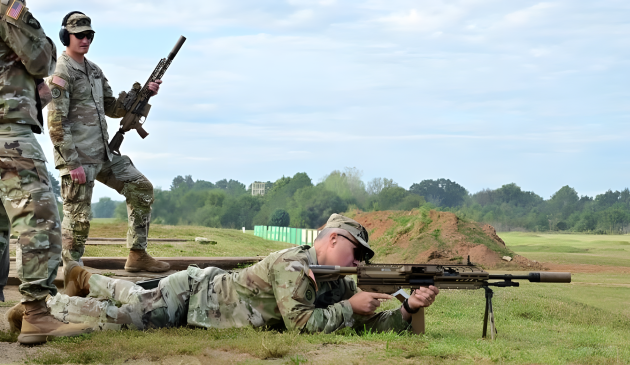
The War Department did not stumble into the 6.8x51mm cartridge because someone wanted a shinier rifle round. There was no stumbling involved.
The Next Generation Squad Weapon program exists because the physics of the battlefield changed. Enemy body armor improved. Engagement distances stretched. The modern infantry squad needed something that hits harder than 5.56 while avoiding the weight and recoil penalties that kept 7.62 from becoming the universal answer.
Enter 6.8x51mm round.
The cartridge at the heart of the NGSW program was built to reset the equation, not tweak it. Velocity, energy, and modern projectile design are the tools. Hybrid-case engineering is the mechanism. The result is a rifle cartridge that pushes performance into territory conventional brass cases simply cannot reach.
Hybrid Case Technology: The Engineering Breakthrough
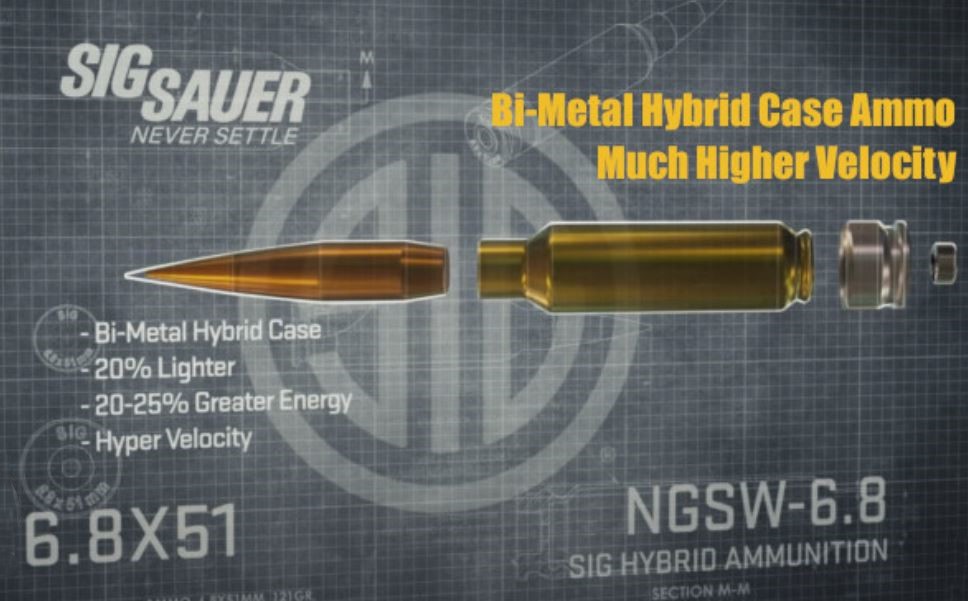
The key to the cartridge is its hybrid case design.
Traditional brass cases have pressure limits. Push them too far, and the case head begins to deform under extreme chamber pressure. SIG’s hybrid case technology addresses that limitation by reinforcing the base of the cartridge case while retaining a brass body. The strengthened case head allows the cartridge to operate at significantly higher pressures than conventional rifle ammunition.
The Sporting Arms and Ammunition Manufacturers’ Institute (SAAMI) lists the commercial version of this cartridge, .277 SIG FURY, with a maximum average pressure of 80,000 psi, substantially higher than most traditional service rifle cartridges.
That pressure ceiling is not an academic number. It translates directly into velocity.
SAAMI documentation for the cartridge references a 135-grain bullet traveling at roughly 3,000 feet per second, putting it firmly in magnum-performance territory while still fitting inside the familiar short-action footprint shared by the 7.62×51 NATO cartridge.
This is the central innovation of the 6.8 system. The cartridge delivers dramatically higher performance while remaining within the physical size class of 7.62 NATO, allowing new weapons to operate within familiar magazine and feed geometries even as the Army accepts the logistical tradeoffs that come with a heavier, higher-energy round.
6.8 vs 5.56: The Energy Gap
For decades, 5.56×45 NATO dominated U.S. infantry rifles for good reasons: controllability, lighter ammunition weight, and the ability for warfighters to carry more rounds.
But 5.56 is fundamentally a small-diameter, lighter-energy projectile. The M855A1 Enhanced Performance Round, for example, pushes a 62-grain bullet at roughly 3,000 feet per second from a 20-inch barrel, producing around 1,300 foot-pounds of muzzle energy depending on barrel length.
The 6.8×51 class of cartridges operates in an entirely different energy bracket.
A 135-grain projectile at 3,000 feet per second produces well over 2,600 foot-pounds of energy, roughly double the energy delivered by typical 5.56 service ammunition. That energy advantage carries downrange, especially when paired with modern high-ballistic-coefficient projectiles designed to resist wind drift.
The practical result is simple: more retained velocity, more retained energy, and better performance at extended combat distances.
6.8 vs 7.62 NATO: Similar Size, Higher Ceiling
At first glance, 7.62×51 NATO appears to occupy the same performance neighborhood.
A standard M80 ball cartridge launches a 147-grain bullet at approximately 2,750 feet per second from a 22-inch test barrel. That has been the Western military baseline for a full-power rifle cartridge for more than half a century.
The 6.8×51 was designed to push beyond that baseline.
Higher allowable chamber pressure allows the cartridge to launch modern .277-caliber projectiles faster while maintaining the same general cartridge length as 7.62 NATO. That means similar magazine geometry but higher velocity potential.
Velocity matters. Higher velocity shortens time of flight, reducing wind drift and improving hit probability at distance.
In simple terms, the cartridge occupies the same physical class as 7.62 while pushing performance closer to magnum territory.
6.8 vs 6.5 Creedmoor: Different Mission Sets
6.5 Creedmoor has earned a strong reputation in the precision shooting world because of its excellent ballistic efficiency. A common 140-grain load travels around 2,700 feet per second, producing strong long-range performance thanks to the caliber’s high ballistic coefficients.
But the NGSW cartridge was not built as a competition round.
It was designed as a combat cartridge capable of operating from relatively short barrels while delivering higher impact energy across a wide range of engagement distances. The elevated pressure capability of the hybrid case allows the 6.8 platform to drive projectiles faster than many conventional cartridges of similar size.
The mission set is different. Creedmoor was optimized for long-range precision. The 6.8 system was engineered for battlefield lethality across the entire spectrum of infantry combat distances.
The Real Objective: Restoring Infantry Overmatch
The Army’s rationale for the NGSW program is straightforward. Peer adversaries are fielding better body armor and operating at longer engagement ranges than the counterinsurgency environments that shaped two decades of U.S. small-arms doctrine.
The 6.8×51 cartridge is intended to restore what military planners call infantry overmatch. That means a rifle and ammunition combination capable of reaching farther, striking harder, and maintaining lethality against modern battlefield threats.
Technology does not win wars by itself. But it does change the rules of the fight.
The hybrid-case 6.8 cartridge is not a minor upgrade. It is a deliberate attempt to move the infantry rifle back onto the dominant side of physics.
And in warfare, physics is the only referee that never lies.








COMMENTS