
Built for Performance: Why Protein Matters and Why Essential Provisions Gets It Right
You cannot walk into a grocery store, gas station, or airport kiosk anymore without the word “protein” shouting at you from a wrapper. Protein bars. Protein chips. Protein cookies. Protein water, somehow. That is not an accident, and it is not just a trend. It is a delayed course correction. For decades, Americans were under-fueled, under-proteined, and sold convenience foods that delivered calories without function. Our bodies noticed. So did science. There is a reason protein is suddenly everywhere, and it starts with the fact that most people are not getting nearly enough of the right kind.
Why Protein Is No Longer Optional
The long-standing Recommended Dietary Allowance for protein sits at 0.8 grams per kilogram of bodyweight. That number was never meant for people who train hard, work long shifts, or operate under stress. It was designed to prevent deficiency in sedentary adults. According to the International Society of Sports Nutrition, physically active individuals often require 1.2 to 2.0 grams per kilogram per day. For a 180-pound adult, that is roughly 100 to 160 grams of protein daily. That gap is where performance, recovery, and resilience are either built or lost.
Protein is not just another macronutrient. It is the raw material the body uses to repair muscle, build enzymes, regulate hormones, and maintain immune function. Every cell in the human body contains protein. Strip it down further and protein is made of amino acids, nine of which are essential, meaning your body cannot make them on its own. If you do not eat them, you do not get them. That is where quality matters as much as quantity.
Quality Over Quantity, and Why It Matters
Dr. Paul Arciero, a clinical research advisor to Essential Provisions and one of the nation’s leading researchers on protein metabolism, frames it in simple terms. Protein is foundational. It is not about chasing a number on a label; it is about giving the body something it recognizes and can actually use. Highly processed foods may advertise protein content, but bioavailability, how well your body absorbs and utilizes that protein, determines whether it actually does any work.
Animal-based proteins tend to deliver all nine essential amino acids in higher concentrations, making them complete proteins. Grass-fed bison, in particular, stands out. It is lean, nutrient dense, and naturally rich in leucine, the amino acid that acts like a light switch for muscle protein synthesis. Without sufficient leucine, the body does not fully activate the machinery needed to repair and build tissue. This is one reason why simply eating more low-quality protein often fails to deliver results.
Field Fuel That Actually Fuels Your Body
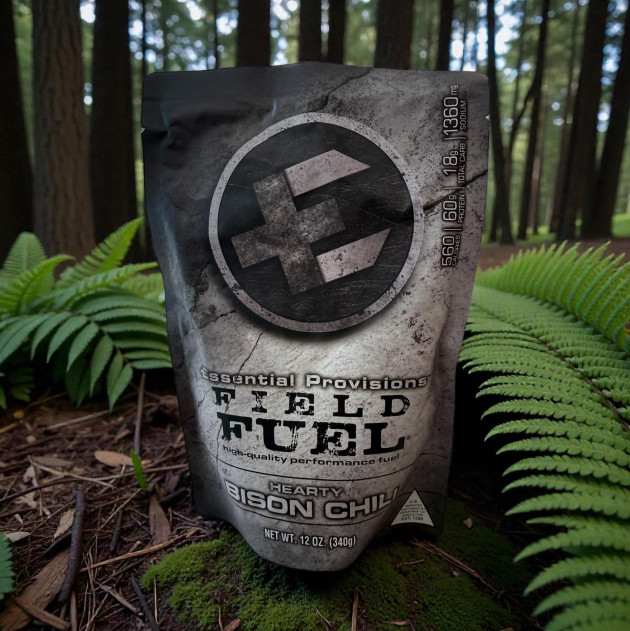
This is where Essential Provisions enters the picture, not as a novelty, but as a corrective. Essential Provisions Field Fuel was designed to solve a real-world problem. How do you deliver high-quality protein, from clean sources, in a format that actually works when conditions are less than ideal?
Their flagship (and my personal favorite) Bison Chili delivers 60 grams of complete protein in a single shelf-stable pouch, along with 560 calories built for work, not snacking. The Bison Stew follows close behind with 43 grams of protein, featuring whole cuts of tender bison. Even the plant-based options rely on real ingredients like lentils and vegetables, not isolates and fillers.
In its animal-based Field Fuel meals, Essential Provisions uses 100 percent grass-fed, grass-finished bison, supplemented with grass-fed collagen and nutrient-rich bone broth, while its plant-based options rely on whole-food ingredients rather than isolates or fillers.
The sourcing matters. Regeneratively raised animals. No antibiotics, no hormones, no seed oils, no added sugars. Third-party testing for hundreds of contaminants. Essential Provisions goes beyond organic checkboxes and into traceability and accountability, which is rare in the shelf-stable space.
Timing, Pacing, and Real-World Performance
Arciero’s research also emphasizes protein pacing, the idea that timing matters as much as total intake. Distributing protein evenly across the day, instead of loading it all at dinner, leads to higher muscle protein synthesis. His work shows up to a 25 percent improvement when protein is spaced across four or five meals. That matters even more for older athletes and anyone operating under caloric stress. Field Fuel fits cleanly into that model. It is a full meal, ready when you are, whether that is hour twelve of a shift or day three of a field problem.
The audience for this kind of nutrition is broad, but the use case is specific. Special operations forces, first responders, endurance athletes, and anyone who cannot afford a blood sugar crash halfway through the job. High-protein meals support satiety, preserve lean mass during caloric deficits, and provide steady energy without the spike-and-crash cycle that defines most convenience food.
Protein is having its moment because it earned it. The science caught up with what hard-working bodies have known for a long time. Food should pull its weight. Essential Provisions understands that. Their meals are built for people who expect performance from themselves and from what they put in their bodies. This is not about hype. It is about fuel that works when it counts.








COMMENTS