

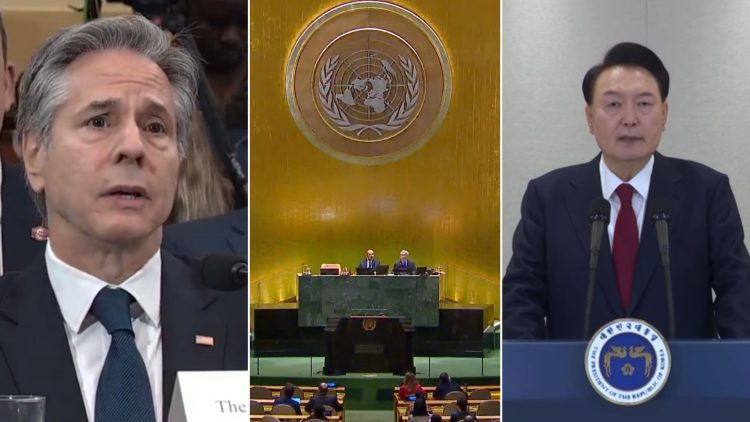
Committee Chair Rep. Michael McCaul, in his final hearing, blamed the chaotic withdrawal for sparking a “failed foreign policy” and accused the administration of leaving Americans and Afghan allies at risk.
The hearing comes months after a Republican-led report criticized Biden’s handling of the withdrawal while downplaying Trump’s role in negotiating the initial deal.
Despite partisan disagreements, previous reviews have found the failures spanned four administrations, with Biden and Trump shouldering the greatest responsibility.
Pentagon Monitors Russia’s Next Move With Oreshnik Missile
On Wednesday, the Pentagon warned that Russia could launch its experimental Oreshnik missile against Ukraine in the coming days as both nations jockey for leverage ahead of potential peace talks.
This advanced ballistic missile, first used last month, is being touted by President Vladimir Putin as a powerful weapon capable of bypassing defenses at Mach 10 speeds.
However, US officials don’t see it as a battlefield game-changer.
The warning comes as tensions between Russia and Ukraine continue to rise. Ukraine recently struck a Russian airbase with US-supplied missiles, prompting Moscow to vow retaliation.
Meanwhile, the Biden administration is ramping up support for Ukraine, announcing last Saturday nearly $1 billion in security aid to bolster air defenses and counter Russian advances.
Putin has made bold claims about Oreshnik’s potential, even suggesting it could rival nuclear weapons in impact. However, some experts note that it’s based on older missile technology and lacks true hypersonic capabilities.
As fighting intensifies, the US is also keeping an eye on how President-elect Trump’s incoming administration may alter America’s support for Kyiv.
With both sides escalating their military efforts, the situation remains volatile, leaving the international community bracing for the next developments in this grinding conflict.
Russian Troops Push Closer to Key Ukrainian Hub Pokrovsk
Russian forces are closing in on the strategic Ukrainian city of Pokrovsk, capturing several positions near its outskirts.
The city, a vital logistics hub and home to Ukraine’s only coking coal mine for its steel industry, has become the center of fierce fighting as Moscow advances within 3 kilometers (1.9 miles) of its southern edge.
Ukraine’s military confirmed Wednesday the loss of two positions, with measures underway to reclaim them.
Commanders describe the battles as exceptionally intense, with Russian troops throwing significant manpower at the front. Despite heavy Russian losses, their momentum in the Pokrovsk sector has been the fastest since the early months of the invasion.
NEW: Russian forces continue to make tactical gains south of Pokrovsk in Donetsk Oblast as they attack into Ukrainian weak points and attempt to conduct a turning maneuver to directly assault Pokrovsk from the south.🧵(1/X) pic.twitter.com/8mRJkGd8dS
— Institute for the Study of War (@TheStudyofWar) December 11, 2024
Pokrovsk’s fall would be a major setback for Kyiv, which is already strategizing unconventional moves to hold the line.
Ukraine is focusing on fortifying its position ahead of potential peace talks, with President-elect Donald Trump calling for an immediate ceasefire once in office.
The situation remains dire as over 70,000 Russian troops are reported on the Pokrovsk front, with reconnaissance and sabotage groups pushing into nearby villages.
For Ukraine, holding Pokrovsk is not just about defense—it’s a fight to maintain critical infrastructure and position for future negotiations.
Israeli Airstrikes Kill 28 in Gaza Following UN Ceasefire Vote
Tensions in Gaza remain high as Israeli airstrikes killed at least 28 people, including seven children, just hours after the UN General Assembly passed a resolution calling for an immediate ceasefire on Wednesday.
Among the strikes, one leveled a home in the crowded Nuseirat refugee camp, while others targeted local aid committee members, killing 15 men working to secure relief convoys.
The UN resolution, although not legally binding, reflects global sentiment for an end to the violence.
Meanwhile, the war, which began with Hamas-led attacks on Israel on October 7, has taken a devastating toll: over 44,800 Palestinians in Gaza have died, according to Gaza’s Health Ministry.
Israel reports 17,000 of these were militants but has not provided evidence.
The conflict has also left 1,200 Israelis dead, and 250 people abducted, with at least a third of the hostages believed dead.
Despite international calls for peace, the cycle of violence continues, with civilians paying the heaviest price.
Syria’s Rebel Leader Dissolves Assad’s Security Forces, Vows Justice
Ahmad al-Sharaa, better known as Abu Mohammed al-Golani, announced sweeping changes in Syria Wednesday after his rebel forces ousted Bashar al-Assad.
In a bold move, Sharaa vowed to dissolve Assad’s infamous security forces, close brutal prisons, and hunt down those responsible for torture and killings.
No pardons will be granted, and Sharaa called on other countries to extradite those who fled.
Syrians are now combing through abandoned prisons like the notorious Sednaya complex, searching for loved ones who disappeared during Assad’s regime.
The emotional toll is immense, as many detainees remain unaccounted for.
The interim administration, led by Mohammad al-Bashir, faces an uphill battle to stabilize Syria, bring back refugees, and rebuild after a devastating civil war.
However, resources are scarce, and international sanctions against both Assad’s regime and the former rebel group Hayat Tahrir al-Sham (HTS) complicate recovery efforts.
International leaders are cautiously engaging with the new government, urging it to respect human rights and ensure humanitarian aid flows freely.
Meanwhile, Syrians at the Turkish border are returning home, hopeful but wary of what lies ahead after years of war and displacement.
South Korea’s Yoon Pledges to “Fight to the End” Amid Impeachment Push
South Korean President Yoon Suk Yeol is doubling down amid a deepening political crisis, vowing Thursday to “fight to the end” as his own party edges closer to supporting an opposition-led impeachment motion.
The turmoil stems from Yoon’s brief martial law declaration earlier this month, which he says was meant to expose election interference by North Korea.
However, critics, including members of his ruling People Power Party (PPP), see it as an overreach that has plunged the nation into chaos.
In a televised address, Yoon accused the opposition of orchestrating a “madness” to oust him and defended his claim of a North Korean hack compromising South Korea’s election commission, though he provided no evidence.
This follows allegations that Yoon’s martial law order included sending troops to election commission offices, sparking outrage.
The opposition has already filed an impeachment bill, set for a vote on Saturday (December 14), and cracks are showing in Yoon’s party.
Key PPP members, including party leader Han Dong-hoon, have called for Yoon’s resignation. If the motion passes, the Constitutional Court will decide within six months whether to remove him from office.
Meanwhile, Yoon is under criminal investigation for alleged insurrection related to his martial law order.
With both his presidency and political future hanging in the balance, Yoon appears to be gambling on a legal battle and public support to stay in power.
Sources: News Agencies, Government Agencies, Press Releases








COMMENTS