


This fight is happening because China is not waiting around. Labs like DeepSeek are cranking out new models almost faster than Marines can burn through a field ruck. DeepSeek’s latest versions push harder into long context reasoning, math, planning, and multimodal “world models” that fuse text, vision, and sensor data. Beijing’s game is simple. Use massive data, industrial-scale training runs, and rapid release cycles to close the gap with, or even outrun, outfits like OpenAI and Google. Then weaponize that edge in industry, surveillance, and eventually on the battlefield.
On our side, the big dogs have their own arms race. OpenAI rolled out its latest flagship over the summer, Google answered with a new Gemini, and everyone is competing on raw IQ, latency, cost, and how many tasks one model can glue together. The catch is that cutting edge models ride on cutting edge chips. If those chips leak to adversaries in bulk, the export controls start looking like a screen door on a submarine.
While the Hill argues about chips, the civilian world is already feeling the blast wave. At a tech conference in Doha, investors and execs were openly saying quiet parts out loud. Some see a future of soaring GDP and unemployment north of thirty percent as AI eats white collar jobs. Others claim it will all balance out with new roles, once people learn to ride the machines instead of hiding from them. Either way, big companies are already shrinking analyst teams and legal staffs because one person with a good model can now do the work of many.
That matters for the military for two reasons. First, the same tools that are rewriting office work are what China is racing to embed into targeting, cyber ops, and autonomous systems. Second, the economic shock at home will shape budgets, recruiting, and the political will to sustain long fights. If half the country thinks AI stole their job, support for buying more AI-flavored weapons gets complicated in a hurry.
Bottom line for door kickers. SAFE CHIPS is not some abstract tech bill. It is one small sandbag on a levee that is already leaking. The other side is sprinting on AI, our own industry is strapped to the same rocket, and the politics are just starting to catch up. Know that the next fight will not just be bullets and breaching charges. Somewhere in the stack there will be a model making recommendations. Your job is to stay lethal, keep a human brain in the loop, and make sure WALL-E doesn’t end up calling the shots.
Hammer Fight in the Ranger Compound
Two former service members from Lacey, Washington, are now facing federal charges after allegedly trying to rob the U.S. Army Ranger compound at Joint Base Lewis‑McChord and getting into a hammer fight with the wrong soldier. According to charging documents, 27‑year‑olds Charles Ethan Fields and Levi Austin Frakes rolled onto JBLM around 2000 (8 p.m.) in a Toyota 4Runner, scanned their IDs at the gate like they still belonged there, and headed for the good stuff.
About an hour later, a soldier walked into a Ranger operations facility and found two masked men surrounded by Army gear laid out like a garage sale. Investigators think bolt cutters did the initial talking. When the soldier challenged them, things went sideways fast. The complaint says the intruders attacked, beating him in the head and torso with a hammer. He managed to wrestle the hammer away, which should have been the end of the stupid, until one of the suspects pulled a knife and waved it at him. The pair then bailed, dropping rucks as they ran. One left a hat behind with “FIELDS” written inside, which is not exactly tradecraft of the year.
Prosecutors say the target theft was about fourteen thousand dollars in helmets, armor, comms gear, and other sensitive kit. That would be bad enough if this was a one‑night special. It probably was not. One of the suspects reportedly told investigators he had been stealing gear from the Ranger compound for about two years to sell or trade.
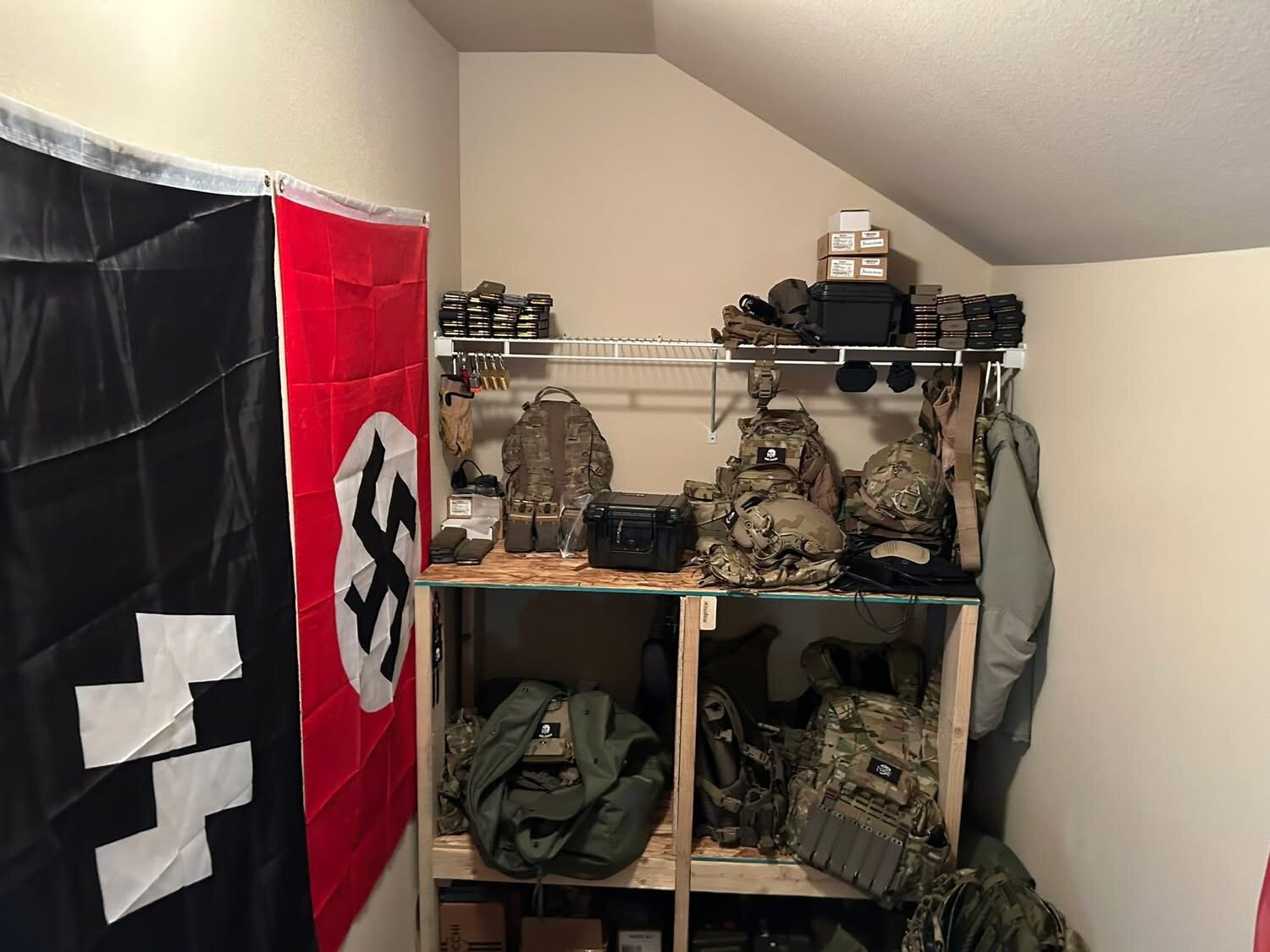
Follow‑on work by Army CID and local law enforcement took them to a house in Lacey used by both men. A search warrant turned up thirty‑five weapons, including rifles, pistols, a machine gun, and suppressors. Agents say they also found night vision devices, flashbangs, smoke grenades, body armor, blasting caps, and other military explosives. Each bedroom reportedly featured Nazi and white‑power flags, murals, and literature. The local sheriff publicly described the pair as “actively involved” in white nationalist activity.
On the blotter, Fields and Frakes are facing federal counts of robbery, assault, and theft of government property, each carrying potential double‑digit prison time. For now, they remain only accused, not convicted.
For door kickers, there are a few takeaways. First, this is what insider threat really looks like. Prior‑service guys who still know the layout, still have base access, and decide the arms room is their personal Walmart. Second, Rangers and other high‑speed-low-drag types can’t afford to treat sensitive gear like it won’t grow legs in garrison. If someone can come in with bolt cutters and fill rucks for two years, there is a physical security problem that needs to be addressed.
On the positive side, these two geniuses picked the wrong customer service rep. Masked or not, hammer or not, they tangled with a soldier who fought back, took the weapon, and pointed CID right to their door. Problem solved, problem staying solved. Rangers Lead the Way!
—
** Editor’s Note: Thinking about subscribing to SOFREP? You can support Veteran Journalism & do it now for only $1 for your first year. Pull the trigger on this amazing offer HERE. – GDM








COMMENTS