

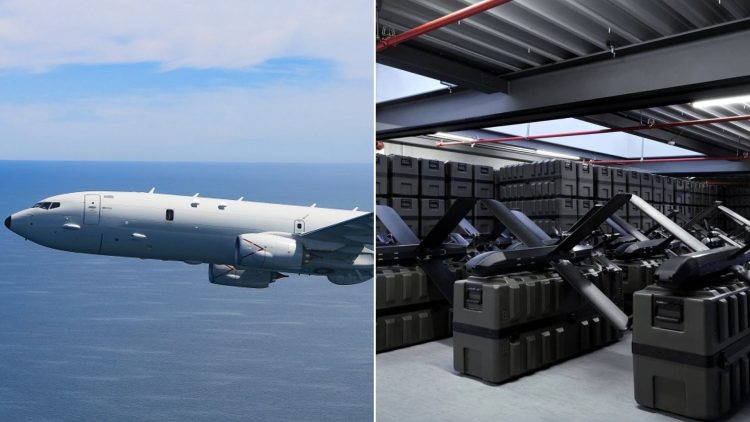
Drones have completely changed the way wars are fought, offering better surveillance and strike capabilities.
But Europe has struggled to keep up with demand. Helsing says its new facility is just the start—it aims to build more across Europe to scale up production when needed.
Germany will send Ukraine 6000 HX-2 AI suicide drones.
Via @JulianRoepcke & @BILD pic.twitter.com/etb9GXdhtM
— Visegrád 24 (@visegrad24) February 13, 2025
The HX-2 drones are designed to be mass-produced at a lower cost than traditional systems. They can travel up to 100 kilometers (60 miles), operate in swarms, and use AI to resist electronic warfare.
This follows an earlier Ukrainian order of 4,000 Helsing HF-1 drones, which are currently being delivered. With drone warfare shaping modern battlefields, Helsing’s expansion could make a big impact.
Australia Calls Out China for ‘Unsafe’ Jet Maneuver
Things got tense over the South China Sea this week when an Australian surveillance plane had a close encounter with a Chinese fighter jet.
According to Australia’s defense department, the Chinese J-16 strike jet flew dangerously close and dropped flares just 30 meters (100 feet) from the Australian Poseidon aircraft, calling the move “unsafe and unprofessional.”
China, however, saw things differently. Beijing accused Australia of violating its airspace near the disputed Paracel Islands, defending its actions as “legitimate and restrained.”
The incident prompted Australia to formally complain to China, emphasizing that its patrol was a routine mission in international airspace.
🇨🇳🇦🇺❗: A PLAAF Jian-16 fighter jet fired flares 30m from an RAAF P-8A patrol aircraft that had entered airspace over the disputed Xisha Islands in the South China Sea. The Australian Defence Ministry called the Chinese pilot’s actions “unsafe and unprofessional”. pic.twitter.com/F91uz7zWs1
— OSINT Expert (@OsintExperts) February 13, 2025
This isn’t the first time tensions have flared.
Last year, a Chinese destroyer allegedly blasted Australian Navy divers with sonar pulses, and a Chinese jet intercepted an Australian Seahawk helicopter.
Meanwhile, three Chinese Navy ships were recently spotted near Australia’s waters—though officials say that’s unrelated to this latest confrontation.
Australia has vowed to keep conducting surveillance flights as part of its right to freedom of navigation, but with China ramping up its military presence in the region, more close calls seem inevitable.
Border Tensions Rise as India, Pakistan Trade Shots
Tensions are heating up again in Kashmir.
Indian and Pakistani troops exchanged gunfire along their heavily militarized border, with Pakistan reporting four casualties—two soldiers and two civilians.
India, on the other hand, says its forces only returned fire after being provoked by Pakistan.
Neither side is offering much detail, with Pakistan’s military declining to comment and India’s army staying silent. But this latest flare-up comes just days after two Indian soldiers were killed by an improvised explosive device (IED) in the region.
Despite a 2003 ceasefire agreement, skirmishes like this are nothing new. Both countries claim Kashmir in full and have fought multiple wars over it.
While overall violence has decreased in recent years, deadly rebel attacks on Indian forces have led to a heavier military presence. India accuses Pakistan of helping militants cross the border to launch attacks, while Pakistan insists it only supports Kashmir’s right to self-determination.
Russia Hits Chernobyl Site with Drone, No Radiation Leak Reported
In a move that’s got plenty of people on edge, a Russian drone slammed into the protective cover over Chernobyl’s infamous Reactor 4.
Ukrainian President Volodymyr Zelenskyy confirmed the hit on Friday, reassuring everyone that radiation levels haven’t spiked.
The International Atomic Energy Agency (IAEA) backed that up, reporting an “explosion” at the site but no dangerous radiation leaks.
According to Ukraine’s Air Force, Russia unleashed over 100 drones across the country overnight, targeting northern regions—including the Chernobyl site.
Images from the IAEA show what appears to be the drone engulfed in flames after impact.
Last night, a Russian attack drone with a high-explosive warhead struck the shelter protecting the world from radiation at the destroyed 4th power unit of the Chornobyl Nuclear Power Plant.
This shelter was built by Ukraine together with other countries of Europe and the world,… pic.twitter.com/mLTGeDYgPT
— Volodymyr Zelenskyy / Володимир Зеленський (@ZelenskyyUa) February 14, 2025
For those who need a refresher, Chernobyl’s Reactor 4 blew up in 1986, causing the worst nuclear disaster in history. Soviet authorities tried to downplay it at the time, but the radioactive fallout spread across Europe. A massive steel and concrete sarcophagus was built over the wreckage to contain the radiation.
Zelenskyy called out Russia as the “only country in the world” attacking nuclear sites with zero regard for the consequences.
Moscow hasn’t responded yet, but this attack is sure to add fuel to an already raging fire in the Ukraine war.
Sources: News Agencies








COMMENTS