

(Note: all of the views expressed in this article are my own and do not necessarily the views of the United Launch Alliance)

3. We know that you put “stuff” into orbit to help the US Military. What can you tell us about this and the contribution that you and your team have brought to the table during the GWOT?
Well, you know from your experiences in the field that one of the huge advantages our military has over its opponents is its information flow and intelligence. We provide the launch services that puts the communications and intelligence gathering platforms in orbit that are vital for keeping the men in harms way in touch with the information and comms they need to stay alive and succeed. I am proud to think of us as a vital contributor to the USA holding the high ground – space. Our launch pace has become frenetic at times, as the field commands and national command structure demands more and more data but that is trivial compared to what you yourself have had to endure. I personally worked a couple launches earlier this year, one off of each coast, for my vehicle in the space of less than 2 weeks. Right now the fleet is launching every 21 days, with every payload a critical space asset.
4. I always wanted to ask an expert, what is the real deal with “space junk” floating around in orbit? Is it impeding your work and could it become a matter of national security in the future?
Yes – it is an issue and has impeded my work. What you see quoted as objects in orbit being tracked is actually a tiny portion of what is likely there. When you think of energy released it is really just a matter of closing velocity – a very small piece of junk (think 20 grams) travelling retrograde (in the opposite direction) to a satellite will have the energy equivalent of several pounds of C-4. Think of that C-4 detonated while attached to a computer server – only small pieces will remain, which is even more space junk. When the Chinese whacked a satellite several years ago they left a ton of un-categorized crap in a popular orbit. Add to that the shootdown a few months later of a crippled US satellite by US ship Based ABM systems directly slipped the launch I was working – I literally showed up at the site to finish my work and was told to go home for 2 weeks to let the orbits clear (gravity does bring stuff down) after being onsite for 15 minutes…
We are working on projects to bring down our upper stages from orbit more efficiently, which is some cool work but a lot of times we send them off on their merry way – check out some of the conspiracy theories about where our second stages go after launch, silly but great fun to watch unfold. We did send one of our upper stages to impact the moon on the LCROSS mission for NASA. The last operation we were responsible for (and I was nervous about watching it on the panels) was the separation of the payload from our upper stage so it could watch the crash into the moon. Ordnance started the show and finished the show on that one.
As for affecting national security – absolutely. The payloads we carry are packed with critical components. One stray bit whacks the bird and if we do not have something parked in a nearby orbit, we have an information hole for the men on the ground. That leads to degraded performance for you in the field.
5. Could you briefly walk us through the development of rocket technology in the United States? What were the factors that led to its development and the different directions that this technology has taken over the decades?
I will take you on a little bit different of a path actually. Since I am an ordnance guy, let me walk you down the path of that technology.
Coming directly out of the advances in propulsion in WWII, the use of propellants and explosive in aircraft and escape systems cropped up – to safely egress a vehicle at high speed, engineers looked to the simple gun type technology used to his doomed aircraft. One of the very earliest ejection systems, lovingly called a “bang seat”, was actually installed on the German Arrow Push-Pull fighter. The technology used though was quite simple – the seat was attached to a tube like the barrel of a gun and the pilot would fire the system after he opened his canopy, pretty slow process until the seat launched you out of the aircraft. Soon it was realized that all sorts of other problems existed. A catapult was pretty vicious on the occupants back. Gradually it was realized that the power source could be damped through various hydraulic flow passages to ease the acceleration loads on an occupants back.
Along with the vast increases in speed with aircrafts, a need was found to get the various and sundry projections around the pilot or weapons being deployed gone…so the canopy now gets kicked off with thrusters, or cut using explosive cord. Or a portion of a missile gets blown off prior to final deployment. The list is almost endless. The pilots feet get pulled pack with small charges tied to cables (predating seat-belt tensioners in lots of cars these days) and tables get pulled back away from their knees, flying wings get deployed on escape capsules, doors get closed over occupants during supersonic ejection etc….wherever a power source was needed quickly you could find a cartridge actuated device. In fact, one of the recent B1B losses successfully demonstrated a component I was very close to – the Aft Hatch Remover – and the crew all got out safely!
The true leaps started to come when, following the gun world, propellants worked through development to become much higher energy, cleaner firing, and far safer to handle – these are the LOVA propellants. Nitramine (RDX/HMX etc) based propellants that deliver something greater than 40% more energy per gram of load. In addition to great leaps in propellant energy delivered, the stability was also addressed, mainly in the nuclear weapons industry with HNS and THPP – and these propellants are all what we have now grown into in the modern rocket world. The combination of new propellants allows us to safely integrate vehicles in the way you carry cartridges in the field – “ship and shoot” we call it. This is the real leap above how the old black-powder devices could be trusted for use and handling.
6. In your opinion, what do you see in the future for rocket technology? What new technologies are on the horizon that could change the way you do business?
I see the future of chemical rocket technology as near its pinnacle. What is currently happening with chemical rockets is simple efficiency gains. With storable chemical liquid and solid fuels we have basically maxed out performance without going to nuclear fission or fusion propulsion. The trick is getting out of the Earth’s gravity well – and that requires thrust to overcome. Without the political will to re-open nuclear fission (NERVA) or Nuclear Pulse Propulsion (Orion), we are stuck with chemical reactions to provide motive power. The real cutting edge work in propulsion is with hypersonic vehicles powered by scramjets. This technology allows the portion of a rocket flying in the atmosphere to scoop its oxygen instead of carry it. Now as to my specific line of work..there is some amazing stuff going on with chemical explosives but I am just not at liberty to talk about it.
What I would love to see is the will to re-energize Nuclear Pulse Propulsion – this one is right up my alley. Launching a 10,000 ton spacecraft on top of the only propulsion combination that has extremely high Isp (which is critical to providing velocity change in microgravity environments) of the 20,000 sec range (the current chemical rockets are hard pressed to get 460 seconds) and massive thrust. This one is a world changer for certain. All on the back of huge explosions. The original test vehicle for this was called “Hot Rod” and launched on chemical explosives. Very cool.
Another potential small payload program around in the fringes is gun launch – my personal favorite. Giant cannons launching small payloads to orbit, or maybe just water and frozen foodstuffs…what the heck…to low earth orbit stations. I dabble with the interior ballistics on this as a hobby so when the personal patent I am working for this gets released, SOFREP will be the media point of release for me.
Now as to cool new technologies…The Space Elevator concept has always intrigued me. A simple ribbon that payloads crawl up into space upon. It is simply a momentum exchange with the planet, similar to used a gravity whip (“crack the whip” as it were) on an interplanetary mission to gain velocity. The material strength challenge for the project is daunting, and those materials can be translated back to everyday life on the planet, but done right you could take the elevator past geosynch and simply step off the edge to go on an interplanetary journey. Once a payload is in orbit, electric thrusters, in situ propellant factories, mass drivers (railguns) all can be used to get you where you need to go. Even solar sails – one of which is flying a Japanese mission to an asteroid rendezvous. This is a ways off.
Near term we work on methods to get more work out of the fuels we have, lightening our vehicles and working projects to carry extra payloads on mission where we have excess performance. In my field we are looking to leverage off the huge ordnance industry centered on automotive safety products and the commercial blasting industry to provide less expensive, but very robust components built in the high volume field.
7. Okay, now I’m going to ask for a little speculation if you don’t mind. What do you make of the Norway spiral? What is this thing? (http://en.wikipedia.org/wiki/2009_Norwegian_spiral_anomaly)
I remember this thing. It could very well have been the upper stage of a missile spinning in an uncontrolled manner along it’s longitudinal axis, don’t be fooled by the other videos in the first news releases of the first stage of a missile spinning end over end. From just a glance it looks more like a burn through on a gas generator on the upper stage and not the entire stage. The sideways shots look like a spreading plume from a Gas Generator (GG) used to spin the stage for stability and not the upper stage flipping end over end. My first thought was a leaking upper stage, but that would imply a liquid upper stage (extraordinarily dangerous in an SLBM) and the online stuff I found said solid stages only on the claimed perpetrator. A case failure on a solid rocket motor is pretty spectacular and over very quickly (Think Shuttle Challenger).
It seems impossible to view something like this on a space/ballistic launch with the naked eye but I have personally seen a second stage ignite on one of our vehicles during a night launch – and it was way downrange. Considering how long the spiral lasted, I wonder if the first stage of the vehicle had failed and this is just the dying body finishing its functions.
In the US we would have destructed the vehicle to protect the public. I don’t think other countries are nearly as careful – the recent loss of a Proton booster (http://www.usatoday.com/story/news/world/2013/07/02/russia-failed-rocket-launch/2481839/) highlights what happens when the vehicle is just allowed to crash downrange instead of being destroyed.
As to the colors – The lights would be the “Northern lights” – manmade though. Solids burn very hot and it is a good bet there is metal in the mix as a part of the fuel, so the hot particles come out ionized, interact with the upper atmospheric and give a nice color (I believe driven by the radiation in the solar wind). If my bet on the angle of view is correct, it is likely the upper stage main motor burning. Depending on the need, the thrust can be varied in a solid by changing the burning surface as it regresses – think of a cigarette, it “regresses” along its axis as it burns, most solids have some pretty funky burning surface to tailor the thrust versus time curve you need for flight. It would look like it pulses as it burns away. Cigarette burners were the very first JATO and fireworks rockets as they are easy to make. (Gun ballistics are even cooler – think 19 perf grains in machine gun ammo…..ordnance heaven right there, like sugar for a diabetic, what a rush!)
8. Next fun one, what in the world are those strange outlines out in the Chinese desert? Some have speculated that they are targets for orbital weapons platforms. What do you think? (http://www.dailymail.co.uk/sciencetech/article-2061424/Gobi-desert-images-Google-Maps-satellite-spots-bizarre-structures-China.html)
This is an unusual one, I know when it first came out there was huge speculation on it. It certainly looks like an enormous firing range to me. The lines are way to blurry to be some sort of calibration system, and if you could make a gigantic calibration grid in the desert I wouldn’t think your orbital sensors would need to be calibrated in this manner as your technology would already be there…as to the system it is the target for…
I fear this is for some sort of “Rods from God” kinetic orbital weapons system for damage assessment etc. That would cause lots of seismic sensors to go off, and the area would be covered in large craters soon so geo-politically I think it would be a demonstration, kind of like it is thought of (in some circles) that the Nagasaki nuke was towards the Russians.
9. What do you think about China’s space program? Are they competitive with us?
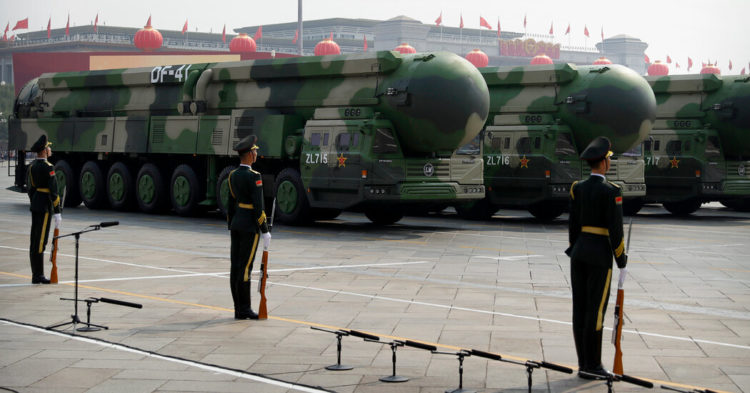
They concern me. They are wizards at getting open source information all over the place (I see them publish all sorts of innovative stuff in my field) and blend technologies from East and West for their launch programs. They are putting more payloads in space now than we are, including a manned space program with a manned orbiting station. Their system looks to be a blend between free-form capitalism with no humanity to temper it from their communism side that will ruthlessly use their human capital to take the high ground. All the international space conferences are trending towards China so yes…they are our direct space rivals in my opinion.
10. What message would you like to send the soldier pounding ground out there and making use of the platforms that you have helped put into orbit?
You are not alone, I will never let something get in the way of us putting the assets in position you need to keep agile and in touch with enough help to get you out of any problem. That is my side of this oath of fealty that I give to all the men who have volunteered to serve protecting my family and my country. No longer will you have to leave safe cover for certain death you have chosen because you can not call down hell in your support. No longer will your commanders not know what is happening in the desert when equipment breaks and improvisation to make mission has to happen.








COMMENTS