
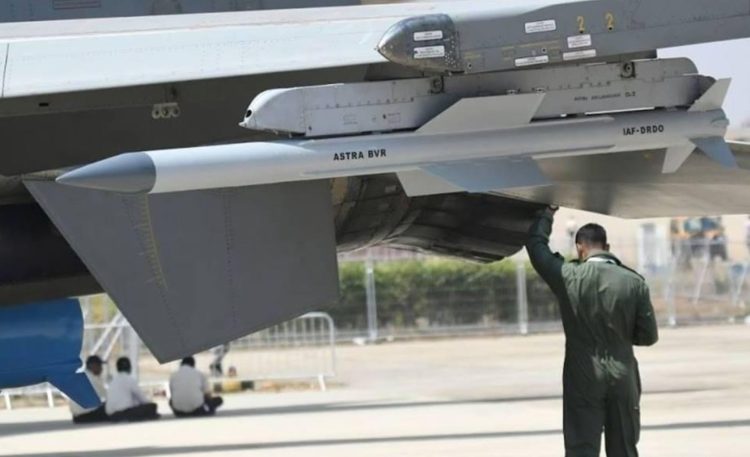
The Astra BVR Missile: India’s Sky Spear
Let’s talk about the snake in the grass—the Astra Beyond Visual Range (BVR) missile. This is some serious homegrown venom. Developed by India’s Defense Research and Development Organization (DRDO), Astra is Latin for “weapon of the gods.” And that’s no accident.
This all-weather, active radar-guided missile has a range of around 110 km (68 miles) in its Mk-1 configuration. But there are whispers (and test footage) that the Mk-2 and Mk-3 variants are pushing the range much farther—well into 200+ km territory.
Its guidance system includes an inertial navigation system with mid-course updates, flipping to active radar homing as it closes in. It can go Mach 4.5, turn on a dime, and strike with high precision even when your pilot’s sweating bullets and throwing chaff like candy to kids at a Halloween parade.
What makes it deadly isn’t just its speed or range—it’s the fact that it’s made in India, for Indian conditions, Indian doctrines, and Indian jets. You want self-reliance in aerospace warfare? Astra is their flagship.
This thing’s been test-fired from Su-30MKIs, Mirage 2000s, and Tejas fighters. It’s like the Swiss Army knife of Indian air dominance. You need to knock something out before it even knows you’re there? Astra’s already on it.
Strategic Implications: A Message in Steel and Smoke
Here’s the rub: India’s pairing of the Su-30MKI with Astra missiles is a tactical and geopolitical mishmash in the best possible way. This is about more than defending airspace. It’s about sending a message to adversaries who like to test boundaries in the Himalayas or over the Indian Ocean.
The Su-30MKI-Astra combo allows India to challenge aircraft deep inside contested zones—without ever crossing a line. It’s deterrence by capability, sovereignty by innovation.
The Chinese have their PL-15s, the Americans have the AIM-120D AMRAAMs. India’s response? The Astra—crafted at home, tested under pressure, and now deployed beneath the wings of one of the world’s most agile fighters.
It’s both defense and declaration.
Final Thoughts
The sight of this pilot beneath his machine, dwarfed by the warhead he’s about to unleash if duty calls, is a portrait of modern warfare: locally sourced, globally relevant, and deeply personal.
This isn’t the IAF of the early ’70s or even 1999. This is an outfit building its own weapons, fine-tuning foreign machines, and flying into the 21st century with a custom loadout and a chip on its shoulder. And that should make the bad guys nervous.








COMMENTS