Armed militias filling the streets of Caracas are more than a show of force; they’re the clearest signal yet that Venezuela is bracing for a storm it can feel long before it sees.
Read the full article for more on:
Important insights and detailed analysis
Expert commentary on current events
Breaking developments and updates
Updating summary...
SOFREP Pic of the Day: Venezuela Arms Its Citizens
Guy D. McCardle
Speed
1x
Listen
COMMENTS
Armed militias filling the streets of Caracas are more than a show of force; they’re the clearest signal yet that Venezuela is bracing for a storm it can feel long before it sees.
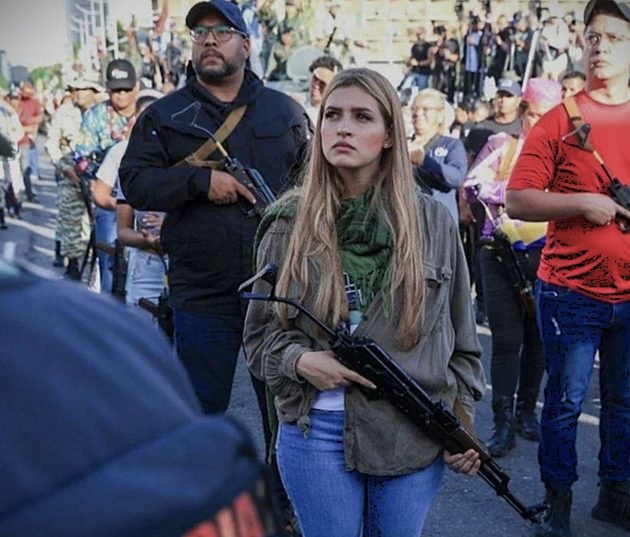
A young Venezuelan militia fighter grips her rifle in a sea of armed citizens as Caracas braces for whatever comes off the horizon. Image Credit: Reddit
Rifles In The Streets Of Caracas
Check out our “pic of the day”. Here we have a young woman, scarf around her neck, hands wrapped around an old East German MPi-KM rifle, while a sea of nervous faces and other citizens with slung rifles stretches into the distance. That is not a parade; it is a warning flare from a country that has been living on the edge for years. Venezuela is arming its citizens again, and this time they are staring out toward a horizon crowded with American warships.
Advertisement
On paper, President Nicolás Maduro calls it “popular defense.” In practice, it is a mix of regime survival, cartel protection program, and human shield for a government that knows a lot of powerful people would love to see it fall.
Maduro’s Human Shield: The Bolivarian Militia
The backbone of the current push is the National Bolivarian Militia, a civilian reserve force created under Hugo Chávez and folded into the armed forces as a “fifth component.”
Recent reporting out of Caracas describes long lines of civil servants, housewives, and retirees signing up or updating their status with the militia after Maduro urged citizens to answer a supposed U.S. invasion threat. The government claims roughly 4.5 million people have already received some level of training and says new digital enlistment drives could push that number toward 8 million.
Advertisement
For a regime that no longer trusts its own regular army, that many rifles in civilian hands are political insurance. Loyalty to the “Bolivarian revolution” is worth more than marksmanship. These formations are paraded on television, rifles held high, with Maduro promising that the United States will find every barrio a battlefield if it ever comes ashore.
Colectivos, Cartels, And A Country Full Of Guns
The militias are only one part of Venezuela’s armed mosaic. You still have the colectivos, the pro-government paramilitary gangs that operate in poor neighborhoods as enforcers, political muscle, and sometimes outright criminal syndicates. Human rights groups and regional analysts describe them as an armed wing of Chavismo, used to crush protests, intimidate journalists, and keep the population in line.
Advertisement
Then there are Colombian guerrilla factions, loyalist militias, and a long list of criminal gangs, all feeding off a glut of weapons. A detailed study on Venezuelan violent groups notes that colectivos, Colombian insurgent remnants, paramilitaries, and organized crime outfits now form a crowded ecosystem of non-state armed actors with overlapping ties to elements of the security forces.
Add in the regime’s brutal post-election crackdown after the disputed July 2024 vote, where security forces and pro-government groups killed, tortured, detained, and disappeared opponents, and you get a sense of why ordinary Venezuelans see rifles on both sides of the street.
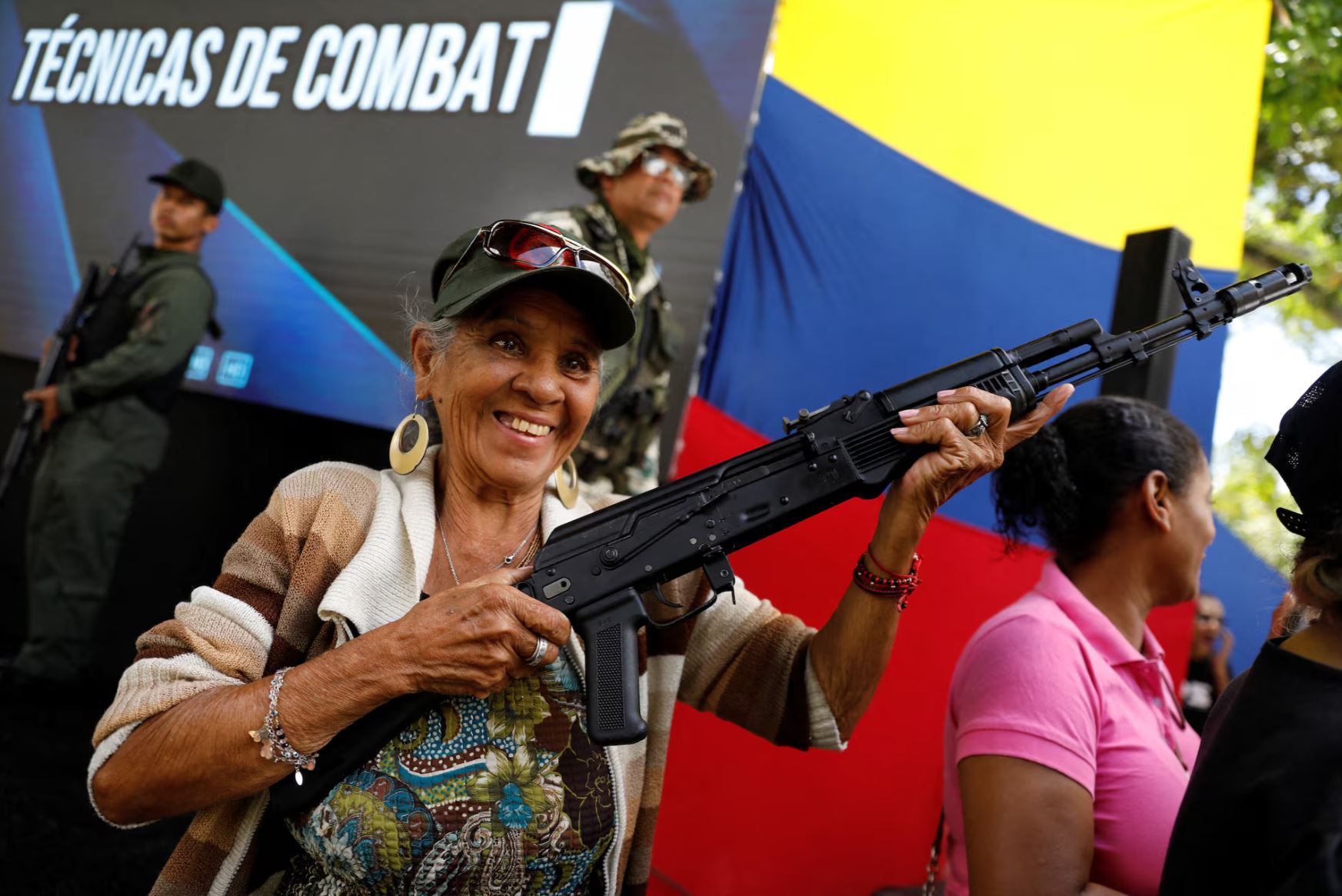
This Venezuelan woman seems happy to be holding a weapon during a training drill led by the Bolivarian National Armed Forces. Image Credit: Reuters
A Price On Maduro’s Head
Washington’s view of Maduro is no mystery. In 2020, U.S. prosecutors in New York charged him with narco-terrorism and cocaine trafficking, basically accusing the Venezuelan state of operating as a cartel with a flag. The State Department initially put a reward of up to 15 million dollars on his head. That figure has climbed over time, first to 25 million, and recent reporting says the current administration has gone as high as 50 million for information leading to his arrest and conviction.
Advertisement
When a sitting head of state carries a bounty that looks like something out of a cartel manhunt, every ship that hoists an American flag near his coastline feels personal.
The U.S. Navy At The Door
Those ships are not hypothetical. Over the past year, the United States has stacked a serious amount of steel in and around the Caribbean under U.S. Southern Command. At various points, seven American warships and a fast-attack submarine have been stationed close to Venezuelan waters, described by some analysts as the largest regional U.S. naval presence since the Cuban Missile Crisis.
Most recently, the carrier USS Gerald R. Ford sailed into the broader Latin American theater with three guided-missile destroyers, adding to an existing flotilla of eight warships, a nuclear submarine, and F-35s already tasked to the counternarcotics mission. The Pentagon says the focus is on drug traffickers and transnational crime; U.S. forces have already struck suspected smuggling vessels in the Caribbean and eastern Pacific, killing at least 76 people in a few months of operations, which has drawn pushback from some allies.
To Maduro, those explanations sound about as comforting as a customs form taped to a Tomahawk. State media presents the deployment as the forward edge of a regime-change plan. Venezuelan officials talk about “continental defense” and warn that any landing will be met by millions of armed patriots.
Essequibo, Oil, And A Crowded Chessboard
Tension is not limited to the U.S.–Venezuela relationship. The long-running territorial dispute with Guyana over the Essequibo region flared again after major offshore oil finds and new drilling licenses. Venezuelan naval incursions into Guyanese-claimed waters triggered sharp protests from Georgetown and Washington, and U.S. warships have trained alongside Guyana, the United Kingdom, and the Netherlands in nearby waters.
From Caracas, this looks like encirclement: oil to the east, sanctions from the north, and a sky full of drones and maritime patrol aircraft tracking every hull that leaves port.
A Nation On A Tripwire
Inside Venezuela, the air feels heavy. Years of economic collapse, mass migration, and political repression have hollowed out the middle of society. The people who stay either cannot leave, are tied to the regime, or are too stubborn to quit. You see them in that photograph, standing in the street with second-hand rifles, somewhere between defiance and resignation.
The United States says it is chasing smugglers and squeezing a corrupt regime that poisons Americans with cocaine and fentanyl. Maduro says he is facing an empire that would cheer his downfall and is turning to the armed poor to save him.
Both things can be true at the same time.
What matters on the ground is that every new militia registration drive, every carrier strike group entering the region, and every fresh batch of sanctions pushes the situation closer to the point where a misread radar return or a jittery militia checkpoint could light a fuse.
Venezuela is arming its citizens while a chunk of the U.S. Navy rides the horizon. Between those two hard facts lies a band of uncertainty wide enough to lose an entire country in.
—
** Editor’s Note: Thinking about subscribing to SOFREP? You can do it now for only $1 for your first year. Pull the trigger on this amazing offer HERE. – GDM
Advertisement
What readers are saying
Generating a quick summary of the conversation...
This summary is AI-generated. AI can make mistakes and this summary is not a replacement for reading the comments.









COMMENTS