

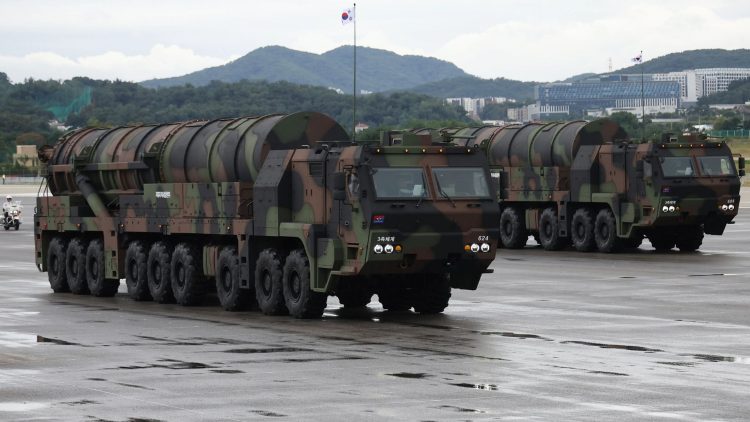
While categorized as a short-range missile, the Hyunmoo-5’s range can reportedly extend beyond 5,000 kilometers (3,107 miles) when equipped with a lighter, one-ton warhead.
This puts significant areas, including parts of China and Russia, within reach, underscoring its strategic importance not only for deterring North Korean threats but also for asserting South Korea’s position in regional defense.
Significance for South Korean Defense
The unveiling of the Hyunmoo-5 during the Armed Forces Day parade is not just a display of military might; it is a crucial part of South Korea’s “three-axis” defense system, a comprehensive strategy designed to counter North Korea’s growing nuclear and missile capabilities.
This three-pronged strategy includes:
Kill Chain: A preemptive strike strategy designed to target and destroy North Korean missile facilities before they can launch.
KAMD (Korea Air and Missile Defense): A defense system aimed at intercepting incoming North Korean missiles.
KMPR (Korea Massive Punishment and Retaliation): A strategy focused on crippling North Korean leadership and infrastructure should a conflict arise.
In his speech at the parade, South Korean President Yoon Suk Yeol emphasized the significance of the Hyunmoo-5 and other military advancements in countering the threats posed by North Korea.
Yoon made it clear that any use of nuclear weapons by Pyongyang would result in a “resolute, overwhelming response” that could signal the end of the North Korean regime.
His words, coupled with the display of advanced military hardware, sent a strong message that South Korea is prepared to defend itself against any aggression.
“Our government, based on the solid ROK-U.S. alliance, will further strengthen security cooperation between the Republic of Korea, the United States, and Japan and closely align with the international community to solidify our security posture even more firmly,” South Korean President Yoon said in his speech on Tuesday, October 1.
US B-1B Strategic Bomber Joins the Parade
One of the parade’s standout moments was the participation of an American B-1B strategic bomber, making its first-ever appearance in South Korea’s Armed Forces Day event.
The B-1B Lancer is a long-range bomber capable of carrying a substantial payload, making it a critical asset in both conventional and nuclear warfare scenarios.
The bomber’s presence underscored the close military alliance between South Korea and the United States, reinforcing their commitment to a joint defense strategy in the face of North Korea’s ongoing missile and nuclear provocations.
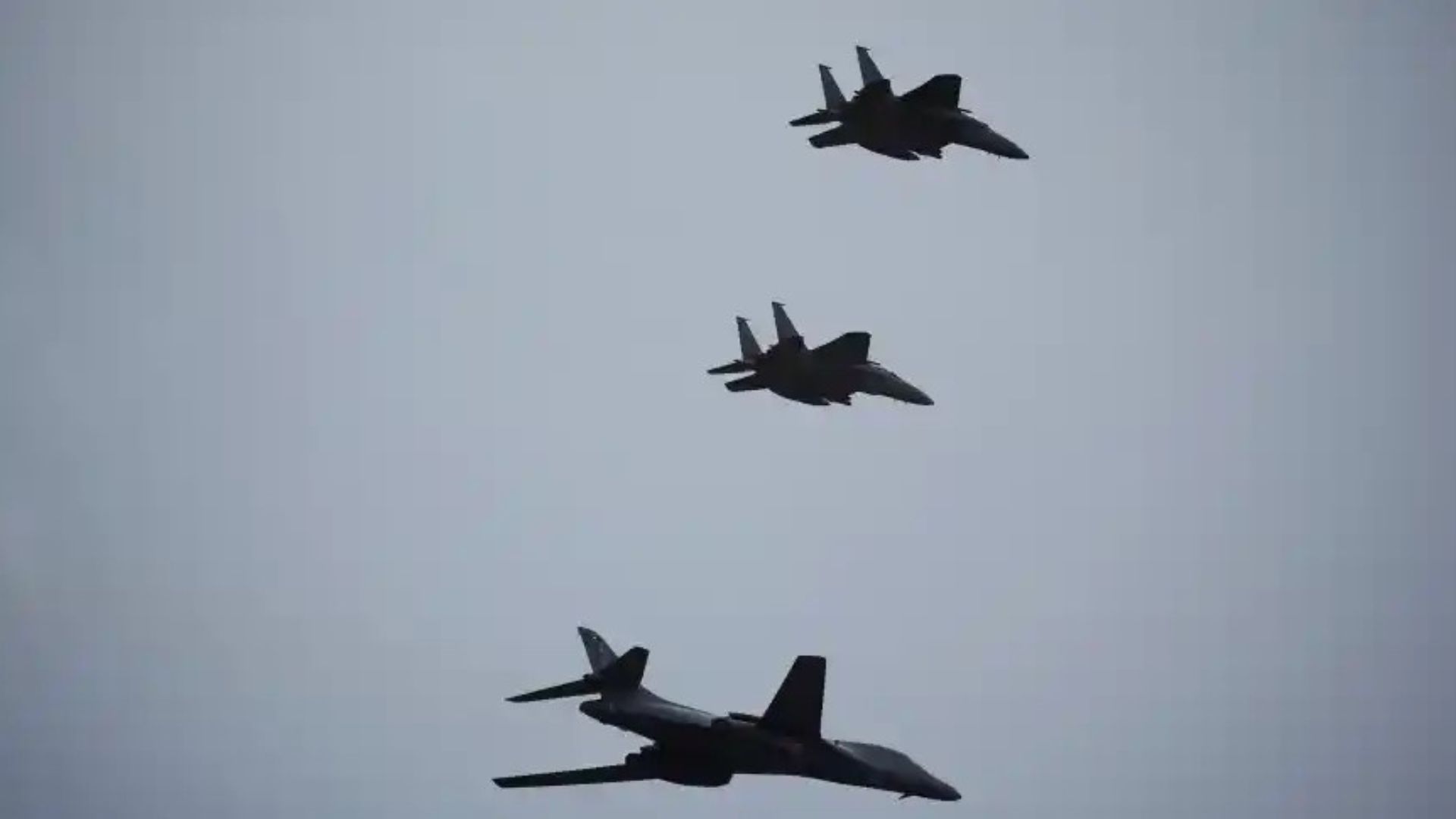
The flyover was not just symbolic; it served as a reminder of the formidable military assets that the US brings to the table in its support of South Korean security.
South Korean and US forces have long coordinated their defense strategies, and the B-1 B’s participation was a visible signal of how tightly woven this alliance has become.
Its inclusion in the parade was also a warning to North Korea that any aggression would be met with a swift and powerful response.
North Korea’s Reaction
Unsurprisingly, the show of military strength did not go unnoticed by North Korea.
Just hours before the ceremony, Kim Kang Il, North Korea’s Vice Minister of National Defense, issued a statement condemning the US bomber flypast, describing it as a “reckless military bluff” and calling for retaliatory measures.
The Vice Minister accused the US and South Korea of conducting provocative actions, particularly criticizing the recent deployment of a nuclear-powered US submarine to South Korea.
“Fresh methods of adding serious concern to the security of the US mainland should be surely produced,” Kim said in a statement. “The armed forces of the DPRK will never remain a passive onlooker to the military provocative acts of the hostile forces escalated in three dimensions in the Korean peninsula and its vicinities, but take a thoroughgoing action corresponding to them.”
—cited by Korean Central News Agency (KCNA)
DPRK, or Democratic People’s Republic of Korea, is the official name of North Korea.
North Korea has long been critical of joint military exercises and displays of military power between South Korea and the US, viewing them as provocations.
However, this year’s parade, particularly with the involvement of the Hyunmoo-5, has undoubtedly added to the regime’s concerns.
As mentioned, the Hyunmoo-5’s ability to target underground bunkers directly threatens North Korea’s strategy of using hidden, fortified command centers in the event of a conflict.
In response, North Korea has pledged to continue developing its “powerful war deterrent,” likely signaling more missile tests and military posturing in the near future.
Closing Thoughts: South Korea’s Defense Just Got Serious
The unveiling of the Hyunmoo-5 marks a significant step forward in South Korea’s defense strategy. This powerful weapon, combined with the broader military capabilities showcased at the Armed Forces Day parade, demonstrates that South Korea is fully prepared to defend itself against any threats from North Korea.
With the participation of the US B-1B bomber and other advanced military assets, the event served as a reminder that the US-South Korea alliance remains strong and ready to respond to any provocation.
While North Korea continues to develop its missile and nuclear programs, South Korea’s message is clear: it will meet any threat with overwhelming force, and the Hyunmoo-5 is at the forefront of that defense.
—
Disclaimer: SOFREP utilizes AI for image generation and article research. Occasionally, it’s like handing a chimpanzee the keys to your liquor cabinet. It’s not always perfect and if a mistake is made, we own up to it full stop. In a world where information comes at us in tidal waves, it is an important tool that helps us sift through the brass for live rounds.








COMMENTS