

Let’s not forget about the four bodies of American hostages that have yet to be repatriated by Hamas.
Over in D.C., President Trump took a victory lap, calling the release a “step taken in good faith” and using it as proof that his administration is still capable of pulling diplomatic rabbits out of hats. Hamas, for its part, hinted that in exchange for this “gesture,” it expects the U.S. to grease the wheels for future Israeli concessions—like releasing some Palestinian prisoners and easing up on humanitarian restrictions.
Both Qatar and Egypt chimed in with diplomatic niceties, hailing the release as a “positive gesture” that could thaw the frozen ceasefire talks. But let’s be honest: this wasn’t a grand resolution—it was a high-stakes trust fall. No ceasefire. No prisoner swap. Just one young American out of the clutches of a terrorist group, and maybe, just maybe, the opening move in a longer, more productive negotiation.
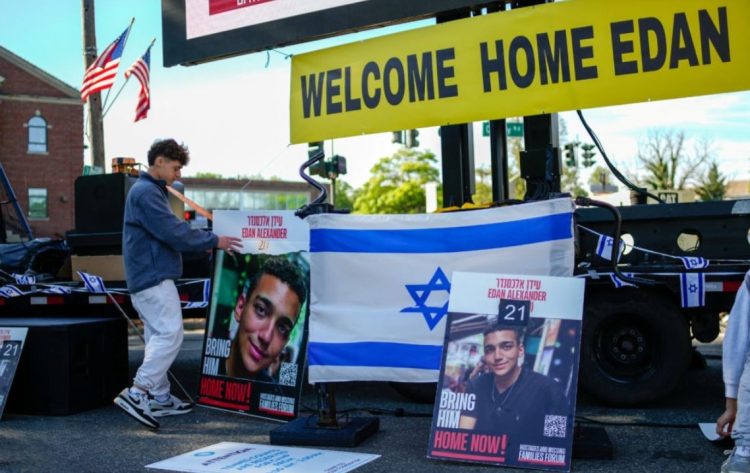
Following his release, Alexander underwent initial medical evaluations at a defense facility in Re’im, Israel. He was then transferred to Ichilov Hospital in Tel Aviv for further treatment. Back in Tenafly, the community erupted in celebration. Residents gathered in Huyler Park, waving flags and expressing relief that their local son was finally coming home. The joyous occasion was tempered by the somber reality that many hostages remain unaccounted for.
Reflections on a Turbulent Journey
Edan Alexander’s 19-month nightmare in Gaza became a story of survival, a crash course in the brutal art of endurance, the raw power of advocacy, and the kind of hope that refuses to die, no matter how dark the circumstances. Through it all, one thing became clear: when families, communities, and even whole nations refuse to shut up or back down, things start to move.
His mother, Yael, was the anchor in the multi-year storm. She kept going not just for Edan, but for her other kids—holding the family together with duct tape and determination, clinging to daily routines while the world teetered on the edge. She became a public voice for the hostages, and damn if that didn’t matter. Alongside other families, she made sure no one forgot Edan or the others. They marched, they shouted, they met with diplomats. They turned private grief into public action, and that pressure helped keep the hostage issue front and center in international politics.
Then there was the Hostages and Missing Families Forum—a mouthful of a name for a group that became a lifeline. These folks didn’t just sit around lighting candles. They organized, they rallied, they made noise. And that noise turned into leverage. It reminded governments that behind every negotiation stall and political excuse, there were real people wasting away in Hamas captivity.
Even from inside that hellhole, Alexander didn’t fold. The guy spent two birthdays underground and still found the guts to speak up for others—reportedly even advocating for Thai workers held alongside him. Other released hostages described him as skinny but unbowed. That kind of empathy and grit doesn’t come from nowhere. It’s built in, forged through training, and whatever moral compass he carried into that fight.
But the real throughline in all of this? Hope. Not the soft, fuzzy kind. The kind you have to drag through the mud and beat back into shape every morning. Hope that your kid is still alive. Hope that the next phone call brings news. Hope that somehow, somewhere, this ends with a hug and not a coffin. As Yael said, “It’s not easy, but you know what, I’m taking strength from my kids… to give them also a lot of hope that Edan is okay.” That’s more than parenting—that’s battlefield-quality leadership.
And finally, the deal itself. It didn’t come easily. It wasn’t clean. But it worked. Through direct talks, relentless pressure, and a rare bit of coordination among the U.S., Qatar, Egypt, and whoever else got roped into the room, Edan came home.
That’s the lesson: hope only works when it’s backed up with action. When people don’t give up. When diplomacy keeps grinding, even when the odds look worse than a blackjack table at 3 a.m.
Edan Alexander’s story isn’t a fairy tale. It’s a reminder that in the worst conditions imaginable, with enough willpower and enough noise, good can claw its way out of the pit.
Hope isn’t just a feeling—it’s a weapon. And sometimes, it’s the only one we’ve got.








COMMENTS