

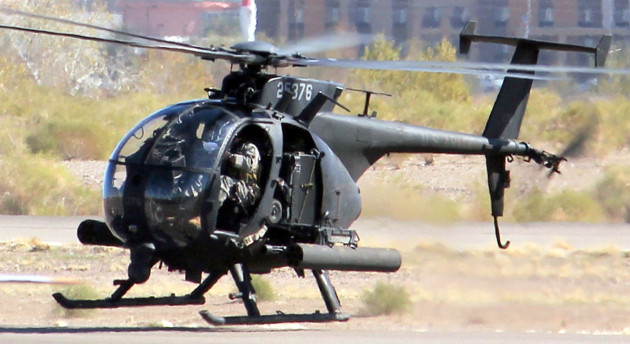
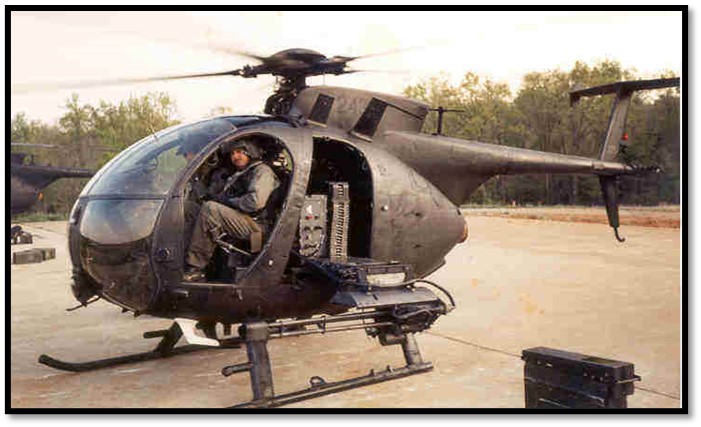
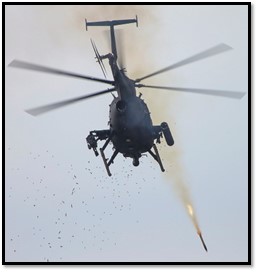
Flying as low as five feet at times, Cooper relentlessly attacked the enemy forces with his twin, M134D-H Gatling guns and 70mm rockets, while defending 20 American special operations soldiers on the ground, but he kept running low on fuel and ammunition, and had to land repeatedly beside his wingman’s downed helicopter to offload its ammunition and auxiliary fuel tank, aided by U.S. troops on-scene, under enemy fire the entire time.
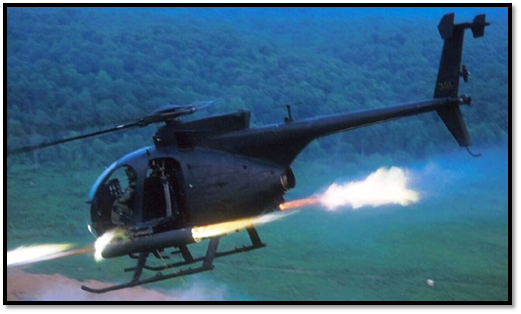
He and his copilot valiantly flew again and again, destroying enemy trucks and a house that they were using for cover, while simultaneously sustaining multiple bullet strikes from the insurgent machine guns. The American troops on the ground were pinned down, outnumbered, and seriously outgunned, with only Cooper to rely upon for close air support.
Just as the tide of battle was beginning to turn, a U.S. Air Force F-16CM Fighting Falcon pilot, Major Troy L. “Trojan” Gilbert, was finally able to identify the enemy vehicles and strafe them from ultra-low level (less than 200 feet altitude) with his 20mm Gatling gun, but he crashed and died about four miles away, posthumously earning the Distinguished Flying Cross with “V” device for valor. Gilbert’s commanding officer stated that, “Troy fought like a tiger in battle that day.” His remains were finally discovered by a tribal leader in Iraq, and sent back to the U.S. in 2016, and were buried in Arlington National Cemetery, Virginia.

After landing a fourth time, Cooper was finally out of fuel and ammunition, and a new team of AH-6Ms was inbound to relieve him. He was subsequently presented with the Distinguished Service Cross, the Army’s second-highest award for valor, and the highest-ever award for a Night Stalker pilot at that time. The citation read that, “his aggressive actions, complete disregard for his personal safety, and extreme courage under fire resulted in him single-handedly repelling the enemy attack…If not for…Cooper’s action, the ground force would have become decisively engaged, and would certainly have taken heavy casualties.”
Less than three years later, on September 14, 2009, al-Qa’ida-linked, al-Shabaab terrorist leader Saleh Ali Saleh Nabhan was located by the CIA, traveling in a two-car convoy near Baraawe, Somalia. When the convoy stopped for breakfast, they were suddenly attacked by a pair of AH-6M Little Birds with GAU-19/A heavy machine guns, accompanied by two unarmed, MH-6M transports carrying U.S. Navy SEALs.
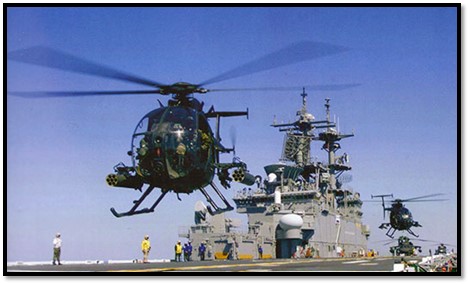
Operation Celestial Balance was launched from a naval vessel offshore, and the result was that Nabhan and five more terrorists were killed, and his body was recovered for positive identification. Navy personnel referred to the menacing, black Little Birds as “Seabats,” an unofficial nickname. This was another typical AH-6M gunship mission.
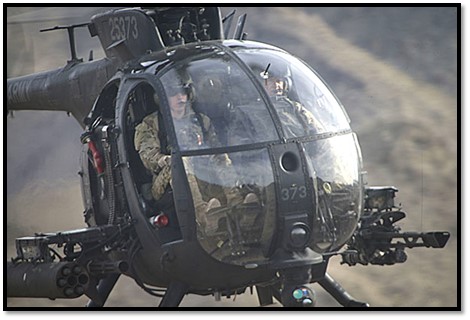
160th SOAR(A) personnel currently wear the standard Army Aircrew Combat Uniform in the Operational Combat Pattern, similar to MultiCam, with suede combat boots or jump boots in Coyote Brown. As paratroopers, they also wear the Army’s maroon Airborne beret when in garrison.
Major General Aubrey S. “Red” Newman, former commander of the 34th Infantry Regiment in World War Two, and holder of the Distinguished Service Cross, the Army’s second-highest award for valor, noted that, “Parachute jumping tests and hardens a soldier under stress in a way that nothing short of battle can do. You never know about the others. But paratroopers will fight. You can bet on that.”
Aircrew survival and self-defense weapons carried by 160th SOAR(A) pilots normally include the Colt M4A1 carbine and the SIG M17 pistol (sometimes the Colt M1911A1 handgun in the past, which Delta Force formerly used), or possibly the Glock-19 Gen. 4/5 pistol, currently favored by Delta Force, SEAL Team Six, Army Rangers, the CIA, and most other special operations units. They are also trained to use Russian-made AK-47-series and AK-74-series assault rifles, in case these are the only weapons available, captured from enemy forces in a combat scenario. The Aircrew Survival Egress Knife (ASEK) completes their pilot gear.
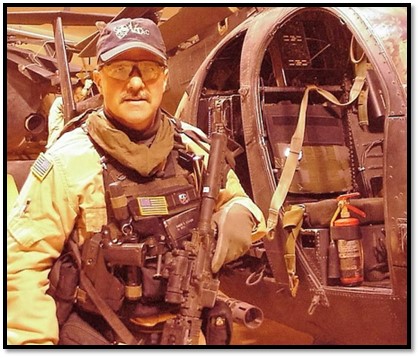
The U.S. Army has begun replacing its M4A1 carbines and M249 squad-automatic weapons in 5.56mm for its frontline, combat units (including special operations forces) with the SIG M7 Spear carbine in 6.8x51mm, with a 13-inch barrel and 20-round magazine, using .277 SIG Fury cartridges. Special operations forces are certainly high on the list to receive these powerful, new rifles as soon as they are available.
At least 22 nations fly variants of the MD-500D/E, MD-530F/G, MH-6J/M, and AH-6J/M/i/R-series helicopters, all based upon the same airframe, with armed, gunship models known to be operated by the military forces of Jordan (6 x MD-530FF and 6 x AH530-BII), Kenya (45 x MD-530F), Lebanon (5 x MD-530F+ Cayuse Warriors), Malaysia (6 x MD-530G-BII), North Korea (84 x MD-500D/E), the Philippines (24 x MD-520MG Defenders), Saudi Arabia (23 x AH-6SA), South Korea (212 x MD-500MD Defender IIs and 45 x MD-520MK Black Tigers), and Thailand (8 x AH-6i), with Nigeria to receive 12 x MD-530F+ Cayuse Warrior gunships soon.
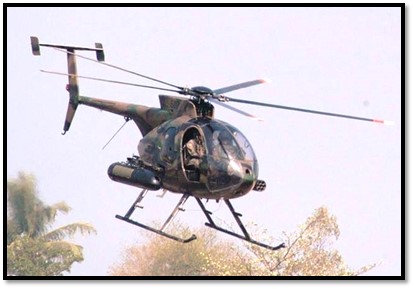
The U.S. Army’s AH-6M/R Little Bird attack helicopter is still the quietest and most advanced of all of these variants, however, the Malaysian and Jordanian MD-530G-BII (AH530-BII) employs the versatile, Thales Scorpion helmet-mounted display (HMD) system from the U.S. Air Force A-10C Warthog attack aircraft, all F-16CM/V Fighting Falcons/Vipers, and the F-22A Raptor stealth fighter, which the AH-6M currently lacks, although this has been updated with the newer, Elbit (Israeli) HDTS (Helmet Display and Tracking System) on the latest versions.
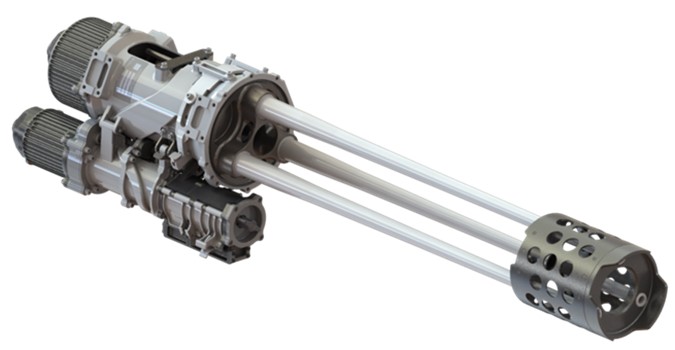
DillonAero (the manufacturer of the M134D-H 7.62mm Gatling gun) currently offers weapons-upgrade packages for the AH-6M Little Bird, including the Mission-Configurable Aircraft System (MCAS-500AH), with up to six weapon stations instead of the standard four, adding two wingtip AGM-176B Griffin-B laser-guided missiles, and the brand-new 503D Gatling gun, designed to replace the .50-caliber, three-barrel, GAU-19/B weapon that is currently standard on the AH-6M. The 503D is 21 percent lighter and 6.5 percent faster-firing than the already lightweight GAU-19/B, which has been in service since 2012.
ArmyRecognition.com posted on January 6, 2026, “Operation Absolute Resolve…the January 3, 2026, raid conducted in Venezuela to capture President (Nicolás) Maduro…high-risk, urban raid in Caracas…the AH-6M is difficult to detect, and can engage point targets with remarkable precision, making it a favorite for supporting SOF teams in dense, cluttered, combat zones.
“(The) AH-6Ms likely flew close escort for MH-6M (troop transport) insertions, offering micro-level, fire support to operators working building-to-building…eliminating rooftop shooters, intercepting hostile vehicles, or striking narrow targets inaccessible to larger gunships. Their presence ensured that the Night Stalkers maintained constant eyes-on-firepower across the urban battlespace, providing rapid-response capability within seconds of a threat emerging.”
Effective March 4, 2025, the Boeing company discontinued production of the vaunted AH/MH-6M Little Bird series. However, MD Helicopters of Mesa, Arizona, is currently in the process of constructing 52 brand-new, ultra-modern, AH-6R Little Bird gunships and MH-6R Little Bird unarmed transports for the 160th Special Operations Aviation Regiment (Airborne).
This upgrade includes a new, zero-time fuselage, a major cockpit facelift, and raises the gross weight limit by 6.4 percent, to 5,000 pounds total, with structural modifications for an increased safety margin. They are also looking at integrating the extra-powerful, General Electric T901 turboshaft engine, and the APQ-187 Silent Knight terrain-following/terrain-avoidance (TF/TA) radar for low-level flight. The first AH-6R was delivered in 2025, and the final example should be delivered by 2031. The 160th SOAR(A) plans to operate them at least as far out as 2040.
In conclusion, today’s amazing AH-6M/R Little Bird special operations gunships remain small, nimble, able to take off and land almost anywhere, and rapidly deployable to hot spots and war zones around the world, while constantly evolving to incorporate the latest weapons and technologies available.








COMMENTS