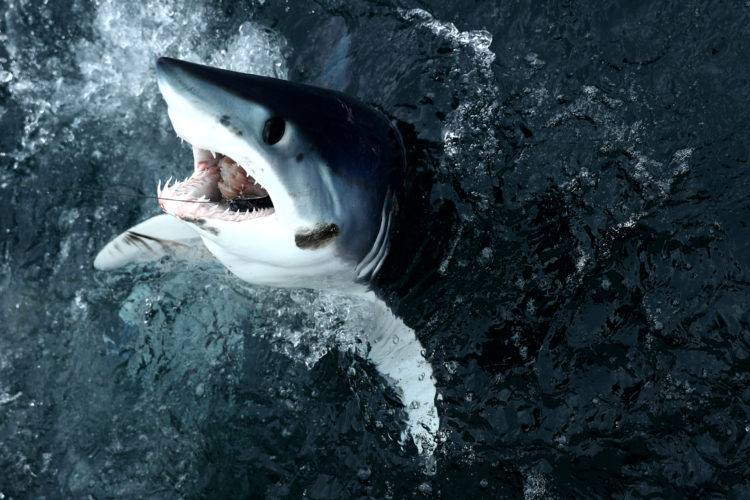
In the never-ending quest to improve the performance of military aircraft, the U.S. Army is testing an unusual material that may make airplanes and helicopters faster and stronger: the skin of the mako shark. New research currently being done at the University of Alabama is exploring why mako sharks can reach unbelievable speeds underwater. According to a recent report from Army Technology, makos have been known to reach “speeds of up to 70mph or 80mph.”
The researchers are hoping to unlock the mystery of the mako’s skin, and possibly develop a synthetic version for use on aircraft. The secret could be the small scales that cover the animal’s body. The scales, which are approximately 0.2mm in length, “can flex at angles more than 40° from the shark’s body” and are triangular in shape.
“It impedes the flow from reversing near the skin, which would otherwise lead to what we call flow separation,” said Dr. Amy Lang, an aeronautical engineer at the University of Alabama who is leading the experiments. “This is the drag you experience if you stick your hand out your car window vertical to the airflow.”
Lang compared the scales’ performance to the dimples found on golf balls. During a presentation at an American Physical Society meeting that took place in Boston this week, Dr. Lang explained how dimpled balls travel “30 percent farther” than smooth balls, according to a report from The Independent. Although circular dimples on an aircraft may affect its lift, the triangular scales found on the mako may be the key to improving aircraft speeds without sacrificing other characteristics.
The tests have produced promising results, with mako skin outperforming man-made materials in water resistance tests. The research is being funded by both the Army and the Boeing Corporation, and is using skin samples taken from the shark’s sides. Further testing is needed to prove the shark skin theory, and a man-made material mirroring the mako skin has yet to be developed; however, researchers at Alabama are optimistic the tests could revolutionize the aerospace industry.
“The potential for a man-made surface to utilize this entirely passive mechanism even in air is very exciting,” said Lang.
The Atlantic shortfin mako shark, the same being used in the tests, can be found throughout waters along the entire length of the East Coast and into the Gulf of Mexico, according to the
Already have an account? Sign In
Two ways to continue to read this article.
Subscribe
$1.99
every 4 weeks
- Unlimited access to all articles
- Support independent journalism
- Ad-free reading experience
Subscribe Now
Recurring Monthly. Cancel Anytime.