

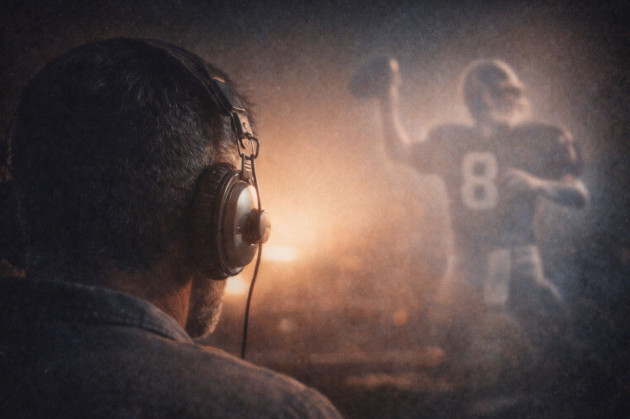
Troy Aikman went down with a knee injury. Backup Steve Beuerlein stepped in and threw a 24-yard touchdown to Michael Irvin. With 13 seconds left in the first half, Aikman, back in the game and battling for his job, lobbed a Hail Mary to Alvin Harper, who outjumped the defenders for a 34-yard touchdown. To start the second half, Jimmy Johnson called a surprise onside kick. The Cowboys recovered. Emmitt Smith, in just his second year, shredded that top-ranked defense for 132 yards and a 32-yard touchdown run.
Dallas won 24–17. They had just beaten the team that would win it all on their turf, with their backup quarterback, using a trick play. It was the turning point game that launched the dynasty of the 90s.
And I saw all of it. In my head.
The announcer gave me fragments. The count. The formation. The snap. And my brain built the rest. I constructed RFK Stadium from sound. I imagined Harper rising above those defenders. I saw Emmitt hit the hole before anyone told me where he went.
I was more of a participant in the game I experienced. Not because I chose to be, but because the technology defaulted to it. My imagination had to show up, or the experience wouldn’t work.
Maybe I was trained for this without knowing it.
In 1987, I was a jazz studies major at the University of North Texas. Every other kid had a TV. I didn’t. But I wasn’t missing anything. I’d spend my spare time listening to records on a turntable, learning to hear what wasn’t there yet.
Jazz does that to you. You’re not always reading sheet music note-for-note. You’re listening to the spaces. Anticipating. Responding. Mentally co-creating.
So, when I’d listen to a ballgame on the radio, building the stadium in my head, it was just… natural. The skill was already there.
Years later, I learned the skill had a name: theater of the mind.
Steve Allen called radio “the theater of the mind” and television “the theater of the mindless.” That sounds harsh. But he wasn’t saying TV is stupid. He was saying it requires less of you. And that extra requirement, that participation, is where something important lives.
Studies show that people who plan vacations in advance spend more time being happy than people who book last minute. Not during the vacation. Before it. In one study, the mood boost from anticipating a trip lasted eight weeks. The boost from the trip itself? Gone within two.
The anticipation was the product. The vacation was just the receipt.
Other research shows that the brain works harder when it has to fill in gaps. Audio without visual stimulates imagination in measurable ways. The more vividly people imagine what they’re hearing, the more they appreciate it. Strip away the audio, too, with just text on a page, and the imagination works even harder. When’s the last time you read a book, and then when the movie came out, you liked it better? Hint: Never.
The work creates the value.
Boredom.
Boredom has a terrible reputation. We treat it like a disease. The whole point of modern technology is to ensure you never, ever have to be bored. Every gap or silence is filled.
But boredom, it turns out, is the engine room of creativity. Research shows it creates space for contemplation, processing, invention, and imagination. It’s potential.
When you’re bored, your brain starts wandering. And when your brain wanders, it makes connections. It imagines. It creates.
Boredom leads to curiosity, curiosity leads to creativity, creativity leads to everything interesting we humans make. Eliminate boredom, and you don’t just remove discomfort. You remove the engine room.
Admittedly, people my age didn’t have superior discipline or more refined taste. We were just lucky. The technology forced us to wait.
You wanted the score? You waited. You wanted to see the Hail Mary to Alvin Harper? You built it in your head first, then maybe saw the replay on the ten o’clock news.
We didn’t build the muscle. The muscle was built for us. That’s not superiority. That’s circumstance.
I’ll also admit that anyone born into a world of instant access who chooses to wait, be bored, or choose participation over consumption… demonstrates more character and discipline than we had to.
The old ways were just limited. And the limits turned out to be load-bearing walls.
The new ways are better in almost every measurable sense. More access, choice, quality, and connection. But they don’t automatically include space for waiting, imagining, or getting bored. That space must be created deliberately now.
The lesson isn’t “go back.” It is to appreciate the aspects of humanity worth keeping. Anticipation. Imagination. Fortitude to participate instead of just consuming. These aren’t relics. They’re human requirements.
I still listen to the radio. 32 years with the same morning show. I know it’s absurd.
But when that segment or story finally comes on, there’s still a small surge. A reward.
Because I waited for it and didn’t know when it was coming. Because I was there, participating in the uncertainty, instead of just receiving the certainty.
Maybe the inconvenience was never a bug.
Maybe it was the feature.








COMMENTS