By Eric Buer and Alex Vohr
China’s military modernization is real, its ambitions are genuine, and its willingness to use force cannot be dismissed. But the People’s Liberation Army that Xi Jinping has built is as much a political instrument of the Chinese Communist Party as it is a fighting force – and that fundamental contradiction may be its greatest vulnerability. For all of China’s defense spending, naval expansion, and increasingly aggressive posture in the Indo-Pacific, the PLA suffers from structural deficiencies that no procurement budget can easily fix: a military whose officers cannot think independently, whose soldiers have never seen combat, whose technology lags a generation behind the West in critical areas, and whose entire institutional culture has been engineered to guarantee political loyalty above battlefield effectiveness.
The Party’s Army, Not the Nation’s
Every soldier, sailor, and airman in the PLA’s four main service branches serves the Chinese Communist Party first and the nation second. This is not a rhetorical distinction; it is baked into the organizational DNA of the entire force. The political commissar system, which embeds party officers at every level of command, ensures that no military decision of consequence occurs without political oversight. Commissars have authority equal to or exceeding operational commanders, creating a dual-chain structure that would be unthinkable in Western militaries. The result is institutionalized paralysis disguised as discipline.
Our goal of building a strong military in the new era is to build the people’s forces into world-class forces that obey the Party’s command. – Chinese President Xi Jinping – March 11, 2013
The more serious damage runs through the NCO and officer corps. In the United States military, noncommissioned officers are the backbone of tactical execution – experienced, empowered professionals who solve problems at the lowest level without waiting for orders from above. The PLA has no equivalent tradition. NCOs are a relatively new concept in China’s military, introduced as a reform measure but still hobbled by a culture that punishes independent initiative. Officers who demonstrate creative thinking, question doctrine, or deviate from the approved playbook risk being flagged as politically unreliable. The CCP cannot simultaneously demand ideological conformity and produce the kind of adaptive, decentralized decision-making that modern warfare requires. Xi has chosen conformity.
This was starkly illustrated by the recent purge of more than 80 senior flag officers since 2023, including both defense ministers, the entire Rocket Force leadership, and multiple members of the Central Military Commission (CMC). Whether driven by corruption investigations or concerns about disloyalty, very likely both, the purge has gutted institutional knowledge at precisely the moment China is accelerating its Taiwan timeline. The CMC, once comprised of six members plus Xi, now operates with essentially two people. The officers best positioned to identify operational risk and push back against flawed plans have been systematically removed. What remains is a senior military leadership optimized for political survival, not combat effectiveness.
The Ground Force: Mass Without Mastery
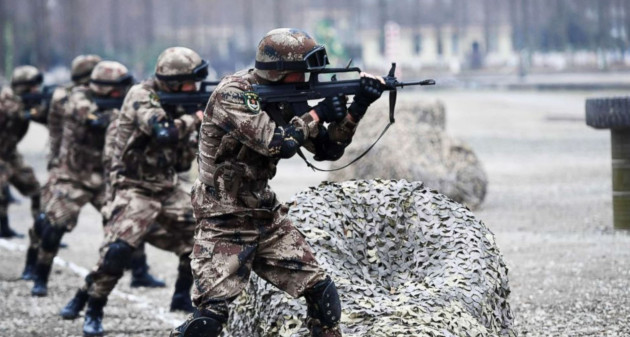
The PLA remains the world’s largest ground force, with approximately 975,000 active personnel organized into five theater commands and a modernizing mix of armored, mechanized, and special operations units. On paper, the numbers are impressive. The PLA fields thousands of modern tanks, including the Type 99A, advanced self-propelled artillery, short-range ballistic missiles, and an air defense architecture that would challenge any invader. China has invested heavily in anti-access and area-denial systems specifically designed to hold American carrier strike groups at range.
But the PLA Army has not fought a major land war since 1979, when Vietnamese forces, fresh from blunting the United States, decimated Chinese units in a brief but humiliating border conflict. The performance was catastrophic and exposed poor coordination, rigid command, inability to adapt, and logistics failures that would recur in any complex modern operation. Nearly five decades later, not a single PLA officer has led troops in sustained high-intensity combat. Training has improved significantly, and joint exercises have grown more sophisticated – but exercises are scripted – war is not. The institutional muscle memory that comes only from combat – the ability to operate in chaos, adapt in real time, and make sound decisions under fire – simply does not, and likely will not, exist in the PLA Army.
The Navy: Quantity Over Capability
China’s naval expansion has been the most dramatic military buildup of the 21st century. The PLAN has grown to more than 370 surface combatants and submarines, surpassing the United States Navy in sheer hull count. It operates two aircraft carriers, with a third under construction, fields advanced destroyers like the Type 055 with capabilities approaching those of the American Ticonderoga-class cruiser and has invested massively in amphibious lift that would be necessary for a Taiwan operation.
Yet numbers obscure critical weaknesses. The PLAN has almost no experience operating carrier strike groups in combat conditions. Chinese submariners are capable but operate significantly noisier boats than their American, British, or Australian counterparts, making them vulnerable to detection in contested waters. The Navy’s logistics and underway replenishment capabilities, essential for sustained blue-water operations, remain years behind those of the US Navy. Perhaps most importantly, Chinese surface warfare officers have never conducted live combat operations against a peer adversary. Their training is improving, but they are learning doctrine in a classroom while their potential opponents have spent decades refining it at sea.
The Air Force: Closing the Gap, Not Bridging It
The People’s Liberation Army Air Force has made arguably the most visible technological strides of any Chinese service branch. The J-20 stealth fighter, China’s answer to the F-22, entered service in 2017 and represents a genuine leap forward in capability. The J-35 naval variant is also advancing rapidly. China fields sophisticated surface-to-air missile systems, advanced beyond-visual-range missiles, and an airborne early warning capability that has matured considerably. In a regional air campaign, the PLAAF would be a serious adversary.
Already have an account? Sign In
Two ways to continue to read this article.
Subscribe
$1.99
every 4 weeks
- Unlimited access to all articles
- Support independent journalism
- Ad-free reading experience
Subscribe Now
Recurring Monthly. Cancel Anytime.
But Western air forces still hold decisive advantages in the domains that matter most in sustained conflict: fifth-generation fighter numbers, electronic warfare capability, pilot training quality, and the cumulative experience of actual air combat operations. American, Israeli, and other Western pilots have flown in combat repeatedly over decades.
PLAAF pilots have fewer flight hours than their American counterparts and have never tested their systems against a sophisticated, modern integrated air defense network. The PLA’s highly centralized, top-down structure remains in place, stifling the skills of its fighter pilots. Unrealistic plans and by-the-book training regimens don’t translate well in combat – the best-intended and designed plans rarely survive contact with the enemy. The PLAAF has also invested less in strategic airlift and long-range power projection, reflecting a force designed primarily for regional dominance rather than global reach.
The Asymmetric Offset: Where China’s Strategy Gets Serious
Acknowledging PLA weaknesses is not the same as dismissing Chinese military power. Where China has been most strategically coherent, and likely the most dangerous, is in its deliberate development of asymmetric capabilities designed to offset Western conventional superiority. The PLA does not need to defeat the United States in a traditional force-on-force engagement. It is necessary only to make the cost of intervention in the conflict over Taiwan high enough that Washington hesitates.
China’s drone program is now among the most advanced in the world. The PLAAF and PLA Army operate a vast inventory of loitering munitions, reconnaissance drones, and kamikaze systems. Chinese defense firms have exported drone technology across the developing world while continuing to refine capabilities at home. Swarm tactics – deploying hundreds of small, low-cost drones to overwhelm point-defense systems pose a genuine tactical challenge that no Western military has fully solved. In any Taiwan scenario, drone warfare would be central to Chinese operations from the opening hours.
In the cyber domain, China has invested more aggressively and persistently than any other nation-state actor. PLA Unit 61398, its advanced persistence threat unit credited with cyberattacks, and its successor organizations have conducted sustained intrusion campaigns against US defense contractors, critical infrastructure, logistics networks, and weapons program databases. The theft of F-35 design data, submarine propulsion technology, and personnel records from the Office of Personnel Management represents intelligence collection on a scale that would have required an army of spies a generation ago. In a conflict scenario, Chinese cyber operations would target command-and-control networks, logistics systems, and civilian infrastructure simultaneously, creating confusion and delay at the precise moment when speed would be decisive.
China’s missile arsenal remains its most credible conventional deterrent. The Rocket Force operates an inventory of ballistic and cruise missiles, including the DF-21D and DF-26 – the so-called ‘carrier killers’, that were designed explicitly to hold American naval power at risk beyond the first and second island chains. Whether these systems would perform as advertised in a contested environment is unknown, but their existence has already changed American operational planning for the Pacific in fundamental ways.
Conclusion: A Dangerous but Flawed Force
The strategic picture of Chinese military power is neither as alarming as Beijing’s propaganda suggests nor as manageable as complacency would imply. The PLA is a large, increasingly capable force with genuine strengths in specific domains – among them missiles, cyber, drone warfare, and coastal defense. Its weaknesses are equally genuine – a leadership culture that punishes independent thinking, an officer and NCO corps with no combat experience, technological gaps in aviation and undersea warfare, and an institutional structure that places political loyalty above operational effectiveness. This is also underpinned by a rapid decrease in the Chinese population under 35 years of age under the one-child policy and a modernizing culture likely unwilling to sacrifice a generation.
What makes China’s military genuinely dangerous is not its ability to defeat the United States in a conventional war – it almost certainly cannot, at least not yet. What makes it dangerous is its potential to impose costs high enough to deter American intervention in a Taiwan scenario, to exploit the hesitation created by asymmetric threats, and to leverage its mass and geographic advantages in the Western Pacific in ways that could present decision-makers in Washington with no good options. That is a threat worth taking seriously. It is not, however, a threat that should be exaggerated into a fire-breathing dragon with impenetrable armor. The CCP has built a military optimized for domestic control and regional coercion – formidable in certain scenarios, brittle in others. Understanding the difference is the first step toward a sound strategy.
—
Alex Vohr is a retired Marine Corps Colonel and combat veteran. He served as a commanding officer, Director of the USMC School of Advanced Warfighting, and as the J4 for US Southern Command. He is the author of Speed Kills and is currently the President of One LNG, a Texas-based energy company.










COMMENTS