

From Veteran Media to the Conservative Mainstream
What begins in veteran circles does not stay there. The same dynamics—skepticism of open-ended commitments, sensitivity to cost, and a bias toward defined national interest—translate into the broader conservative media ecosystem, where they acquire scale.
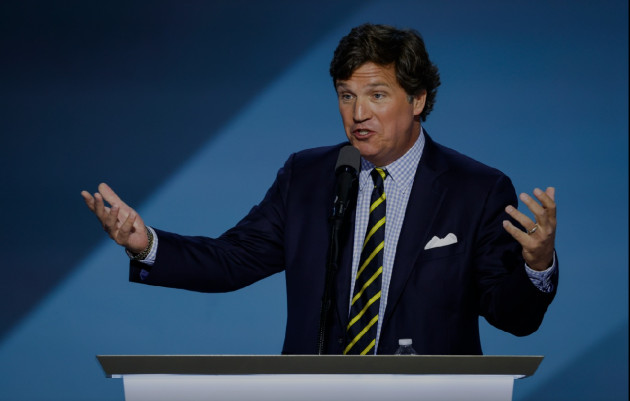
The shift becomes more visible on higher-reach platforms. Figures like Tucker Carlson have taken what once sat at the periphery and placed it at the center of conservative discourse. By framing the current conflict through the lens of American burden rather than alliance loyalty, Carlson gives coherence to instincts already circulating across podcasts and smaller platforms.
Joe Kent’s appearance in that environment marks a transition from dispersed sentiment to consolidated narrative. The argument no longer lives only in comment sections or veteran-run channels; it now moves through formats that reach millions and shape the broader terms of debate.
Other media figures and influencers reinforce the shift through repetition and variation. Some approach it through foreign policy restraint, others through concerns about external influence, others through a general distrust of entrenched institutions. The language differs; the direction aligns. Each iteration lowers the barrier to entry for the next, making skepticism more legible, more acceptable, and more politically usable.
This is how a position moves from the margins toward the center. Not through a single conversion, but through accumulation. Exposure normalizes the argument. Repetition stabilizes it. What once required justification begins to present itself as common sense within certain segments of the audience.
The fact that the now former Director of National Counterterrorism Center @joekent16jan19 holds the Nazi view rooted in zero evidence that Israel killed Charlie Kirk is alarming.
No wonder why the Islamic terror level only increased in the US under Joe Kent.
He is a… https://t.co/Pi7Rohqazb
— Laura Loomer (@LauraLoomer) March 19, 2026
The Edge of the Ecosystem
At the outer edge of this media environment, more confrontational voices test arguments in their most explicit form. Figures like Nick Fuentes operate in that space, speaking to younger, highly online audiences who are less bound by institutional loyalties and more responsive to narratives framed around national prioritization and perceived foreign influence.
That edge does not exist in isolation. It overlaps with higher-visibility personalities who, at times, amplify or flirt with adjacent lines of argument. Candace Owens has increasingly framed Israel through a critical lens that resonates with populist audiences, while figures like Charlie Kirk have faced backlash and internal friction when controversial or conspiratorial claims about Israel circulate within their orbit. The specifics vary; the effect is cumulative. Boundaries that once held firm now show signs of strain.
That dynamic sharpens when it intersects with figures carrying institutional credibility. In a recent interview with Tucker Carlson, Joe Kent suggested that certain lines of inquiry related to the assassination of Charlie Kirk had been constrained during his time in government. He stopped short of making direct accusations. The phrasing was careful, but the implication was clear enough to resonate with audiences already primed to question official narratives. In that environment, restraint does not dampen speculation; it often intensifies it.
Their reach remains uneven, and they hold no unified institutional power. Their function is different. They act as boundary-setters, introducing arguments in their most direct form and normalizing frames that would be politically unusable in formal settings. As those ideas circulate, they are softened, repackaged, and redistributed through larger platforms with broader legitimacy.
This dynamic does not make these figures dominant. It makes them directional. They indicate where segments of the discourse are willing to go, even if the political system is not prepared to follow. Over time, that gap narrows.
The result is not consensus, but reweighting. Pro-Israel positions remain dominant within party leadership and formal policy structures. At the same time, the surrounding media environment grows less predictable and less controllable. Politicians operating within that environment begin to adjust accordingly, even before formal positions change.
Nick Fuentes GOES NUCLEAR on Trump, calling for him to be IMPEACHED over Joe Kent’s resignation
“Either every word out of your fat disgusting mouth is a lie, or you committed treason. You should be IMPEACHED!” pic.twitter.com/v9IKCBT3Dm
— 𝐆𝐫𝐢𝐦𝐚𝐥𝐝𝐮𝐬 (@ImperiumFirst) March 18, 2026
Elections, Incentives, and Managed Alignment
The shift in tone across conservative media arrives at an inconvenient moment for Republican politicians. Midterm elections approach, bringing familiar constraints: turnout, coalition management, message discipline. Foreign policy rarely decides these contests outright; it shapes them indirectly, through perceptions of judgment, priorities, and alignment with voter sentiment.
In that environment, support for Israel no longer carries the same political simplicity. It remains a default position within party leadership and donor networks. It also now sits inside a more contested information environment, where portions of the base respond skeptically to foreign entanglements framed as costly or misaligned with American interests. That tension does not need to dominate an election cycle to matter. It only needs to complicate messaging.
Accordingly, incentives shift. Candidates and incumbents are less likely to foreground Israel as a defining feature of their public positioning. They speak in broader terms—regional stability, deterrence, counterterrorism—while avoiding language that suggests open-ended commitment or subordination of U.S. priorities. Support continues; its presentation changes.
What emerges is a form of managed alignment. Public rhetoric narrows. Commitments are framed through U.S. interest rather than shared identity. Visibility decreases even as underlying policy remains largely intact. The adjustment is incremental, and it is politically rational.
Power, Consent, and the Shape of the Alliance
What is taking shape is a change in how the U.S.–Israel relationship is sustained. For decades, support operated with minimal political friction inside the American right. That environment has begun to shift; as a result, the alliance now moves through a more contested domestic landscape.
Even so, institutions retain control over policy and continue to fund, coordinate, and defend the relationship at the state level. At the same time, parts of the electorate are renegotiating the terms under which that support is understood. In turn, the language has shifted toward cost, priority, and national interest, placing policy under greater scrutiny.
In practice, political actors respond to incentives before they respond to ideology. As the cost of overt alignment rises in certain segments, the presentation of that alignment adjusts. Consequently, support becomes quieter, more conditional in tone, and more carefully framed. Over time, these incremental changes accumulate, reflecting a deeper reality: authority is no longer reinforced automatically from below.
For that reason, durable arrangements rarely unravel all at once. Instead, they evolve through changes in how they are justified, explained, and defended. The alliance endures; the consensus that once surrounded it has weakened.








COMMENTS