

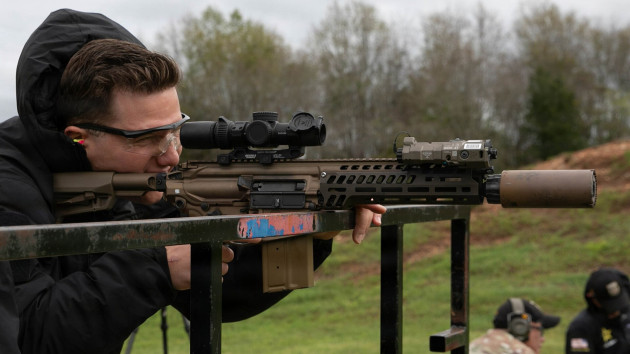
Weight has also come down. The M7 sits at 8.36 pounds without a suppressor. The XM8 comes in at 7.33 pounds without a suppressor. That reduction, combined with a shorter overall profile, translates directly into a weapon that is quicker to present, easier to move with, and less fatiguing over time.
The stock has shifted from a folding design to a fixed configuration after soldier feedback favored strength and consistency. The suppressor has been shortened. The front end has been trimmed and stiffened to improve balance.
These are not cosmetic tweaks.
They are targeted improvements that make the weapon more controllable, more predictable, and more effective in the environments where most fights happen.
An 11-Inch Carbine Built for Movement
Cutting barrel length on a high-pressure cartridge like 6.8x51mm changes the weapon. That is unavoidable.
Velocity drops compared to the longer M7. But what the XM8 does is concentrate its performance where it is most often needed.
Closer engagement distances. Faster handling. More efficient movement.
Instead of stretching capability to the outer edge of the envelope, the XM8 brings the core strengths of the 6.8 system into a tighter, more usable package. You still get significantly more terminal performance than legacy 5.56 platforms, but in a rifle that can keep up with the pace of close and complex terrain.
This is not a compromise.
It is a deliberate shift toward practical performance.
Why the Army Built It
The M7 addressed a real requirement. The Army needed greater lethality, better performance against modern armor, and extended reach.
It delivered.
The XM8 builds on that success by refining how that capability is applied. It recognizes that most engagements are not happening at maximum range, and that mobility, speed, and control are just as decisive as raw ballistic performance.
Rather than stepping back from the 6.8 system, the Army is doubling down on it and shaping it to fit a wider range of real-world scenarios.
A System Still Being Refined
The XM8 sits within the broader Next Generation Squad Weapon system, and that system is still being refined in real time.
In its FY2024 annual report, published in January 2025, the Director of Operational Test and Evaluation reported that the XM7 with the mounted XM157 fire control optic showed a low probability of completing a 72-hour wartime mission without a critical failure. Soldiers also assessed the XM157’s usability as below average or failing.
This is not necessarily a bad thing; it points out opportunities for improvement.
There have also been ongoing concerns tied to suppressor heat, burn risk, and noxious gas exposure.
That context is hard to ignore.
But it also shows something else. The Army is identifying friction points early and pushing improvements into the system while it is still being fielded.
The XM8 is part of that ongoing process.
Where the XM8 Stands Right Now
The M7 is already in soldiers’ hands. Initial fielding began in March 2024 with the 101st Airborne Division, and the rifle was formally type-classified in May 2025.
The XM8 is following behind it, still in testing and evaluation, but clearly moving forward as a serious addition to the platform.
The Army has not finalized the exact mix of configurations, and that flexibility is intentional.
Different missions demand different tools. A longer rifle for reach. A shorter carbine for confined spaces.
The XM8 gives units another option without breaking compatibility with the system they are already fielding.
Refining the M7 for Real-World Performance
The discussion around the M7 has not gone quiet.
Weight, 20-round magazine capacity, and overall handling have been the recurring friction points. Those are not abstract complaints. They are what soldiers feel immediately when the rifle is carried, maneuvered, and used under pressure.
The XM8 directly addresses the biggest of those issues.
It reduces length. It improves balance. It makes the weapon easier to run in tight spaces.
It does not change the fundamentals of the 6.8 system, but it makes that system more usable where it counts.
Not Every Service Is Following
The Marine Corps has chosen to stay with the M27 platform rather than adopt the NGSW rifle at this time.
That divergence keeps the debate alive.
It also highlights the Army’s approach. The Army is pushing forward with a system designed to increase performance, even if that means accepting some tradeoffs up front and refining them over time.
What Happens Next
The next phase will focus on how the M7 and XM8 fit together across units and mission sets.
Expect continued testing. Expect additional refinements. Expect more clarity as soldiers spend more time with both configurations.
The Army is still learning where each version performs best, and that learning is shaping the system in real time.
The Bottom Line
The XM8 carbine is not a reset.
It is a refinement built on a system that is already delivering increased lethality and range.
Shorter barrel, now clearly defined at 11 inches. Lighter profile. Same cartridge.
A rifle that brings the power of the 6.8 system into a more agile, more usable form.
And a clear indication that this generation of infantry weapons is not standing still.








COMMENTS